Accidental Discoveries · Physics
The Dust-Stopper Cork That Revealed Electricity Could Travel — and the Boy Hung From a Ceiling to Prove It
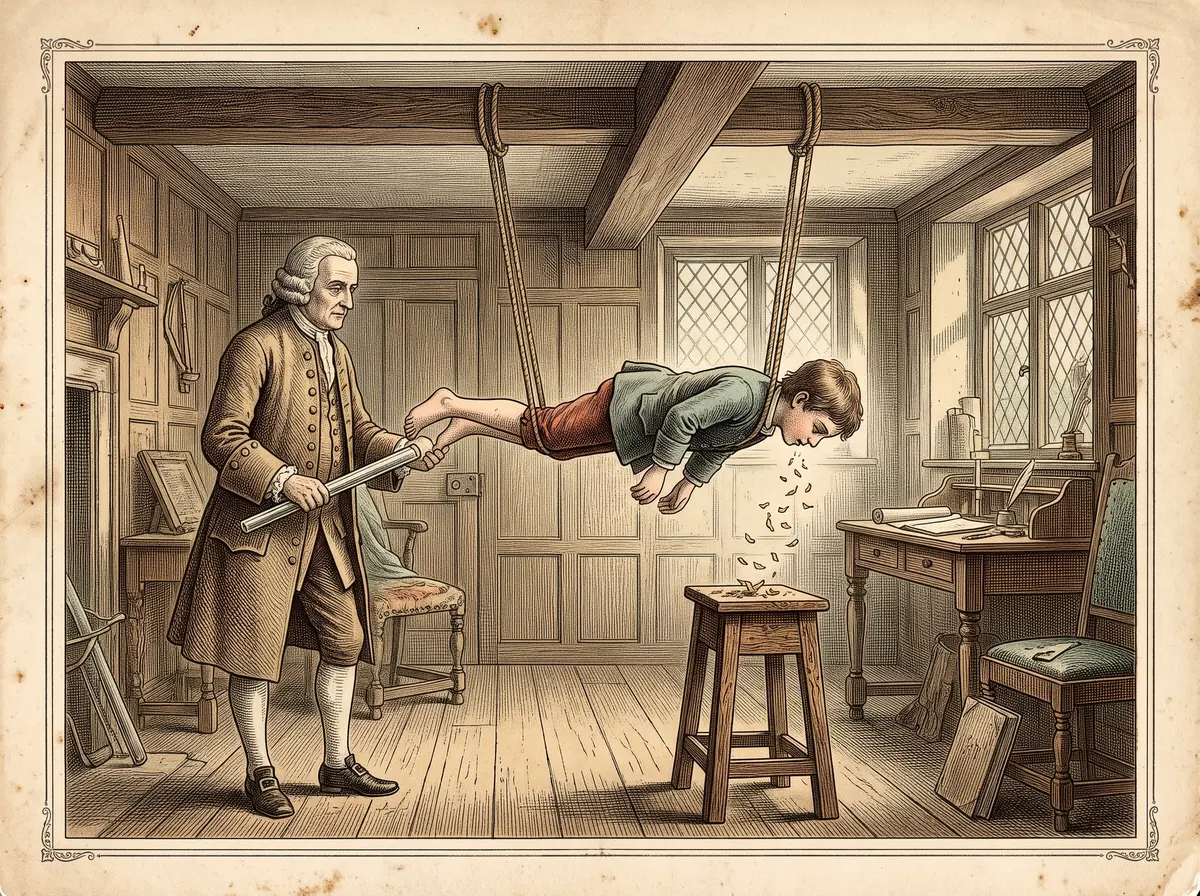
On April 8, 1730, in a small room at the Charterhouse almshouse in London, a 63-year-old retired cloth-dyer named Stephen Gray hung a boy from his ceiling beam. The boy, eight or nine years old and weighing 47 pounds 10 ounces with his clothes on, lay face down in midair on two clotheslines. Gray rubbed a glass tube, held it near the boy's feet, and watched flakes of brass leaf leap up off a stand toward the boy's face.
By the Curiosities Desk · · 5 min read · Filed under Physics · Today’s round
What happened: Stephen Gray
Stephen Gray was born in Canterbury in 1666 and trained in his family’s cloth-dyeing trade. He had little formal schooling, but he taught himself astronomy and optics, built his own instruments, and sent observations to the Royal Society. In 1720, with help from well-connected friends, he won a place as a pensioner at the Charterhouse, a London charity that housed older men without means. That is where he spent his evenings rubbing glass.
His main tool was simple: a long glass tube. Rub it with a dry hand or cloth and it becomes “excited,” as people then said, and will pull light things like feathers, paper scraps, and thin brass leaf toward it. In early 1729, Gray had stopped the ends of his tube with corks to keep dust out when it wasn’t in use. Testing the tube with a feather, he noticed something nobody had asked about. The feather went to the cork, too, “being attracted and repelled by it,” he wrote, as if the cork had been rubbed itself.
That small accident changed his whole line of questions. If the “attractive virtue” could pass from the glass into the cork, how far could it go? Gray pushed a fir stick into the cork, then an ivory ball on the end of the stick. Still attraction. He swapped in a length of pack-thread, a sturdy hemp string, and let it hang down. Still attraction, at the far end.
In the summer of 1729 he took the question to Otterden Place in Kent, home of his friend Granville Wheler, a Fellow of the Royal Society with a long gallery and plenty of string. On July 2 they ran a line back and forth across the gallery, hanging it from loops of silk. It worked. On July 3 they made it longer, 293 feet, and the silk loops snapped under the weight.
So they reached for something stronger. Thin iron wire was too weak. Heavier brass wire held the line up perfectly, and the electricity vanished. Nothing at the far end moved.
That failure was the real discovery. The silk had not worked because it was thin. It worked because of what it was. Silk held the “virtue” inside the string. Metal let it drain away into the house. Wheler rigged a new arrangement so each silk loop carried less weight, and the line grew again. On August 1, 1729, their thread carried the effect 886 feet across the grounds, and at its end, Gray reported, the brass leaf still lifted.
Back in London the next spring, Gray tried the most portable conductor he could think of: a person. In his own account he suspended the boy on “two Hair-Lines, such as Cloaths are dried on.” His face drew the brass leaf up from eight and sometimes ten inches below. With the boy’s arms stretched out, his hands attracted too. Later retellings often call him a Charterhouse “charity boy” and say he hung from silk, but Gray’s report on that first trial names neither his school nor silk. He is simply “a Boy.”
In 1731 the Royal Society awarded Gray its first-ever Copley Medal for this work, and gave him the second one the next year.
Why it was strange: Stephen Gray
Before Gray, electricity was something an object had, the way amber or glass could be coaxed into grabbing chaff after a good rub. Nobody thought of it as something that moved. Gray showed it could leave the glass and travel down a cork, a stick, a string, a garden, or a child, and arrive somewhere else entirely.
And he got there by accident twice: first by a dust stopper, then by a snapped silk loop and a “better” wire that ruined everything. The experiment that failed told him more than the one that worked.
Another early experimenter who used a line of people to chase electricity was The Abbé Who Shocked 200 Monks in a Line a Mile Long to Time the Speed of Electricity.
What scientists learned: Stephen Gray
Gray’s work split the world into two kinds of material. Some, like metal, damp thread, and the human body, let electric charge flow through them. His fellow experimenter John Theophilus Desaguliers later called these “conductors.” Others, like silk, glass, and hair, hold charge in place. Today we call them insulators.
Gray didn’t know about electrons, the tiny charged particles that do the moving. But his rule still holds: a charge spreads across a conductor and leaks away through any conducting path to the ground, unless an insulator blocks the way. The brass wire failed because it handed the charge to the house.
His experiments also inspired the French scientist Charles du Fay, who in the 1730s found that there were two kinds of electric charge, later named positive and negative by Benjamin Franklin.
More stories of finds that began on a different errand are collected in Found While Looking for Something Else.
How it reaches us today: Stephen Gray
Every cord in your home is Gray’s experiment, upgraded. A copper core carries the current, and a plastic coat around it plays the role of his silk loops, keeping the electricity from draining off where it shouldn’t go. Power lines hang from glass or ceramic insulators for the same reason.
The suspended boy had a long afterlife, too. In the 1740s and 1750s, lecturers repeated the trick with electrical machines, turning Gray’s quiet chamber experiment into a crowd-pleasing demonstration of how electricity moves through people. Gray himself died at the Charterhouse in February 1736, poor and soon overlooked, and the exact spot where he was buried is unknown.
To follow the story from rubbed glass to stored power, read From Frog Legs to Lithium: A Short History of the Battery.
Fun fact: Stephen Gray
The first person ever to win the Royal Society’s Copley Medal, thought to be the oldest scientific prize in the world, was a retired cloth-dyer living in a charity almshouse.
Sources: Stephen Gray
- Gray, Stephen. “A Letter to Cromwell Mortimer, M. D. Secr. R. S. Containing Several Experiments concerning Electricity.” Philosophical Transactions 37 (1731) — full text
- “Stephen Gray,” Scientist of the Day, Linda Hall Library
- “Gray and gold,” The Royal Society blog (2020)
- “Early electrical experiments at Otterden Place,” Faversham Life