The Eggs That Stood Up for Spring — and the Astronomer Who Balanced Them for Five Weeks to Check
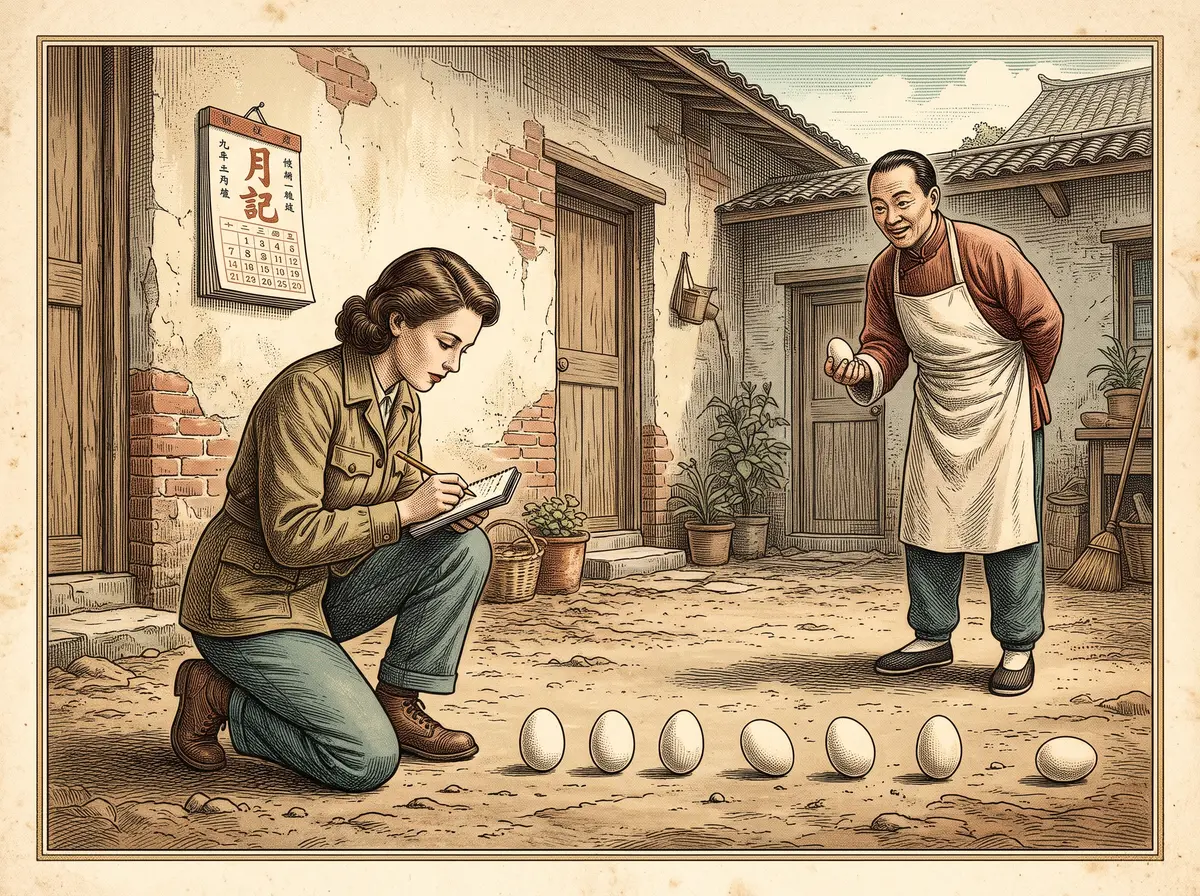
In early February 1945, in the middle of a world war, a foreign correspondent in Chungking, China, watched raw eggs stand upright on their ends in the courtyard of the Press Hostel. Some stood on the fat end, some on the narrow end, and a few leaned like tiny towers of Pisa. The local calendar had promised it. At one o'clock on the day winter officially ended, it said, eggs would stand. And there they were.
By the Curiosities Desk · · 5 min read · Filed under Space · Today’s round
Part of The Version Everyone Remembers
What happened: The Equinox Egg Myth
The correspondent was Annalee Jacoby, reporting for Time and Life. The day was Lichun (立春, “the beginning of spring”), one of the 24 solar terms of the traditional Chinese calendar, which falls around February 4 or 5, when the Sun reaches a set point along its yearly path through the sky. Folk tradition held that on Lichun, a fresh egg could be stood on its end.
Her short dispatch, printed in Time on February 12, 1945, read like a puzzled field report. The eggs stood best right at one o’clock, she wrote, and got harder to balance by two. They stood on the bare earth, as tradition required, but the same eggs toppled when moved onto a wooden floor. Even her cook’s breakfast egg stood up. She hunted for an explanation and found none. The Moon’s pull was ruled out, and nobody had been feeding the hens anything unusual. When she asked Jimmy Wei of China’s Ministry of Information, he was in no hurry to solve it. Why, he asked, should anyone explain in a single day what had gone unexplained for 4,000 years? Time ran the item under a headline assuring readers it had “no political significance.”
Life followed on March 19, 1945, with a two-page story titled “Eggs Stand on End in Chungking.” That was the moment the idea jumped the Pacific. Somewhere in the crossing, the special day quietly moved. Americans did not use the Chinese solar calendar, so the egg-standing day attached itself to a date they did know: the vernal equinox, around March 20, when day and night are roughly equal in length.
The new version took on a life of its own. In 1976, the New York artist Donna Henes began holding public egg-standing ceremonies timed to the exact minute of the equinox, framed as a celebration of balance and harmony. She kept them going for decades and was still gathering more than a hundred people at New York’s South Street Seaport in 2010. In 1985, an art group at the University of Alaska Anchorage reportedly balanced 204 eggs around the spring equinox, with some staying upright for as long as four days.
Then, in 1984, an astronomer decided to look at the rest of the calendar. Frank Ghigo, at the University of Minnesota, had been fielding questions about the New York festival. So he bought eggs: four batches of 12. Every day from February 27 to April 3, 1984, he tried to stand them on their large ends on a Formica tabletop. The equinox that year was March 20. He could balance eggs on the equinox. He could also balance them on plenty of other days. Some eggs stood almost every day; some never stood at all. Equinox or not, it was mostly about the egg.
Why it was strange: The Equinox Egg Myth
The myth has an appealing logic. The equinox is a real astronomical moment, and it feels as if something that cosmic ought to leave a fingerprint on the kitchen counter.
But the Sun’s gravitational tug on an egg barely changes from one day to the next, and an equinox is simply the point where Earth’s tilt is turned sideways relative to the Sun. Nothing about that geometry reaches into an eggshell. What makes the story strange is how convincing the evidence looked. Every spring, thousands of people tried, and plenty succeeded. Almost nobody tried again the following Tuesday.
The writer Martin Gardner, writing in Skeptical Inquirer in 1996, suggested that belief itself helped. People who expected success might “try a little harder, be more patient, and use steadier hands,” he wrote. A believer’s patience turned into an egg standing, which looked like proof.
For another myth that someone finally tested with a lot of patience, see The Bathtub That Took 24 Hours to Drain to Test a Myth.
What scientists learned: The Equinox Egg Myth
The real answer is about shape, not sky. An object stays upright when its center of mass (the average position of all its weight) sits directly above the area it rests on. A perfectly smooth egg would have only one tiny contact point and would always roll. But real eggshells are covered in small bumps and dimples. With patience, you can find a spot where the egg rests on three of those tiny bumps, forming a little triangle. If the center of mass lands inside that triangle, the egg stands.
Japan’s Ukichiro Nakaya, a physicist best known for his studies of snow crystals, reached the same conclusion in a 1947 essay on the Lichun egg: it can be done on any day of the year. Ghigo’s results added another human detail. His success rate improved with practice, and he noted that the balancer’s mood and persistence mattered a great deal. His summary was dry. There was not, he said, “too much relationship” between astronomy and balancing eggs.
For another sky-sized claim that took a long time to check, see The Great Wall ‘Visible From the Moon’ — Promised 215 Years Before Anyone Could Check.
How it reaches us today: The Equinox Egg Myth
Every March and September, the equinox egg comes back on social media, sometimes joined by a newer cousin: the claim that a broom will stand on its bristles only on that day. Like the egg, a broom with a flat, stiff head can stand on any day you care to try.
The egg has become a classroom favorite for the same reason it fooled people. It teaches center of mass with an object everyone owns. It also teaches a habit that matters well beyond physics: when something seems to work only on a special day, test it on an ordinary one.
The egg sits on the same shelf as other stories everyone remembers a little wrong, in The Version Everyone Remembers.
Fun fact: The Equinox Egg Myth
Ukichiro Nakaya, one of the physicists who took on the Lichun egg, was the first person to grow an artificial snow crystal in a laboratory. On March 12, 1936, he grew it on a single strand of rabbit fur.
Sources: The Equinox Egg Myth
- Annalee Jacoby, “China: No Political Significance,” Time, February 12, 1945 (Time archive)
- Annalee Jacoby, “Eggs Stand on End in Chungking,” Life, March 19, 1945, pp. 36–37 (Google Books)
- David Mikkelson, “Infernal Egguinox,” Snopes (summarizing Frank Ghigo’s 1984 experiment and Associated Press coverage)
- “Spring Equinox Brings Balance, At Least To Eggs,” NPR, March 2010
- Cecil Adams, “Can you stand eggs on end at the vernal equinox and at no other time?,” The Straight Dope, 1986