The 'Space Drink' NASA Didn't Invent — and the Moonwalker Who Finally Said 'Tang Sucks'
In June 2013, Buzz Aldrin, the second person to walk on the Moon, was taping a cable TV awards show when the subject turned to the orange powder that a generation of children had been told astronauts loved. Aldrin's review was two words long: "Tang sucks." For millions of people who grew up stirring it into their breakfast water, it was a double surprise. Not only did one of the most famous astronauts dislike Tang — NASA had never invented it in the first place.
By the Curiosities Desk · · 5 min read · Filed under Space · Today’s round
Part of The Version Everyone Remembers
What happened: The 'Space Drink' NASA Didn't Invent — and the Moonwalker Who Finally Said
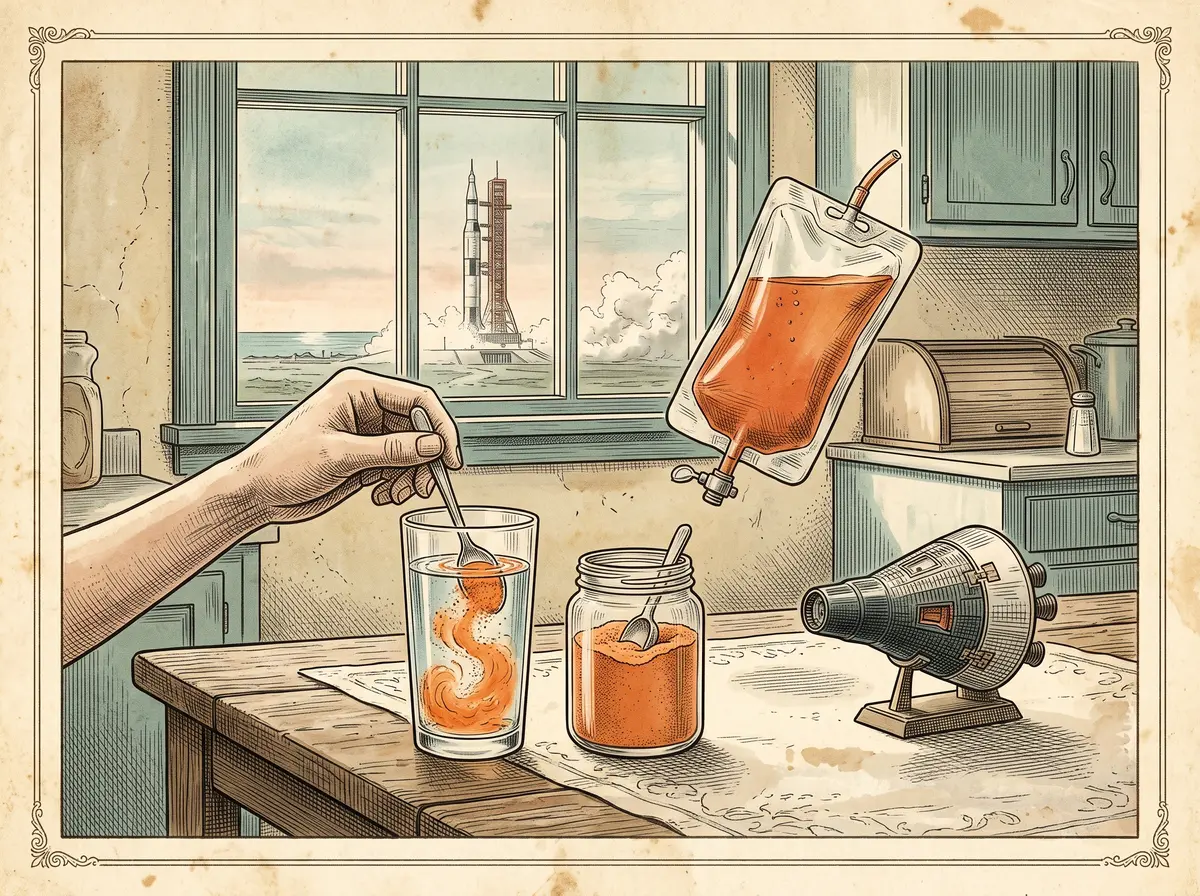
Tang began in a food lab, not a launch center. In 1957, William A. Mitchell, a chemist at the General Foods Corporation, developed a powdered, fruit-flavored drink mix, working with fellow chemist William Bruce James. The company tested it in a few markets in 1958 and put it on store shelves in 1959 as an instant “breakfast drink” fortified with vitamin C. The pitch was convenience: no squeezing oranges, no frozen concentrate, just a spoonful in a glass of water.
Shoppers were unimpressed. By most accounts, Tang sold slowly for its first few years.
Then came the space program. NASA’s food specialists needed things astronauts could eat and drink in a cramped capsule, and a light, shelf-stable powder that turned into a vitamin-rich drink with a little water was a natural fit. NASA says Tang was adopted for use in the Mercury food system, and the Linda Hall Library’s history of Mitchell notes that it was used on the Mercury and Gemini missions of the early-to-mid 1960s. NASA gave it a plainer name on the menu, “Orange Drink,” and it has stayed on astronaut menus ever since. Crews still drink it on the International Space Station.
The most famous part of the story is also the shakiest. NASA’s own Spinoff FAQ says that John Glenn consumed Tang in orbit during his Friendship 7 flight in February 1962, the first time an American orbited Earth. But NASA’s 60th-anniversary history of that same flight lists only a tube of applesauce and xylose sugar tablets as Glenn’s in-flight experiments with eating, and the Smithsonian’s National Air and Space Museum describes his menu as applesauce, pureed beef with vegetables, and sugar tablets with water. A New York Times report the day after the flight also described a meal of a beef-vegetable mixture and applesauce, with no mention of an orange drink. Whether Tang actually rode on Friendship 7, or simply rode on its publicity, is a question even NASA’s own web pages answer differently.
Either way, General Foods did not need certainty. Its advertising leaned hard into the connection, promoting Tang as the “space age” drink of the astronauts, and sales took off. Kids in the 1960s saw Tang ads during the space race and drew an easy conclusion: if astronauts drank it, NASA must have made it. The idea hardened into one of the most repeated “facts” about the space program.
Aldrin had been quietly unenthusiastic for decades. In his 1973 memoir, Return to Earth, he recalled that the Apollo 11 crew tried Tang before their flight and picked a grapefruit-orange drink instead. His blunt verdict in 2013, first reported by TMZ and then by NPR, simply made it official.
Why it was strange: The 'Space Drink' NASA Didn't Invent — and the Moonwalker Who Finally Said
The myth runs backward. The usual story of a space spinoff is that NASA solves a problem in orbit and the solution trickles down to your kitchen. Tang made the opposite trip: a supermarket product, already for sale, went up into space and came back with a reputation it had not earned in a lab.
It’s also strange how durable the belief is. NASA has spent years correcting it. Its Spinoff FAQ answers the question “Did NASA invent Tang?” with a flat “No. General Foods developed Tang in 1957.” The same FAQ notes that NASA didn’t invent Velcro or Teflon either, two other products that people routinely credit to the space agency.
The Tang story sits comfortably on The Version Everyone Remembers, next to The Million-Dollar Space Pen Myth — and the $128.89 Pencils NASA Actually Bought.
What scientists learned: The 'Space Drink' NASA Didn't Invent — and the Moonwalker Who Finally Said
The early flights taught NASA something basic but important: people can swallow and digest food in weightlessness. Before Glenn’s flight, some researchers worried that eating without gravity might be difficult or even dangerous. His applesauce test, and the meals and drinks on later Mercury and Gemini flights, showed it was manageable.
Drinks posed their own engineering puzzle. Liquids don’t pour in microgravity; they float as wobbling blobs. Powders solved part of the problem. A dry mix weighs almost nothing, keeps for a long time, and can be packed into a pouch, then rehydrated with water. On Gemini, fuel cells that generated electricity also produced water as a byproduct, which crews used to rehydrate food, though, as the Smithsonian notes, only cold water was available. A flavored powder that dissolved easily in cold water was exactly what that system could handle.
The myth also teaches a lesson about how people remember science. A product that appears alongside a famous achievement can absorb its glow, and repetition can turn “used by” into “invented by.” Velcro, another product often wrongly credited to NASA, has its own very earthly origin story: The Burrs Stuck to a Dog That Became Velcro.
How it reaches us today: The 'Space Drink' NASA Didn't Invent — and the Moonwalker Who Finally Said
Tang outlived the space race. In 2011, Kraft Foods announced that Tang had become a billion-dollar brand.
NASA’s real spinoffs are plentiful, too. The agency documents them in its annual Spinoff publication, which is part of why it bothers to correct the Tang story: crediting NASA with the wrong inventions can bury the right ones.
And “Orange Drink” is still on the menu. The powder that once sold poorly in grocery stores now travels to the space station, which means at least some astronauts disagree with Buzz Aldrin.
For another meal that made space history for the wrong reasons, see The Corned Beef Sandwich That Got NASA Hauled Before Congress.
Fun fact: The 'Space Drink' NASA Didn't Invent — and the Moonwalker Who Finally Said
Tang’s inventor, William A. Mitchell, also invented Cool Whip and Pop Rocks, which means one General Foods chemist was behind a breakfast drink, a whipped topping, and a candy that crackles on your tongue.
Sources: The 'Space Drink' NASA Didn't Invent — and the Moonwalker Who Finally Said
- Spinoff Frequently Asked Questions — NASA (primary source: “General Foods developed Tang in 1957”; Velcro and Teflon not NASA inventions)
- Space Food Systems — NASA Johnson Space Center (Tang adopted for the Mercury food system; “Orange Drink” still used on the ISS)
- 60 Years Ago, John Glenn Became the First American to Orbit the Earth — NASA History (Glenn’s applesauce and xylose tablets)
- What Is Really Astronaut Food? — Smithsonian National Air and Space Museum (Glenn’s menu; Gemini fuel-cell water)
- Now He Tells Us: ‘Tang Sucks,’ Says Apollo 11’s Buzz Aldrin — NPR, June 13, 2013
#NASA #William A. Mitchell #General Foods #John Glenn #space food