The Martian Meteorite That Supposedly Vaporized a Dog in Egypt — and the Geologist Who Checked
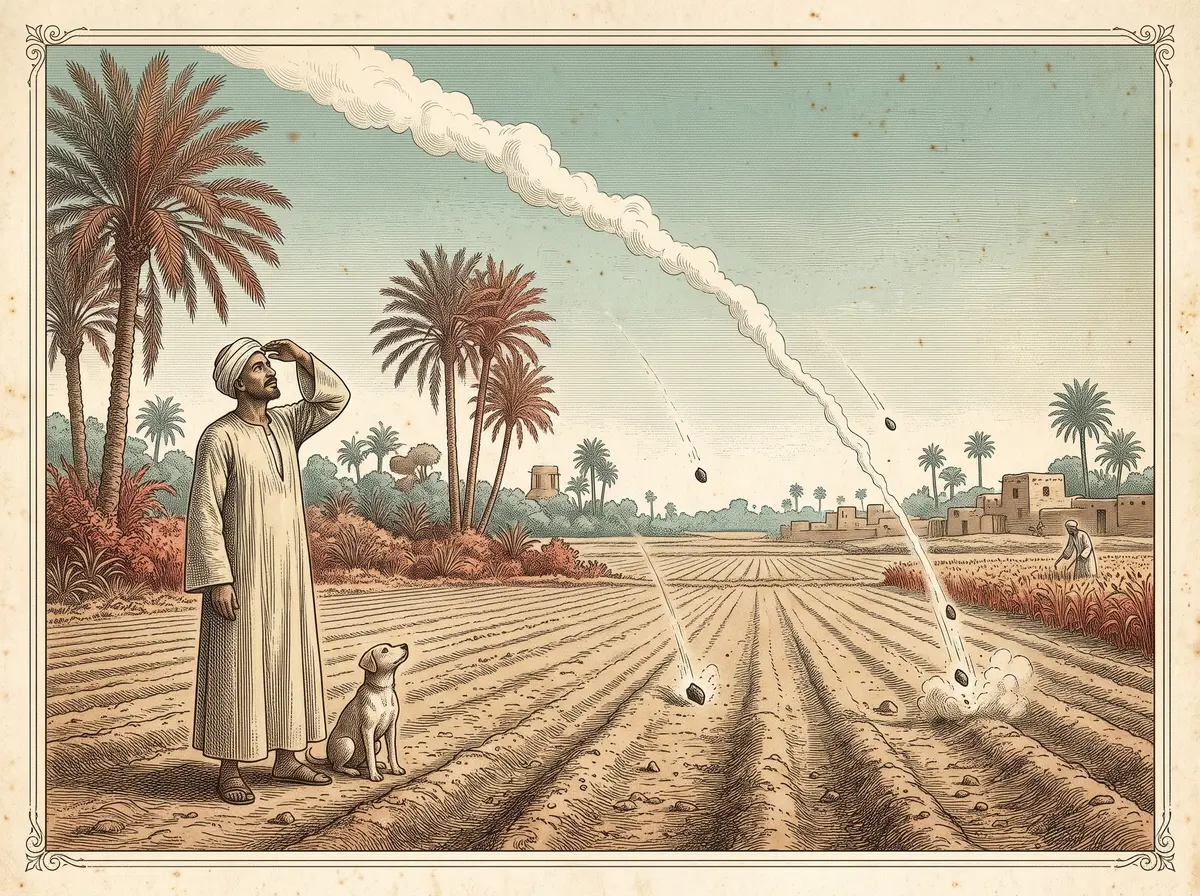
On the morning of June 28, 1911, a loud bang rolled across the farm fields of Egypt's Nile Delta, and stones began dropping out of the sky. Soon after, an Arabic newspaper carried a startling detail: one of the stones had landed on a dog and left it "like ashes in a moment." More than a century later, the dog is the most famous casualty of a rock from Mars. There is just one problem. Nobody has ever found any sign that the dog existed.
By the Curiosities Desk · · 5 min read · Filed under Space · Today’s round
Part of The Version Everyone Remembers
What happened: The Nakhla Dog Story
The fall happened at about nine in the morning near the village of El Nakhla El Baharia, in the Abu Hommos district roughly 40 kilometers southeast of Alexandria. Witnesses described a column of white smoke in the sky and a noise that some compared to a gunshot and others to a railway train pulling into a station. Then stones rained down over a patch of farmland a few kilometers wide, burying themselves 10 to 30 centimeters deep in the soil. Villagers who dug them out reported that the stones were cool to the touch.
The first word of the event came from a farmer named Mohammed Ali Effendi Hakim, who sent a note to the Arabic newspaper El Ahali. His report placed the fall at Denshal, a village some distance from El Nakhla, gave the date as June 29, and included the line that would outlive everything else in it: one stone, he said, had struck a dog.
The Egyptian Survey Department took the report seriously, and that is the part of the story that rarely gets told. William Fraser Hume, a geologist with the department, traveled to the district himself, interviewed eyewitnesses, and collected about a dozen stones. The Ministry of the Interior bought more from local farmers. A survey official named Dahab Effendi Hassan went back in October and purchased about twenty more. In all, about 40 stones were recovered, weighing nearly 10 kilograms together. The largest weighed 1,813 grams and was shaped roughly like a double wedge; the smallest weighed about 20 grams.
In 1912, the department’s John Ball published a careful account of the fall. He credited the farmer’s newspaper note with launching the investigation. He also reported what happened when officials made “careful enquiries” at Denshal: no stones had fallen there, and no one there had seen the smoke column. In a footnote, Ball dealt with the dog in a single sentence. The claim, he wrote, was “doubtless the product of a lively imagination.”
That should have been the end of it. Instead, the dog took on a life of its own. Meteorite collectors started calling Nakhla “the dog-killing meteorite,” and the story spread through reference books, websites, and dealer catalogs.
Why it was strange: The Nakhla Dog Story
The dog story survived because of what Nakhla turned out to be. In 1911, nobody knew where the stones had come from. They were clearly unusual, made mostly of a green mineral called clinopyroxene, but they looked like ordinary volcanic rock from somewhere.
Decades later, that somewhere turned out to be Mars. And once Nakhla was known as a Martian meteorite, the dog stopped being a throwaway detail in an old newspaper clipping. It became “the only known casualty of a Martian attack,” a line too good for writers to resist.
But the evidence never improved. The only source is the farmer’s newspaper report. No remains were produced, no second witness came forward, and the investigators who visited the area at the time found nothing to back it up. Some meteorite researchers have even suggested that the original Arabic phrase may have been misread, and that the dog might simply have been nearby and walked away. That idea is a guess too. What can be said plainly is that the vaporized dog is a legend, not a recorded event.
For another Mars story that grew far beyond its evidence, see The Astronomer Who Saw Canals on Mars That Weren’t Real.
What scientists learned: The Nakhla Dog Story
Nakhla’s real story is stranger than the dog. In 1976, NASA’s Viking landers measured the gases in the Martian atmosphere. In 1983, researchers at NASA’s Johnson Space Center found that gas trapped inside a meteorite collected in Antarctica matched the Viking measurements. That linked a whole family of unusual meteorites, including Nakhla, to Mars. Scientists group them as SNC meteorites, after three falls named Shergotty, Nakhla, and Chassigny. Nakhla gave its name to a subgroup, the nakhlites.
The rock itself formed roughly 1.3 billion years ago in a volcano on Mars. Much later, an asteroid impact blasted it off the planet, and after a long drift through space it landed in Egyptian farmland. Inside, researchers found carbonates and clay-like minerals that form only when liquid water reacts with rock. That made Nakhla the first Martian meteorite shown to carry signs of water acting on Mars.
There are also tantalizing claims that did not hold up. Teams have reported amino acids and tiny shapes that resemble bacteria inside Nakhla, but contamination on Earth and ordinary chemistry can explain them, and most researchers do not regard them as signs of life.
For a longer look at how people came to accept that stones really do fall from the sky, see From a Thunderstone Chained in a Church to a Meteorite That Dented a Chevy: A Short History of Meteorites.
How it reaches us today: The Nakhla Dog Story
Nakhla fragments are scattered across museums in Cairo, London, Paris, Berlin, and Washington, and they are still being studied. In 1998, London’s Natural History Museum sent NASA a 641-gram stone, which was split open in a nitrogen-filled glove box to avoid contamination. From 1998 to 2001, scientists made 65 separate sample requests from that one stone for work on the rock’s age, chemistry, and history of water.
The dog has a legacy too, as a lesson in how stories travel. Being hit by a meteorite really is rare. The best-documented case of a person being struck is Ann Hodges of Sylacauga, Alabama, who was bruised by a meteorite that crashed through her roof in 1954. The Nakhla dog, by contrast, rests on one newspaper item that the original investigators rejected.
The dog sits with other tales that improved with every retelling, in The Version Everyone Remembers.
Fun fact: The Nakhla Dog Story
Hume sent two Nakhla stones, weighing 117 grams and 52 grams, to the Smithsonian, where they arrived in August 1911. The museum held pieces of Mars for 72 years before anyone realized that is what they were.
Sources: The Nakhla Dog Story
- John Ball, The Meteorite of El Nakhla El Baharia, Survey Department Paper No. 25, Cairo, 1912 (scanned text)
- G. T. Prior, “The Meteoric Stones of El Nakhla El Baharia (Egypt),” Mineralogical Magazine, vol. 16, 1912, pp. 274–281
- “One Hundred Years Ago Today, a Mars Meteorite Fell in a Blaze,” Smithsonian Magazine, June 2011
- K. M. McBride and K. Righter, “The 100th Anniversary of the Fall of Nakhla: The Subdivision of BM1913,25,” Meteoritical Society, 2011 (NASA Technical Reports Server)
- David Weir, “The Legend of the Nakhla Dog,” Meteorite Studies