From a Thunderstone Chained in a Church to a Meteorite That Dented a Chevy: A Short History of Meteorites
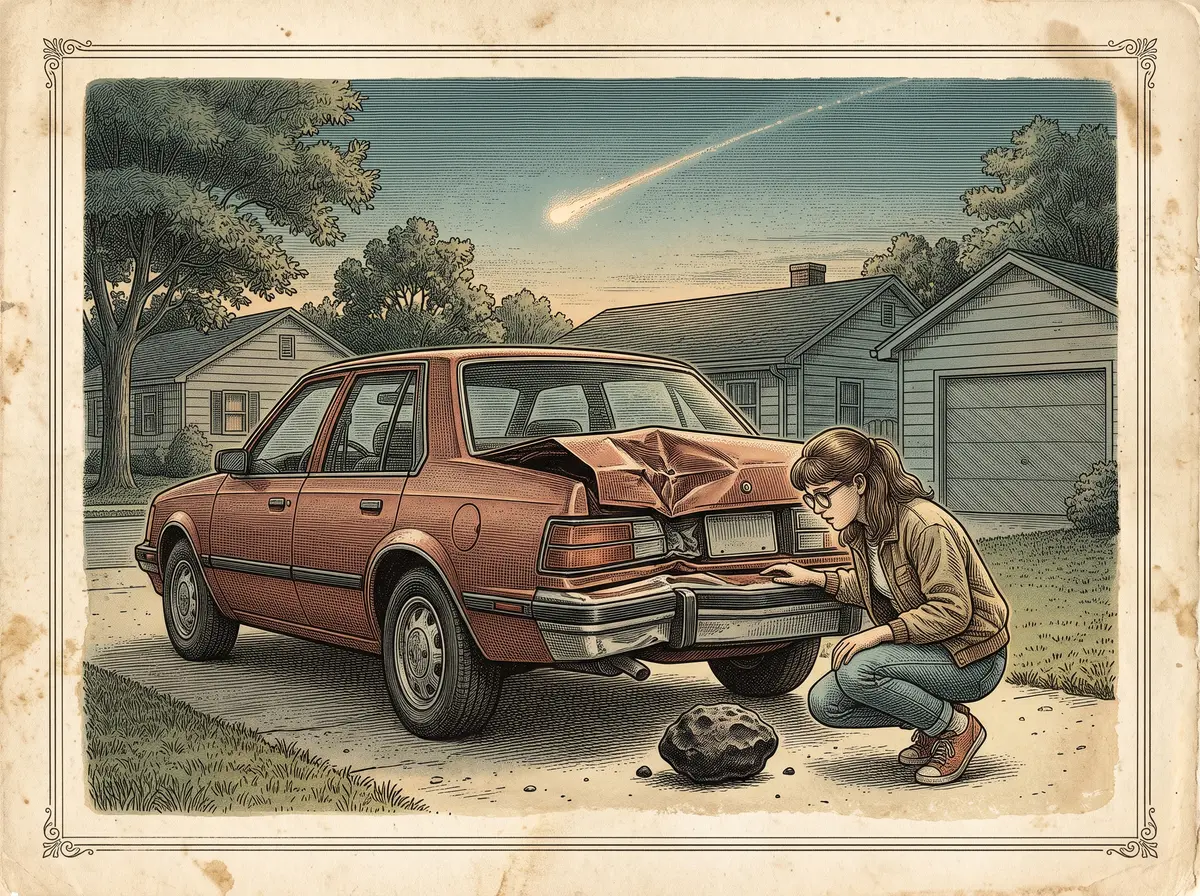
On the evening of October 9, 1992, 17-year-old Michelle Knapp of Peekskill, New York, heard a crash outside her house. She found the trunk of her red 1980 Chevy Malibu crushed and, underneath the car, a dark, football-sized rock weighing about 27 pounds. Hundreds of miles away, people at Friday-night high school football games had just filmed a green fireball streaking across the sky. For most of human history, the learned answer to "did that rock fall from space?" would have been a polite no.
By the Curiosities Desk · · 5 min read · Filed under Space · Today’s round
What happened: The History of Meteorites
The story of how we came to believe in meteorites begins in a wheat field outside Ensisheim, a walled town in Alsace (then part of the Holy Roman Empire, now in France). On November 7, 1492, a fireball was seen from as far as 150 kilometers away, and a stone of about 127 kilograms (280 pounds) slammed into the ground, leaving a hole roughly a meter deep. Townspeople rushed out and began chipping off souvenirs until a local magistrate stopped them.
A few weeks later, King Maximilian I passed through on his way to a campaign against France. He and his advisors read the stone as a good omen. The poet Sebastian Brant turned it into broadsheets announcing heaven’s support for the king. Maximilian ordered the “thunderstone” kept in the parish church, where, according to the usual account, it hung from a chain. Later retellings add that the chain was there to stop it from flying off again. That detail is legend, not record, but it captures the mood: the stone was a sign, not a specimen.
For the next three centuries, scholars mostly stopped believing in sky-stones at all. Educated Europeans had inherited the view, going back to Aristotle, that the heavens beyond the Moon were perfect and unchanging. Stories of stones raining down were filed alongside reports of rains of blood, milk, or frogs: peasant tales to be explained away as lightning strikes, volcanic debris, or plain error.
The first serious push back came from an unlikely source. Ernst Chladni, a German physicist best known for studying the patterns sand makes on vibrating plates, published a short book in 1794 arguing that certain stones and masses of iron had come from outer space. He had never visited a fall or interviewed a witness. He simply took the old reports seriously and compared them. Many scientists thought he had gone too far.
The sky answered almost immediately. Stones fell near Siena, Italy, in 1794, and in Yorkshire, England, in 1795. Chemists found that several of these “fallen” stones shared an odd recipe, including nickel-bearing iron, unlike ordinary local rocks.
Then, in the early afternoon of April 26, 1803, more than 3,000 stones pelted the town of L’Aigle in Normandy. The French Academy of Sciences sent the young physicist Jean-Baptiste Biot to investigate. He walked the area, collected stones, and interviewed villagers, priests, and officials. His report made two arguments. The stones matched each other and earlier falls, and nothing like them came from local mines or foundries. And dozens of witnesses from different walks of life, who had no reason to collude, described the same “rain of stones.” Within months, most of the scientific world accepted that rocks really do fall from the sky.
Why it was strange: The History of Meteorites
The strangest thing is that the experts were the holdouts. Ordinary witnesses had been describing falling stones for centuries; it was the trained scholars who decided those people must be mistaken. The skeptics were not foolish. They were applying a reasonable rule, that extraordinary claims need extraordinary evidence, to a claim that turned out to be true.
That tension produced one of history’s most quoted lines. After stones fell near Weston, Connecticut, in December 1807, and Yale professors Benjamin Silliman and James Kingsley investigated, Thomas Jefferson supposedly said it was easier to believe two Yankee professors would lie than that stones fall from heaven. Researchers at Monticello have found no evidence he said it. The line appears to trace to an 1874 speech by Silliman’s son. What Jefferson actually wrote, in a February 1808 letter, was far more careful: “we certainly are not to deny whatever we cannot account for.”
For another tale of the sky being stranger than the experts allowed, see The Newspaper Hoax That Put Bat-People on the Moon.
What scientists learned: The History of Meteorites
Once meteorites were accepted, they became some of the most valuable rocks on Earth. A meteorite is a piece of an asteroid, or occasionally of the Moon or Mars, that survives the plunge through our atmosphere. The bright streak it makes on the way down is the meteor; the rock that reaches the ground is the meteorite.
Most meteorites are fragments of asteroids that formed when the solar system was young and never melted into a full planet. That makes many of them time capsules. The oldest grains in some meteorites have been dated to about 4.57 billion years ago, older than any surviving rock formed on Earth.
Peekskill added something new. Because the fireball was caught on more than a dozen home video cameras, many of them pointed at football fields, astronomers could reconstruct its path through the air and calculate its orbit. A 1994 paper in Nature used that footage to trace the rock’s journey back out toward the asteroid belt.
A modern example of a meteorite hiding in plain sight: The Doorstop That Fell From Space.
How it reaches us today: The History of Meteorites
Today, scientists comb Antarctica’s ice fields, where dark stones stand out against white snow, and recover hundreds of new meteorites in a good season. Camera networks now watch the night sky specifically to catch fireballs, so their landing zones can be found and their orbits traced, just as Peekskill’s was.
The same question Biot faced, whether something really fell, also shapes planetary defense, the effort to find and track asteroids that could someday hit Earth. Even the dented Chevy lived on: it was sold to collectors and has toured museums as perhaps the most famous car ever hit by a rock from space.
Space debris falls on us too, sometimes with paperwork attached: The Time a Falling Space Station Got a $400 Littering Ticket.
The long walk from a thunderstone in a church to a rock under a car is on the shelf of From the First Spark to the Thing You Still Use.
Fun fact: The History of Meteorites
More than 500 years after it fell, the Ensisheim meteorite still has its own honor guard. A local brotherhood called the Confraternity of the Ensisheim Meteorite Guardians hosts an annual meteorite show in the town’s historic Regency Palace, where the remains of the stone are kept.
Sources: The History of Meteorites
- Jean-Baptiste Biot, Relation d’un voyage fait dans le département de l’Orne, pour constater la réalité d’un météore observé à l’Aigle le 6 floréal an 11 (1803), summarized in K. Eschner, “Scientists Didn’t Believe in Meteorites Until 1803,” Smithsonian — https://www.smithsonianmag.com/smart-news/1803-rain-rocks-helped-establish-existence-meteorites-180963017/
- Thomas Jefferson to Daniel Salmon, 15 February 1808, Founders Online, U.S. National Archives — https://founders.archives.gov/documents/Jefferson/99-01-02-7423
- “Who Is the Liar Now?” Thomas Jefferson Foundation, Monticello — https://www.monticello.org/stories/who-is-the-liar-now
- P. Brown et al., “The orbit and atmospheric trajectory of the Peekskill meteorite from video records,” Nature 367, 624–626 (1994); video archive at University of Western Ontario — https://aquarid.physics.uwo.ca/~pbrown/Videos/peekskill.htm
- “Ensisheim,” Buseck Center for Meteorite Studies, Arizona State University — https://meteorites.asu.edu/meteorites/ensisheim