Everyday Objects · Engineering
The Engineer Who Sucked on a Restaurant Chair to Invent the Vacuum Cleaner
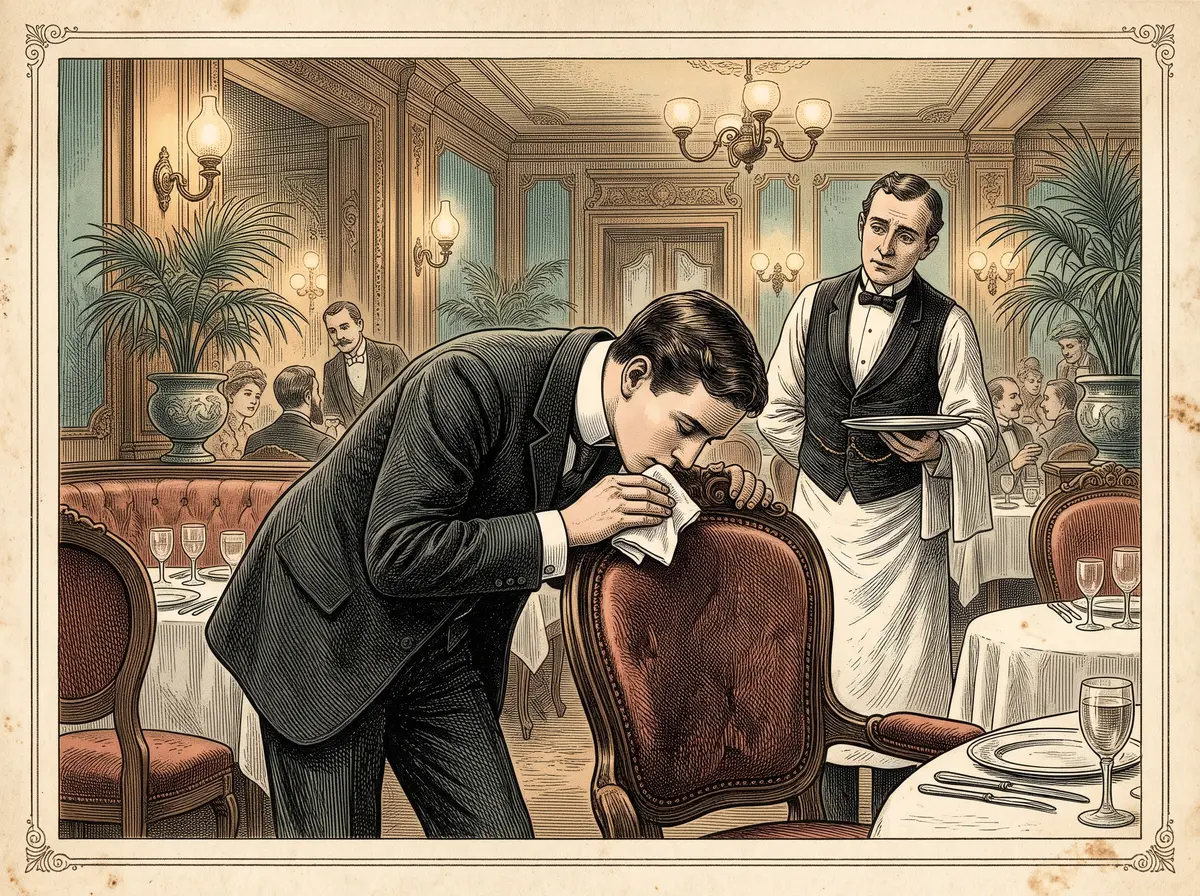
In London around 1901, a young engineer named Hubert Cecil Booth sat down in a restaurant, leaned over the plush back of a seat, laid a cloth against it, put his mouth to the cloth, and sucked as hard as he could. Retellings say he coughed and nearly choked. But when he looked at the underside of the cloth, it carried a ring of grime. The experiment was undignified, and it worked. It became the first proof that a cleaner could pull dust *in* instead of blowing it around.
By the Curiosities Desk · · 5 min read · Filed under Engineering · Today’s round
What happened: The Vacuum Cleaner
Booth was not a cleaning enthusiast. Born in Gloucester in 1871, he trained as a civil and mechanical engineer in London and spent the 1890s at the firm Maudslay, Sons and Field, helping design giant “Great Wheels” (fairground observation wheels) for London, Blackpool, Paris, and Vienna. He also worked on engines for Royal Navy ships.
Around 1900 or 1901, he went to watch a demonstration of an American dust-removing machine. Accounts describe it as a compressed-air cleaner of the kind used on railway carriages. It blasted air at upholstery so that dust flew off one side to be caught, mostly, somewhere else. Booth asked the inventor, who is usually identified as the American John S. Thurman, why he didn’t suck the dust out instead. By Booth’s own telling, the inventor insisted suction was impossible and walked off.
Booth wasn’t convinced. Hence the restaurant chair. Retellings disagree on the small details: some say he used a handkerchief, others a damp cloth, and Booth’s quoted account sets it at a restaurant on Victoria Street. All agree on the main point. If a mouth could pull dirt into a filter, a machine could do it better.
He received a British patent on 30 August 1901. His first machine was enormous: a petrol-driven pump and cloth filter mounted on a horse-drawn cart, later nicknamed “Puffing Billy.” It was far too large to come indoors. Instead, the cart parked in the street, and uniformed operators fed long hoses through the windows and doors of the building to be cleaned. Booth didn’t sell the machines at first. He sold the service, through a company whose prospectus, according to most histories, is the first known use of the phrase “vacuum cleaner.”
Then came the publicity. In 1902, the company is said to have cleaned the great carpet of Westminster Abbey around the coronation of King Edward VII. That job helped win the business a royal seal of approval. Wealthy Londoners reportedly hosted “vacuum cleaner parties,” where guests came to watch the machine at work. In one widely repeated job, 15 of Booth’s machines spent four weeks pulling 26 tonnes of dust from the girders of the Crystal Palace.
Not everyone loved the noisy cart outside their door. Booth is often said to have been fined because his machine frightened passing horses. That detail appears in many retellings, but it’s hard to trace to a court record, so treat it as part of the legend.
Why it was strange: The Vacuum Cleaner
The obvious idea wasn’t obvious. Everyone already knew dust could be moved with air: carpet beaters, brooms, and the American blowing machines all worked that way. The professionals’ instinct was to push dirt somewhere else. Booth’s insight was to flip the direction of the airflow and add a filter so the dirt stayed caught.
It’s also strange how the first proof looked. A trained engineer who designed fairground wheels and warship engines tested the most important idea of his career with his own mouth, in public, on someone else’s furniture. You can find more stories like this in The Ordinary Object With the Strange Origin.
What scientists learned: The Vacuum Cleaner
A vacuum cleaner never makes a true vacuum. It works by making a pressure difference. A pump or fan pulls air out of a sealed chamber, so the pressure inside drops below the surrounding air pressure. Outside air rushes in through the hose to fill the gap and drags dust with it. A filter (cloth in Booth’s day) lets the air through but traps the particles.
The engineering challenge was getting enough airflow through a long hose to lift dirt out of thick carpet. That’s why Booth’s first machines were so large: a small motor couldn’t move enough air. The same airflow principle later turned up in a very different machine, described in The Two Vacuum Cleaners That Learned to Breathe.
How it reaches us today: The Vacuum Cleaner
Booth’s company, the British Vacuum Cleaner Company, moved into smaller machines. One of its early cleaners, made around 1905 for the Royal Naval College at Osborne on the Isle of Wight, is now in the Science Museum Group collection in London. The company later sold household models under the name “Goblin.” Booth defended his patents fiercely. He wrote that he was involved in 23 infringement suits and won 19.
The household market eventually went to lighter, cheaper machines, starting with the upright cleaner that William Hoover bought from its inventor, James Murray Spangler, in the United States in 1908. But every one of them, from the stick vacuum to the robot that bumps around your kitchen, runs on the idea that the American inventor dismissed: suck, don’t blow. New gadgets often need a show before people trust them, as Harrods found with The Department Store That Served Brandy at the Top of Its Moving Staircase.
Fun fact: The Vacuum Cleaner
Booth’s vacuum business began as a house call: the “vacuum cleaner” first arrived on your street pulled by a horse, and only its hose came inside.
Sources: The Vacuum Cleaner
- Institution of Civil Engineers, “Obituary. Hubert Cecil Booth. 1871–1955,” ICE Proceedings 4(4), 631–632 (1955): https://doi.org/10.1680/iicep.1955.11412
- Science Museum Group Collection, “Original vacuum cleaner, from Royal Naval College” (object 1958-199, c. 1905): https://collection.sciencemuseumgroup.org.uk/objects/co48604
- Grace’s Guide to British Industrial History, “H. C. Booth”: https://gracesguide.co.uk/H._C._Booth
- Mary Robinson Sive, “Vacuum Cleaners Before Electricity,” Historical Text Archive (citing Booth’s paper “The Origin of the Vacuum Cleaner,” Transactions of the Newcomen Society): https://historicaltextarchive.org/sections/article/769-vacuum-cleaners-before-electricity
- Smithsonian Magazine, “The Vacuum Cleaner Was Harder to Invent Than You Might Think”: https://www.smithsonianmag.com/smart-news/vacuum-cleaner-was-harder-invent-you-might-think-180964631/