The 'Flu-Proof' Smoke Ball That Bet £100 You Wouldn't Catch the Flu — and Lost to a Woman Who Did
In January 1892, a London woman named Louisa Carlill came down with the flu. That was bad news for her, and much worse news for the Carbolic Smoke Ball Company. For about two months she had been squeezing the company's rubber ball three times a day and puffing its medicated powder up her nose, exactly as the instructions said. The company had promised in print to pay £100 to anyone who did that and still got sick. She did, she had, and she wanted her £100.
By the Curiosities Desk · · 5 min read · Filed under Medicine · Today’s round
Part of Medicine, Before It Was Sure
What happened: The Carbolic Smoke Ball
The smoke ball was born in a frightened city. Between 1889 and 1890, a pandemic often called the “Russian flu” swept the world, killing an estimated one million people, and a fresh wave was rolling through Britain at the end of 1891. Nobody yet knew what caused influenza, let alone how to stop it.
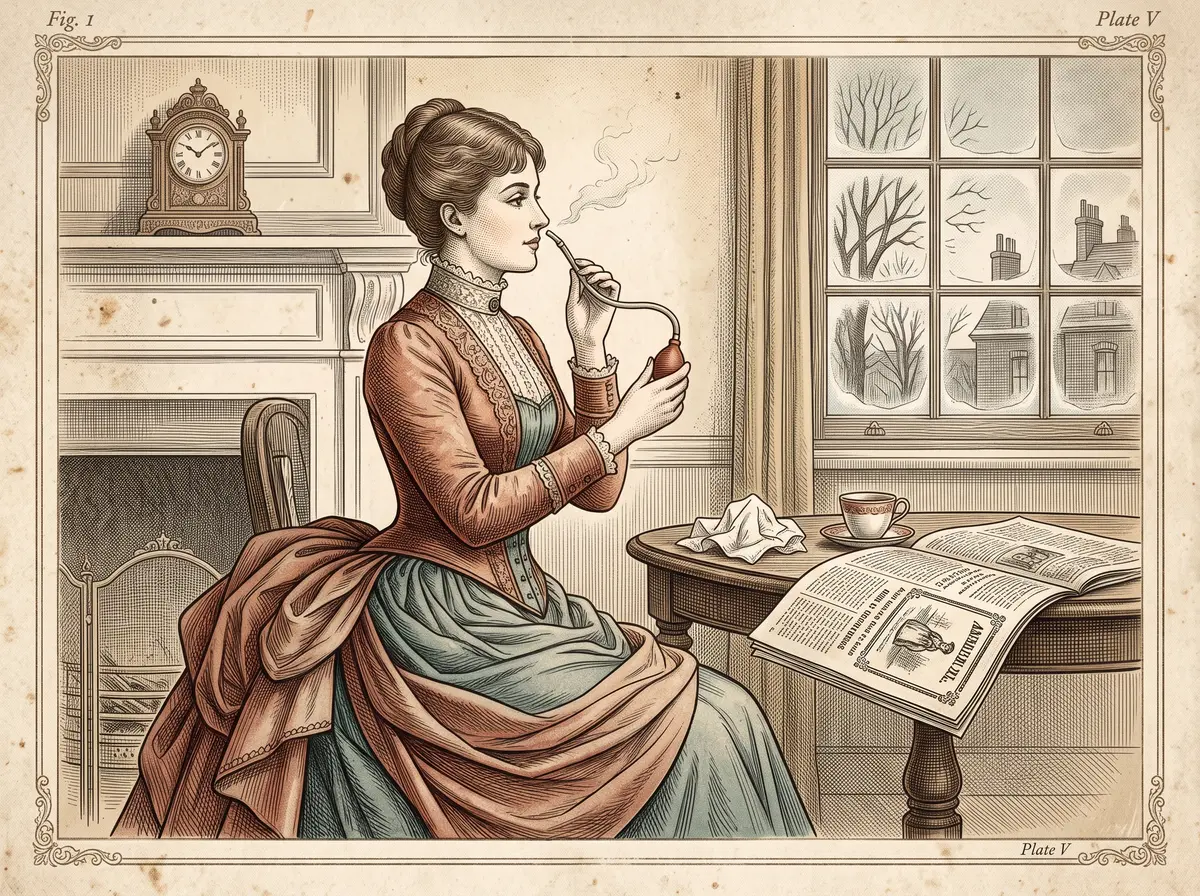
Into that gap stepped Frederick Augustus Roe, a London businessman who sold the Carbolic Smoke Ball. It was a small rubber ball with a tube attached, filled with powder containing carbolic acid, a strong-smelling disinfectant that chemists now call phenol. The user put the tube to their nose and squeezed, releasing a puff of vapor. It cost 10 shillings, post free.
On 13 November 1891, the company ran an advertisement in the Pall Mall Gazette and other papers. It promised that “£100 reward will be paid by the Carbolic Smoke Ball Company to any person who contracts the increasing epidemic influenza, colds, or any disease caused by taking cold,” after using the ball three times daily for two weeks according to the printed directions. To show it meant business, the ad added that £1,000 had been deposited with the Alliance Bank on Regent Street, “shewing our sincerity in the matter.” It also claimed that during the last epidemic, many thousands of balls had been sold with no recorded case of infection among their users.
Louisa Carlill read the ad and bought a ball. She used it as directed for nearly two months. On 17 January 1892, she caught influenza anyway.
Her husband, a solicitor, wrote to the company asking for the reward. The first two letters went unanswered. The third reply was anonymous: the company said it had complete confidence in its product and suggested she visit its office daily so they could check that she was using the ball properly.
Instead, she sued. The company hired a capable barrister, H. H. Asquith, and argued that the ad was never a real promise. It was, they said, the kind of exaggerated sales talk nobody takes literally. Mr Justice Hawkins disagreed and awarded her the £100. The company appealed, and on 7 December 1892 three Court of Appeal judges, Lindley, Bowen, and A. L. Smith, ruled unanimously against it. Lindley LJ considered whether the ad was “a mere puff which meant nothing,” and concluded the bank deposit proved otherwise: the company had gone out of its way to say it was serious.
Why it was strange: The Carbolic Smoke Ball
The company lost because of the very line it had written to win customers’ trust. The £1,000 deposit was a marketing flourish meant to sound confident. In court, it became the evidence that the promise was real.
There’s a deeper irony, too. The smoke ball’s sales pitch rested on a scientific claim nobody could test in 1891. No one knew what caused flu, so no one could say whether puffing phenol up your nose blocked it. The company effectively placed a public bet on an unknown, and a single customer was enough to settle it.
Roe was not done advertising. In February 1893, he ran a new ad in the Illustrated London News offering an even bigger reward, £200, this time wrapped in conditions and small print. The company limped on and was wound up in 1896.
The smoke ball is a fine example of Medicine, Before It Was Sure, when confidence often ran ahead of evidence.
What scientists learned: The Carbolic Smoke Ball
The case itself was decided by judges, not scientists, but it landed in the middle of a real scientific mystery: what is influenza?
In 1892, the German bacteriologist Richard Pfeiffer announced that he had found the culprit, a bacterium he isolated from flu patients. For decades many doctors accepted it as the cause. They were wrong. That germ, now called Haemophilus influenzae, can cause serious infections of its own, but it does not cause the flu. Influenza is caused by a virus, too small to see with the microscopes of the day. Researchers in London first isolated a human influenza virus in 1933.
That makes the smoke ball’s promise even shakier. Carbolic acid really did kill germs on surfaces. In the 1860s, the surgeon Joseph Lister had used it to cut infections after operations, which gave the chemical a glowing reputation. But killing bacteria on a wound is not the same as stopping a virus in the airways, and a puff of powder up the nose was never tested in anything like a fair trial. Medicine was only beginning to learn how to run fair tests, a story told in The Fake Metal Rods That Accidentally Invented the Placebo-Controlled Trial.
How it reaches us today: The Carbolic Smoke Ball
Carlill v Carbolic Smoke Ball Co became one of the most famous cases in English law, and law students across the common-law world still study it in their first weeks of contract law. It set out a principle that shoppers benefit from every day: an advertisement making a specific, serious promise can be a binding offer, and the person who simply does what it asks has accepted it, no reply needed. Reward posters, “money back if not satisfied” guarantees, and contest prizes all lean on that idea.
It also became part of a long push to make health claims answerable to evidence. Today, regulators in many countries require companies to back up what they say a remedy can do, though it took decades of patent-medicine scandals to get there. Some of those were far more dangerous than a puff of phenol, such as The Radioactive Tonic That Dissolved a Millionaire’s Jaw.
Fun fact: The Carbolic Smoke Ball
Louisa Carlill lived to 96. When she died in 1942, her doctor recorded old age as the main cause, with influenza also listed.
Sources: The Carbolic Smoke Ball
- Carlill v Carbolic Smoke Ball Company [1892] EWCA Civ 1 — BAILII (primary source: the Court of Appeal judgment, 7 December 1892, quoting the advertisement)
- Classic Cases: Contract — Carlill v. Carbolic Smoke Ball Co. — University of Minnesota Law Library
- A. W. B. Simpson, “Quackery and Contract Law: The Case of the Carbolic Smoke Ball,” Journal of Legal Studies 14, no. 2 (1985): 345–389 (the definitive history, including Roe, the later ads, and Mrs Carlill’s later life)
- Carlill v Carbolic Smoke Ball Co — Wikipedia (overview with citations to Simpson and the law reports)
- 1889–1890 Pandemic — Wikipedia (background on the “Russian flu” and its estimated toll)
If you’re feeling unwell, a doctor or pharmacist is still the best person to ask about what actually works — no smoke ball required.