Impossible Inventions · Medicine
The Glass Operating Room Where Only the Patient's Head Was Allowed Outside
In Breslau in 1904, a surgical team stepped through a double-door airlock into a glass-walled room, sealed it behind them, and switched on a pump to suck out a little of the air. Their patient lay on the table inside with them, except for one part: the head, which poked out through an airtight collar in the wall, breathing ordinary room air next to an anesthetist who could barely hear a word the surgeons said.
By the Curiosities Desk · · 5 min read · Filed under Medicine · Today’s round
Part of Built to Do the Impossible
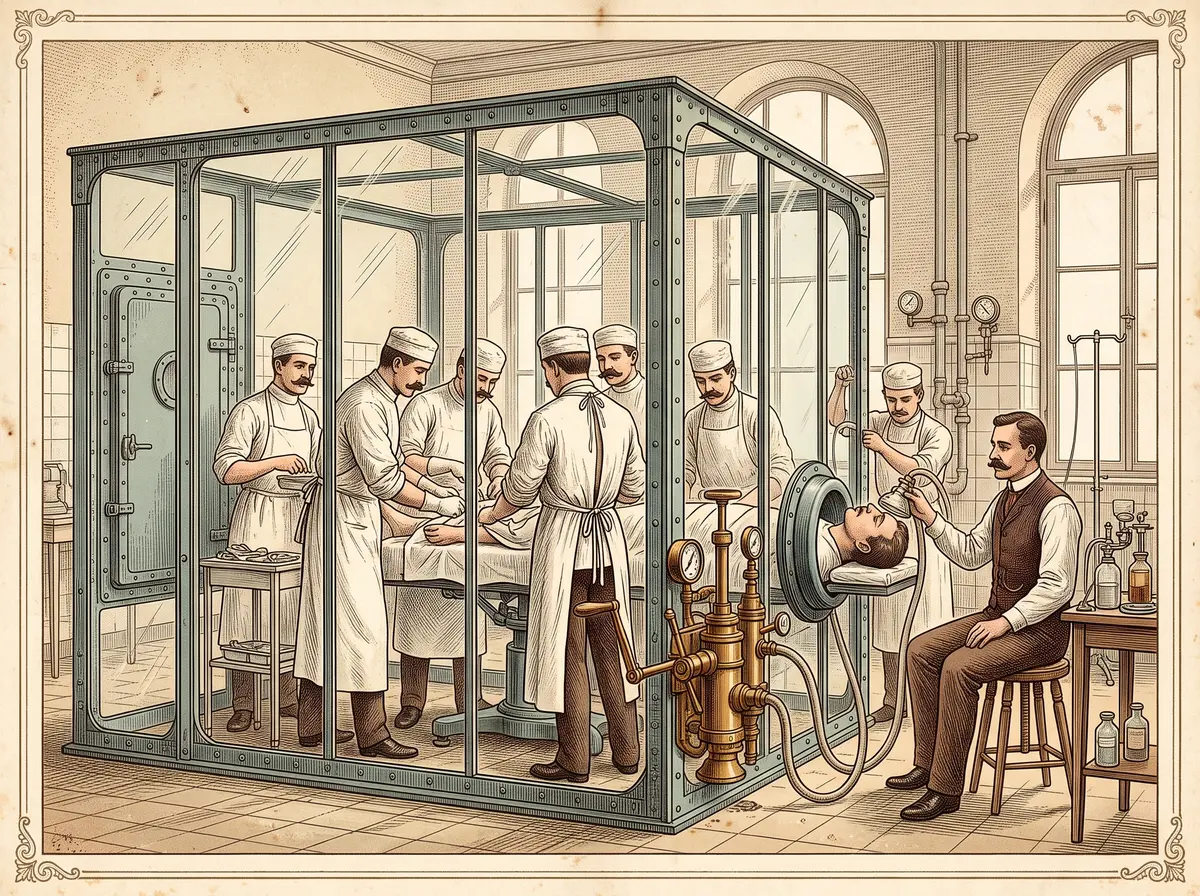
What happened: The Sauerbruch Chamber
At the start of the 1900s, the chest was close to a no-go zone for surgeons. The lungs don’t inflate by themselves. They sit inside a sealed cavity where the pressure is slightly lower than the air outside, and that small difference keeps them stretched open. Cut into the chest and air rushes into that cavity, and the lung on that side collapses, a condition called pneumothorax (air where it shouldn’t be, around the lung). For a patient breathing on their own under anesthesia, an open chest could be fatal within minutes.
Ernst Ferdinand Sauerbruch, a young assistant at the university surgical clinic in Breslau (today Wrocław, Poland), worked under the celebrated surgeon Jan Mikulicz-Radecki, who wanted a way past this wall. In 1903 Sauerbruch’s idea was to flip the problem around. If the trouble was that the outside air pressure was too high compared with the inside of the chest, why not lower the outside air pressure instead? Put the open chest in a room whose air was slightly thinned, and the lungs would stay inflated, just as they do inside a closed body.
He started small: a glass box with one opening for an air pump and one for the surgeon’s arms, with dogs as patients. The pressure drop was tiny, on the order of 10 millimeters of mercury, a bit more than one percent below normal air pressure. By one account, he logged dozens of successful dog operations. The demonstration that mattered went badly, though. When Mikulicz came to watch, air leaked into the apparatus, the dog’s lungs collapsed, and the dog died. Sauerbruch was blamed and dismissed from the clinic. He kept working privately, apologized through a colleague, and won back his place after a demonstration that worked.
In April 1904 Mikulicz introduced the method to the German Surgical Society’s congress in Berlin. The chamber had grown into a room. A 1904 description gives it about 14 cubic meters of space, plate-glass walls, a double-door airlock, and a suction pump able to pull out 300 liters of air a minute. The patient’s body went inside with the surgeons. The neck passed through a snug seal, so the head stayed at normal pressure, where the anesthetist worked.
The first human operation in the chamber ended in the patient’s death, and Mikulicz took responsibility for it. Later operations went better. By late July 1904, a movable chamber in Breslau had been used for a successful operation on a tumor of the esophagus, the food pipe that runs down through the chest. Sauerbruch went on to build chambers in Zurich and, after the First World War, in Munich. By around 1914, the city hospital in Offenbach, Germany, had installed what it believes may be the first permanent negative-pressure operating room in Europe.
(Sauerbruch’s later life is complicated. He accepted honors under the Nazi regime, while also, by several accounts, opposing its “euthanasia” killings. A 1949 denazification tribunal did not convict him. That is a longer story than this one.)
Why it was strange: The Sauerbruch Chamber
Most inventions change the patient. This one changed the weather around the patient. To keep one pair of lungs open, Sauerbruch thinned the air for everybody in the room.
That came with real costs. Surgeons described the chamber as cramped and hot. If the seal around the neck slipped, the protection was gone. And because the anesthetist sat outside, talking to the person keeping the patient asleep was, in the words of one later account, practically impossible. The surgeons were locked in a glass box with their patient’s body while the person watching the patient’s breathing stood on the other side of the wall.
Stranger still, a simpler answer appeared almost at once. Also in 1904, the physician Ludolph Brauer proposed the opposite trick: leave the room alone and push slightly pressurized air into the patient’s lungs using a pressurized cabinet around the head. Same goal, a fraction of the building.
What scientists learned: The Sauerbruch Chamber
The chamber proved something important: what keeps a lung open is a pressure difference, not a fixed pressure. Lower the outside or raise the inside and you get the same result. Sauerbruch lowered the outside. Brauer raised the inside.
The raise-the-inside camp kept getting simpler. In 1909, at the Rockefeller Institute in New York, Samuel Meltzer and his son-in-law John Auer showed in animals that blowing air and anesthetic gas through a tube placed in the windpipe could keep the lungs inflated even with the chest open. Sauerbruch rejected insufflation, and his influence slowed its adoption in Germany, but the tube eventually won. Once tracheal intubation (placing a breathing tube into the windpipe) and positive-pressure ventilation became routine, a whole sealed room could be replaced by a tube and a bag.
The same lesson shows up in From Laughing Gas Parties to the Operating Room: A Short History of Anesthesia: surgery advanced as fast as the ways to keep patients breathing.
How it reaches us today: The Sauerbruch Chamber
Every heart operation, lung cancer resection, and esophageal surgery depends on the problem Sauerbruch’s chamber was built to solve. Today it is solved with a breathing tube and a ventilator, sometimes with special tubes that let surgeons deflate one lung while the other keeps working.
The negative-pressure idea didn’t vanish, either. It returned in the late 1920s in a machine that surrounded the body and left the head outside, this time to help paralyzed patients breathe: The Two Vacuum Cleaners That Learned to Breathe. For more machines asked to do something nobody thought possible, see Built to Do the Impossible.
Fun fact: The Sauerbruch Chamber
Sauerbruch’s life became a 1954 West German film, The Life of Surgeon Sauerbruch, based on memoirs that were ghostwritten by a journalist.
Sources: The Sauerbruch Chamber
- Sauerbruch, E. F. “Ueber die physiologischen und physikalischen Grundlagen bei intrathorakalen Eingriffen in meiner pneumatischen Operationskammer.” Verhandlungen der Deutschen Gesellschaft für Chirurgie 32 (1904), pt. 2, 105–115. Catalog entry (Garrison-Morton 3185): https://www.historyofmedicine.com/id/4207
- Hektoen International, “Ferdinand Sauerbruch: Father of Thoracic Surgery.” https://hekint.org/2020/03/11/ferdinand-sauerbruch-father-of-thoracic-surgery/
- Life in the Fast Lane (LITFL), “Ferdinand Sauerbruch.” https://litfl.com/ferdinand-sauerbruch/
- City of Offenbach, “Negative pressure chamber” (city history). https://www.offenbach.de/gaeste/stadtgeschichte/geschichte-offenbach/1900-1932/unterdruckkammer.php?loc=en
- MDedge / AATS history series, “Confronting the open chest: Samuel J. Meltzer and the first AATS annual meeting.” https://mdedge.com/content/confronting-open-chest-samuel-j-meltzer-and-first-aats-annual-meeting
A note on this story: it touches on surgery, cancer, and death. If any of that is close to home for you right now, it can help to talk it through with someone you trust or a healthcare professional.