Impossible Inventions · Biology
The Goats Bred to Make Spider Silk in Their Milk
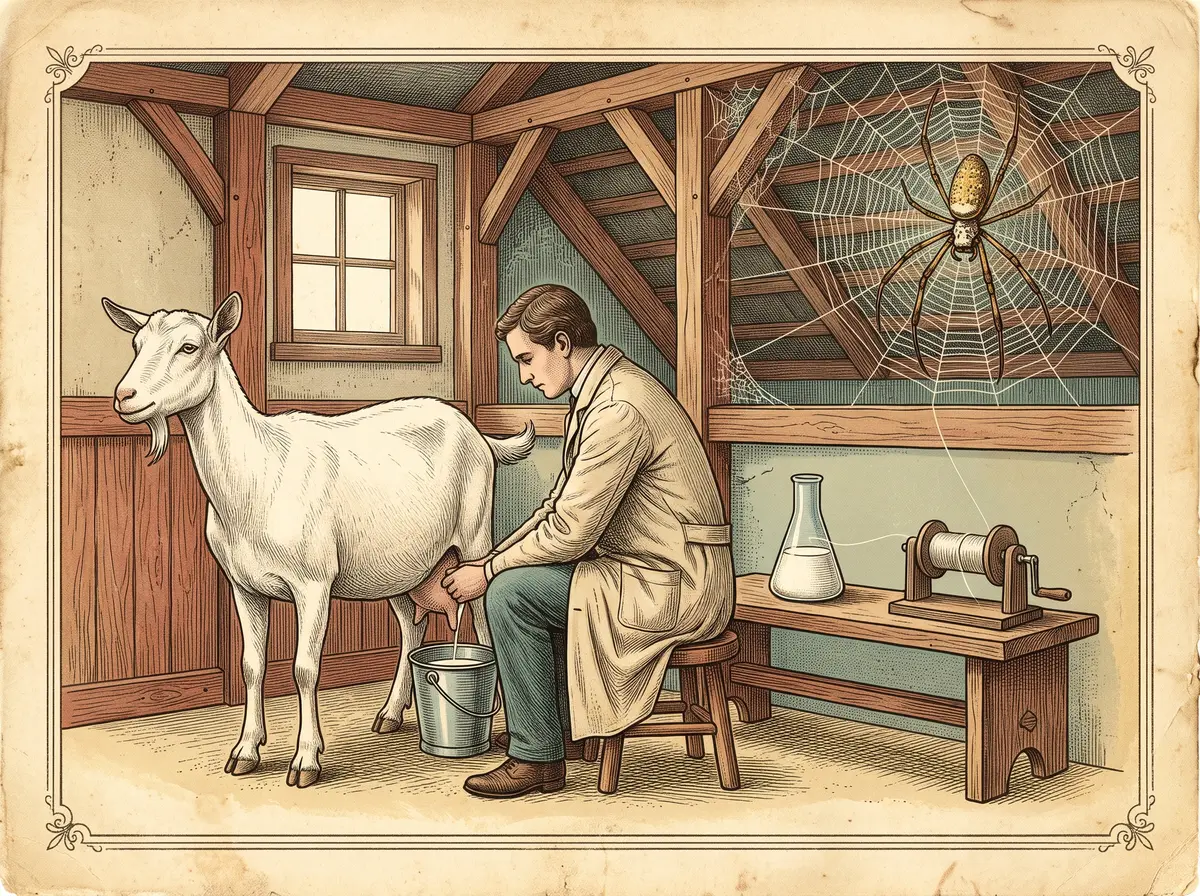
In 2000, a biotech company outside Montreal announced the birth of two young male goats named Peter and Webster. They looked like any other kids on a Quebec farm, but each one carried a gene borrowed from a spider. The plan was that their daughters would one day be milked like ordinary dairy goats, and the milk would be filtered for a protein that could be pulled into thread. The company called the material BioSteel. If it worked, a farm full of goats would do the job that no one had ever managed to get spiders to do.
By the Curiosities Desk · · 5 min read · Filed under Biology · Today’s round
What happened: The Goats Bred to Make Spider Silk in Their Milk
The problem started with spiders. Dragline silk, the strong thread an orb-weaving spider uses for the frame of its web and as a safety line, is famous among materials scientists. It is light, elastic, and very tough, and engineers have long dreamed of using it for sutures, fishing line, parachutes, and protective vests. But spiders can’t be farmed the way silkworms are. They are territorial, and many will eat each other if crowded together. A single spider also makes very little silk.
Nexia Biotechnologies, a company spun out of McGill University and run by its president, Jeffrey Turner, tried a workaround. Goats already turn out large amounts of protein in their milk. So the company joined a spider silk gene to a “milk-specific promoter,” a genetic on-switch that only works in the cells of the udder. A female goat carrying that construct should make spider silk protein only when she is producing milk, and nowhere else in her body.
Making the protein was only half the battle. A spider doesn’t just make silk protein; it spins it, pushing a concentrated liquid through a narrow duct that lines the molecules up as the thread forms. Nexia teamed up with the U.S. Army’s soldier research center in Natick, Massachusetts, to work on that half of the problem. In January 2002, the team published a paper in Science describing fibers spun from spider silk proteins made by engineered hamster kidney cells and cow udder cells growing in the lab. The team squeezed the protein solution into fibers, then stretched them, which made a big difference.
The fibers were real, but they weren’t spider silk yet. The press reported at the time that the lab-made threads were about as tough as the natural kind but only about a third as strong. The proteins were also shorter than the spider’s, and the cells made only one of the two main proteins found in dragline silk. Meanwhile, Peter and Webster’s offspring were confirmed to carry the working gene.
Then the business side unraveled. According to the Canadian science museum Ingenium, Nexia did little development work on the goats after 2005, and many were sent to the University of Wyoming in 2007. That’s where Randy Lewis, a molecular biologist who had isolated a dragline silk gene from orb weavers years earlier, carried on the work. When Lewis moved to Utah State University in 2011, the project went with him. Local reporters described the routine at the university farm: about 30 goats, milked twice a day, with the milk frozen, skimmed, and passed through finer and finer filters to separate out the silk proteins. Two goat groups made the two different proteins, which were then combined and pushed through a needle to form fiber. By mid-2011, the team had spun about 10 meters of it.
Why it was strange: The Goats Bred to Make Spider Silk in Their Milk
It sounds like a bad science-fiction pitch: cross a spider with a goat and get a superhero. But the goats were not part spider in any way you could see. Each one carried a tiny piece of spider DNA, and the only difference showed up in the milk. That milk wasn’t for drinking, and a goat’s udder can’t spin thread. The goats were basically protein factories that happened to eat hay.
The idea also flipped the usual order of invention. Most new materials are designed by chemists. BioSteel was supposed to be a natural material, made by one animal following instructions copied from another, and then finished by engineers who were still figuring out how spiders do the spinning.
It belongs on the shelf with Built to Do the Impossible.
What scientists learned: The Goats Bred to Make Spider Silk in Their Milk
The big lesson was that the recipe isn’t the same as the product. Spider silk gets its strength from the way its long protein chains fold and line up as the thread is drawn out of the spider. Making the right protein in a goat solved the supply problem only in part. The protein still had to be purified, concentrated, and spun under conditions that copy the spider’s own duct. The 2002 Science paper showed that stretching the fibers after spinning helped line up the molecules.
The milk itself turned out to be a bottleneck. Lewis’s team spent years working out how to get more silk protein out of each liter, and how to make the fibers stronger or stretchier for different uses.
You’ll often read that a strand of spider silk as thick as a pencil could stop a flying jumbo jet. That’s a back-of-the-envelope estimate that keeps getting repeated, not something anyone has tested. The safer claim is that dragline silk is extremely tough for its weight.
Spider silk has inspired other unusual experiments; see The 300 Spiders a Chemist Raised to String a Violin.
How it reaches us today: The Goats Bred to Make Spider Silk in Their Milk
BioSteel never reached store shelves or soldiers’ vests. Nexia was delisted in 2009, and that year a Canadian research network bought its spider silk assets. Two of its last goats, Sugar and Spice, were bought by the Canada Agriculture Museum in Ottawa. The museum said it had bought them for education and would never breed them. In 2012 a visiting professor publicly objected to the display, and it became a small public debate over genetically engineered animals.
The research outlived the company. Lewis’s lab kept breeding silk-producing goats, and its main medical goal shifted toward artificial ligaments and tendons. The broader effort to make spider silk without spiders, in microbes, plants, and animals, continues today in labs and startups around the world.
For another unusual animal fiber that caught materials scientists’ attention, see The 7,500 Pounds of Hagfish That Slimed Five Cars and Closed a Highway.
Fun fact: The Goats Bred to Make Spider Silk in Their Milk
The museum’s spider goats weren’t the only souvenirs. Canada’s national science collection holds a small sample of the finished product: a translucent strand of BioSteel wound around a rod, with a handwritten label reading “BIOSTEEL/ continuos strand,” misspelling included.
Sources: The Goats Bred to Make Spider Silk in Their Milk
- Lazaris, A., et al. (2002). “Spider Silk Fibers Spun from Soluble Recombinant Silk Produced in Mammalian Cells.” Science 295(5554): 472–476 (primary source)
- Ingenium (Canada Science and Technology Museum), “Fibre sample,” BioSteel recombinant silk fiber, artifact 2010.0081.001
- Utah State University, “Spider-Man: Spider Silk Scientist Is New USTAR Researcher at USU” (2011)
- CBC News, “‘Spider goats’ display angers Ottawa professor” (2012)
- The Herald Journal (Logan, Utah), “From milk to silk: Transgenic goats produce same proteins as spiders” (2011)