Impossible Inventions · Medicine
The Gold Tapeworm Trap You Swallowed on a String — Baited for a Worm With No Mouth
It's 1854, and a doctor in Logansport, Indiana, has a plan for your tapeworm. First, you stop eating for several days, so the worm gets hungry. Then you swallow a tiny spring-loaded box made of gold, stuffed with something tasty, while a cord trails up your throat and out between your teeth. You wait. When the worm pokes its head inside to grab a snack, the trap snaps shut. Then the doctor starts reeling.
By the Curiosities Desk · · 5 min read · Filed under Medicine · Today’s round
Part of Built to Do the Impossible
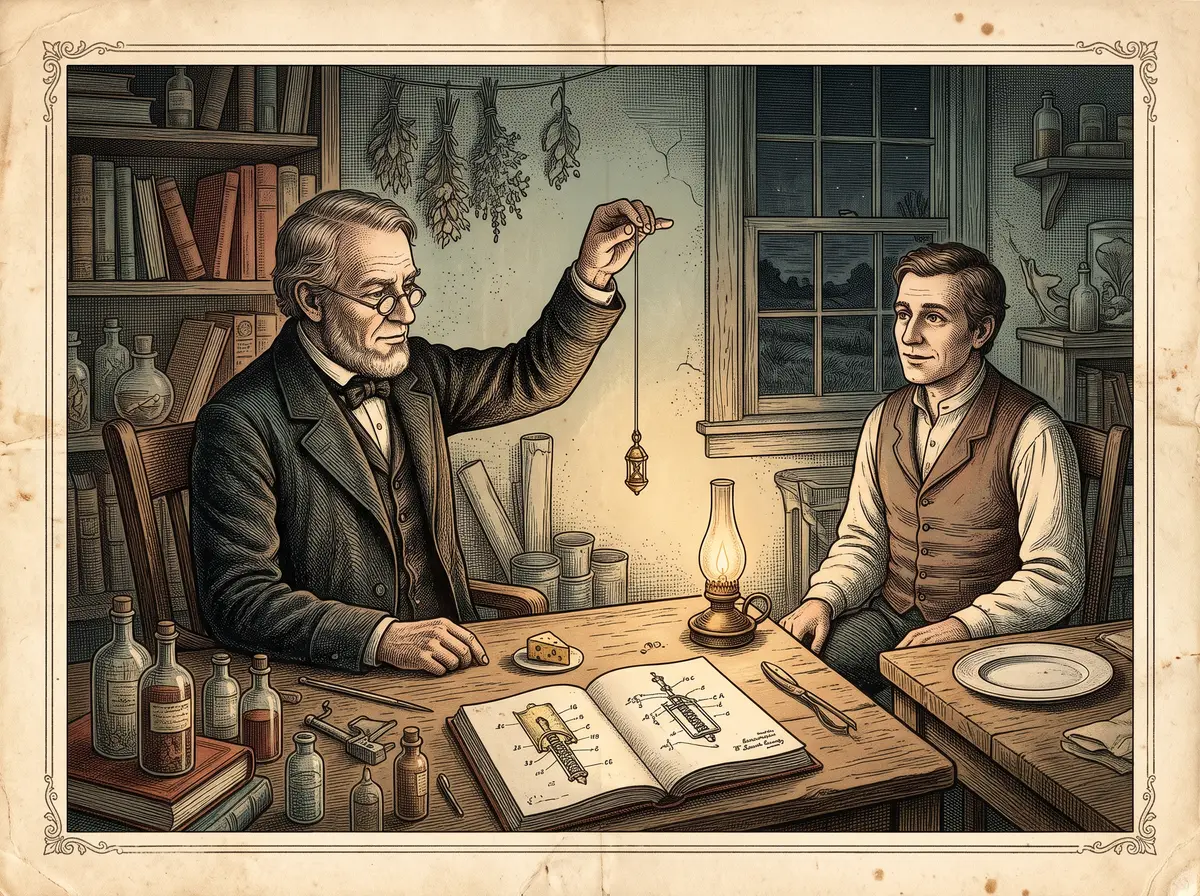
What happened: The Gold Tapeworm Trap
On November 14, 1854, the U.S. Patent Office granted Letters Patent No. 11,942 to Alpheus Myers, M.D., of Logansport, in Cass County, Indiana. The title was blunt: “Tapeworm-trap.”
The worm medicines of the day were harsh. Doctors dosed patients with male fern extract, turpentine, pomegranate bark and pumpkin seeds, followed by strong laxatives, and hoped the worm let go. Myers’s patent pitched his device as a way to remove worms “without employing medicines,” which, he wrote, could injure the patient.
His solution was mechanical. The trap was a small metal box, made of gold, platinum or another metal that would not easily corrode. Inside it sat a second box, pushed upward by a coiled spring and held down by a tiny catch. Both boxes had an opening just wide enough for a worm’s head. The patient (or doctor) filled the inner box with “nutritious” bait, set the catch so the two openings lined up, and tied a cord to a ring on the outside.
After going without food “of suitable duration,” the patient swallowed the trap. The idea was that a starving worm would find the bait, push its head in to eat, and knock the inner box loose. The spring would shove it upward, pinning the worm’s head against the serrated edge of the outer opening. Then the trap, and the worm attached to it, could be pulled back out by the cord.
Myers even thought about spring strength. The patent warns that the spring should be strong enough to hold the worm, but not so strong that it cuts off the worm’s head. If the head stayed behind, the whole exercise would be wasted.
The press noticed. In 1855, Scientific American described the device as “a neat, small instrument” of very thin gold or silver, baited with “any nutritious food, such as a piece of cheese.” Newspapers and later writers ran with the cheese detail, though the patent itself only asks for something nourishing.
Did anyone actually use it? There are claims, but they are hard to trust. According to medical historian Thomas Morris, a report of the time said Dr. Myers had removed a worm “fifty feet in length” from a patient. Another report, from 1857 and retold in Cabinet magazine, credited Myers with pulling a “snake” about three and a half feet long and an inch and a half thick out of a Mrs. E. Ryan of nearby Fort Wayne. Tapeworms are flat ribbons, not thick snakes, so whatever that story describes, it probably wasn’t a tapeworm. No independent medical record confirms that the trap ever worked.
Not every doctor was impressed. In September 1856, a physician named J. Gotham wrote to the Medical and Surgical Reporter to mock the device and to blame the government officials who had granted a patent for it.
Why it was strange: The Gold Tapeworm Trap
The trap was clever engineering built on a wrong picture of the animal. Myers imagined the tapeworm as a sort of fish in the gut: starve it, and it would rise toward the stomach, smell the bait and bite.
The trouble is that a tapeworm has no mouth. It has no stomach or intestine of its own, either. It doesn’t eat. It soaks up nutrients through its skin from the already-digested food flowing past it in your small intestine. As Cabinet puts it, a tapeworm almost certainly cannot smell cheese, and it couldn’t eat it in solid form anyway.
Myers had patented a very fine mousetrap for an animal that never goes near the cheese.
Another device that tried to solve a medical fear with a clever spring is The Coffin That Waved a Flag if You Woke Up Buried.
What scientists learned: The Gold Tapeworm Trap
Tapeworms belong to a group of parasitic flatworms called cestodes. The kinds that most often live in people, Taenia saginata (beef tapeworm) and Taenia solium (pork tapeworm), are picked up by eating raw or undercooked meat containing larval cysts. Once swallowed, the larva attaches to the wall of the small intestine and grows into an adult over about two months. According to the CDC, an adult beef tapeworm is usually 4 to 12 meters long and can reach about 25 meters.
The front end of the worm is the scolex, a knob usually smaller than a millimeter, with suckers (and in some species hooks) that grip the gut wall. Behind it grows a long chain of segments called proglottids. Each segment contains both male and female reproductive organs, and the ripe ones at the tail end break off and leave the body full of eggs.
That anatomy explains why Myers worried about the head. If treatment removes the chain but leaves the scolex attached, the worm can simply grow back. It also explains why his trap was unlikely to catch anything: the scolex is anchored firmly in the intestine, far below the stomach, and it has no reason to go looking for food.
How it reaches us today: The Gold Tapeworm Trap
Today a tapeworm is usually treated with a single dose or short course of medicine. Praziquantel is the main drug, with niclosamide used as an alternative in some countries.
The best prevention is the one Myers didn’t have: meat inspection and thorough cooking, which kill the larval cysts before they reach anyone’s intestine. In the United States, where cattle are federally inspected, beef tapeworm is now uncommon. It remains a problem in parts of Africa, Latin America and Asia, where the pork tapeworm can also cause cysticercosis, a more serious infection of tissues such as the brain.
For another hopeful gadget sold as a body fix, see The Spring-Loaded Dimple Maker That Promised Dimples by Morning. The trap sits with the other machines asked to do the impossible, in Built to Do the Impossible.
Fun fact: The Gold Tapeworm Trap
Because Myers patented both the trap and the way to use it, his patent technically gave him the exclusive right, for 14 years, to fish tapeworms out of people with bait.
If you think you might have a tapeworm (for example, if you notice small white segments in your stool), see a doctor. It’s a common, very treatable infection, and no string is involved.
Sources: The Gold Tapeworm Trap
- Alpheus Myers, “Tapeworm-trap,” U.S. Patent No. 11,942 (November 14, 1854) — the original patent, with its description, drawings and the warning about spring strength
- Natalie de Souza, “The Beast Within”, Cabinet 34 (Summer 2009) — on the 1855 Scientific American description, the 1857 Fort Wayne report and tapeworm biology
- Thomas Morris, “The tapeworm trap” (2017) — medical historian’s account drawing on the 1856 Medical and Surgical Reporter letter and the “fifty feet” claim
- Centers for Disease Control and Prevention, “Clinical Overview of Taeniasis” — species, adult lengths and how infection is acquired
- MSD Manual Professional Version, “Taenia saginata (Beef Tapeworm) Infection” — symptoms, praziquantel and niclosamide treatment, and where infection is common
#patents #medical devices #Scientific American #19th century medicine