Impossible Inventions · Medicine
The Spring-Loaded Dimple Maker That Promised Dimples by Morning
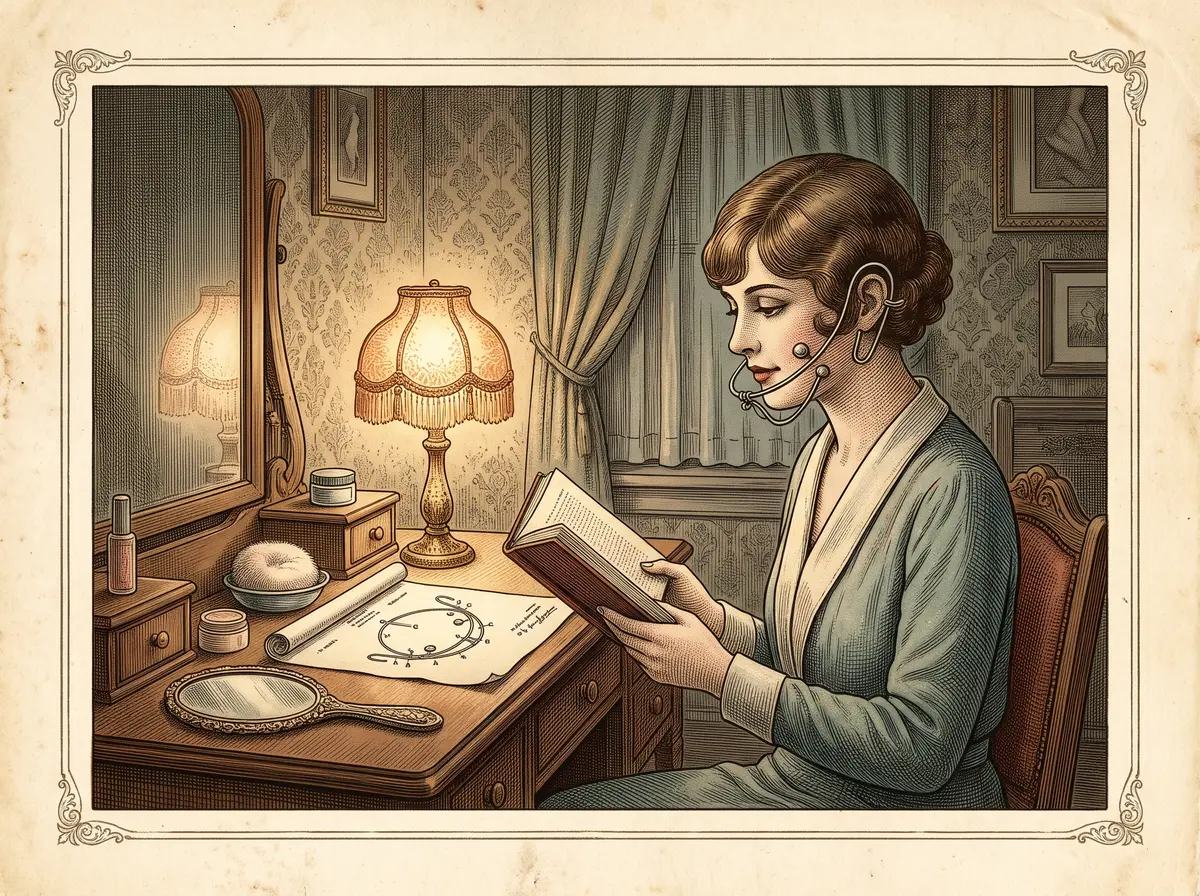
In 1926 a patent told you to go to bed with a wire bow hooked over your ears, two little knobs pressed into your cheeks, and a coiled spring keeping them pushed in all night. According to the 1926 patent for this contraption, that was the whole plan: "if the appliance be used during the night dimples will be present during the next day."
By the Curiosities Desk · · 5 min read · Filed under Medicine · Today’s round
Part of Built to Do the Impossible
What happened: The Dimple-Maker Patent
In July 1921, Evangeline Isabella Gilbert of Rochester, New York, filed a patent for a “dimple producing appliance.” The U.S. Patent Office granted it on February 16, 1926, as Patent No. 1,572,891.
The appliance was meant “to produce dimples in the cheeks of a person which will be indistinguishable from natural dimples.” Two small dimple-pressing pieces sat at the ends of a springy bow, with a coil of wire wrapped around the bow for extra bounce. You pulled the two ends apart to put the bow under tension, set the pieces on your cheeks where you wanted dimples, and hooked the ends over your ears. The spring then supplied what the patent called “yielding pressure for an extended length of time.” How long that took, Gilbert admitted, varied from person to person, but she wrote that a night of wear would do the trick.
Gilbert kept refining the design. A second patent, filed in 1923 and granted in November 1927 (No. 1,648,221), let users slide each dimple piece along the bow and lock it in place with a screw, so the appliance could be “readily adjusted to fit the faces of different individuals.” The bows were now resilient wire coated in celluloid, an early plastic, and they ran beneath the mouth and up to the ears like the arms of a pair of glasses.
A third version, filed in 1936 and granted in August 1937 (No. 2,091,276), went further still. It added a removable tapered piece at the center of the bow for a chin dimple, plus screws for turning up the pressure on each cheek. By now Gilbert was also claiming a bonus: the device “not only has a tendency to produce dimples but it tends to lift the face and remove wrinkles.”
That third design is the one that made her briefly famous. In August 1936, the Detroit Free Press ran a photograph of a woman wearing the “dimple maker,” and popular science magazines of the era picked it up as a curiosity. Advertising copy reproduced in modern retellings tells users to “wear dimplers five minutes at a time, two or three times a day, while dressing, resting, reading or writing.” That gentler schedule doesn’t match the patent’s overnight plan, and the original ad is hard to trace, so treat it as reported rather than confirmed.
Many modern write-ups also say the American Medical Association dismissed the gadget, but no traceable original statement turns up, so that’s best read as legend. What can be checked is the paper trail: three patents across 16 years from one inventor who kept improving her idea.
Why it was strange: The Dimple-Maker Patent
The appliance rested on a reasonable-sounding guess: press skin into a shape long enough, and it will keep that shape. Skin does hold temporary marks. Anyone who has slept on a wrinkled pillowcase has woken up with a crease pattern on one cheek.
But a pillow crease fades within hours, because skin is elastic. A natural dimple works differently. It isn’t a dent pressed in from the outside. It’s pulled in from the inside, and it appears or deepens when a person smiles. No amount of outside pressure can install the anchor that makes that happen. The dimple maker was trying to copy the shape of a dimple without the machinery behind it.
It also arrived in a crowded field. Its stablemates included gadgets like The ‘Electric’ Hairbrush With No Electricity in It — and the Tiny Compass Packed In to Prove It Worked, which likewise sold a body-improving promise that its mechanism couldn’t keep.
What scientists learned: The Dimple-Maker Patent
The best-supported explanation for cheek dimples came decades after Gilbert’s patents. In 1998, a team led by plastic surgeon Joel Pessa reported on 50 dissections of one side of the face (hemifacial dissections, in surgical shorthand). In 17 of them, or 34 percent, the zygomaticus major muscle, the main muscle that pulls the corners of your mouth up into a smile, was split into two bundles. The researchers saw the lower bundle attach to the skin and proposed that when this muscle contracts, it tugs that patch of skin inward, forming a dimple.
In other words, a dimple is a tethering point. The skin is connected to the muscle beneath it, so the smile pulls the dent into existence. That’s why many dimples come and go with expression.
Their inheritance is shakier than textbooks suggest. Biologist John McDonald of the University of Delaware searched the scientific literature and found no published genetic studies showing that cheek dimples follow the simple dominant-gene pattern taught in many classrooms. He also noted reports of people who had dimples as children and lost them as adults, which makes neat “dimples or no dimples” categories hard to draw.
For more on gadgets that measured or reshaped the head with more confidence than evidence, see The Head-Bump Machine That Printed Your Personality on Ticker Tape.
How it reaches us today: The Dimple-Maker Patent
Gilbert’s goal survives, though the method has changed completely. Today, cosmetic surgeons perform a procedure called dimpleplasty, or dimple creation surgery. A 2017 review in the Indian Journal of Dental Sciences describes the basic idea: through a small incision, the surgeon stitches the underside of the cheek skin to a deeper layer. The scar tissue that forms holds a small permanent dimple in place.
That’s essentially the tether Pessa’s team described, built on purpose. The dimple maker had the right idea about where a dimple goes and the wrong idea about how it gets there.
It’s also a reminder of what a patent does and doesn’t prove. Gilbert’s were granted because her design was new, not because anyone tested whether it worked, and that’s still true of patents today. Another product whose beauty promise outran its original purpose is The Gas Mask Filter That Became a Makeup Wipe — Until America Started Blowing Its Nose in It. The bow sits with the other machines asked to do the impossible, in Built to Do the Impossible.
Fun fact: The Dimple-Maker Patent
The “dimples are a dominant gene” lesson in many biology classes may have no study behind it at all. When McDonald traced it back, the claim he found was a 1951 textbook assertion that cited no studies, and he couldn’t find any either.
Sources: The Dimple-Maker Patent
- Google Patents — US 1,572,891, E. I. Gilbert, “Dimple Producing Appliance” (filed 1921, granted Feb. 16, 1926; primary source)
- Google Patents — US 2,091,276, E. I. Gilbert, “Dimple Making Appliance” (filed 1936, granted Aug. 31, 1937)
- Pessa et al., “Double or bifid zygomaticus major muscle: anatomy, incidence, and clinical correlation,” Clinical Anatomy (1998), via PubMed
- John H. McDonald, University of Delaware — “Cheek dimples: The myth”
- Kumar et al., “Facial dimple creation surgery: A review of literature,” Indian Journal of Dental Sciences (2017), via DOAJ