The Gas Mask Filter That Became a Makeup Wipe — Until America Started Blowing Its Nose in It
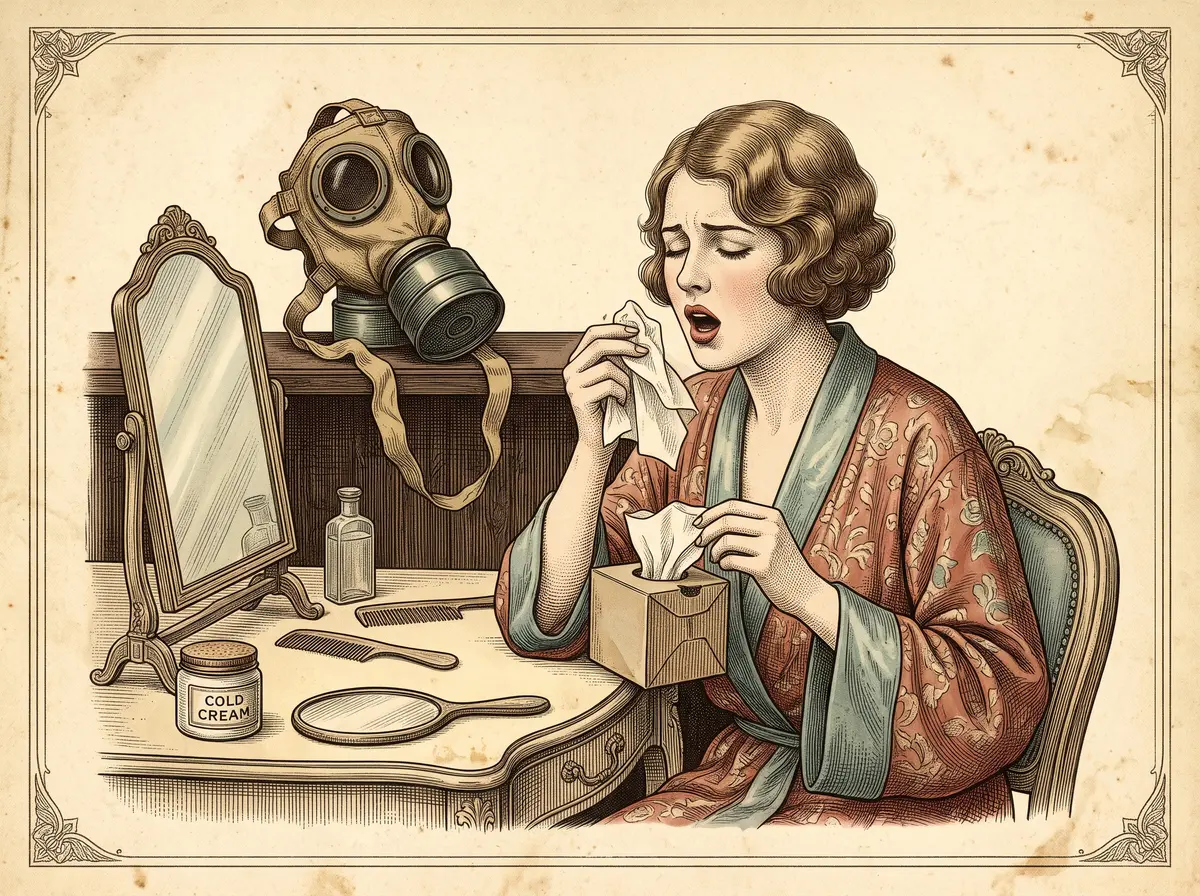
In 1924, Kimberly-Clark began selling a box of soft paper sheets with one carefully chosen job: wiping cold cream off your face. The ads promised beauty secrets from Hollywood makeup rooms. The customers had other ideas. Letters started arriving at the company saying, more or less, *this is great, but we've been blowing our noses in it.* The company that had built the world's most glamorous makeup remover had to decide whether to argue with its own buyers, or start selling them a handkerchief.
By the Curiosities Desk · · 5 min read · Filed under Medicine · Today’s round
What happened: The History of Kleenex
The paper started out in a war. During World War I, the Wisconsin papermaker Kimberly-Clark had a creped wood-pulp material it called Cellucotton, which company executive Ernst Mahler had trademarked after seeing similar materials in European mills in 1914. Mahler convinced the U.S. surgeon general’s office that it could stand in for scarce surgical cotton as a wound dressing. He also suggested a flattened version could serve as a filter inside gas masks. That project, according to the company’s own history, ended when the war did in 1918.
So the company had a soft, absorbent paper and no war to use it in. Its first peacetime idea, in the early 1920s, was a menstrual pad called Kotex. Its second was a thinner, gentler sheet for a very 1920s problem. Many women cleaned their faces with cold cream rather than soap and water, then wiped it away with a “cold cream towel” that had to be laundered, and was not especially clean between washes.
In 1924, Kleenex arrived to replace that towel. A box of 100 sheets, each about 6 by 7 inches, sold for 65 cents. The trademark filing described the product, in full, as “absorbent pads or sheets for removing cold cream.” Ads called it “the sanitary cold cream remover,” and featured actresses such as Helen Hayes removing stage makeup “the scientific way.”
Then the mail came in. People reported using the sheets for colds and hay fever. In 1927 Kimberly-Clark began cautiously suggesting the sheets as “absorbent kerchiefs,” while still mainly selling them for makeup.
The next part is the company’s favorite story, and it should be treated as a company story. As it’s usually told, Kimberly-Clark ran a test in a newspaper in Peoria, Illinois: one version of the ad pitched Kleenex for cold cream, another pitched it as a handkerchief, and readers were asked to say how they used it. Roughly 60 percent said they blew their noses in it. Retellings disagree on the year (1926 and 1930 both appear) and on whether the figure was 60 or 61 percent, and the original newspaper data is rarely cited. What’s well documented is the result: by 1930, the company had flipped its marketing to “the handkerchief you can throw away,” and later slogans warned, “Don’t put a cold in your pocket.”
In 1929 the company added a pop-up box that fed one sheet up as you pulled the last one out. Paper meant for the vanity table had moved to the nightstand.
Why it was strange: The History of Kleenex
Most products are designed for a problem and then sold for it. Kleenex is the reverse: the customers discovered what it was for, and the company caught up. A material engineered to filter poison gas became a cosmetic, and the cosmetic became a medical-adjacent product, without the paper itself really changing.
It’s also strange how unglamorous the winning use was. The company spent years tying its tissue to movie stars and makeup studios. The public quietly decided the best thing about it was that you could sneeze into it and throw it away.
For another everyday medical object that began as an improvised bit of paper, see The Rolled-Up Paper That Became the Stethoscope.
What scientists learned: The History of Kleenex
The “throw it away” pitch landed because of germ theory, the idea, accepted by the late 1800s, that many diseases are spread by microbes. A cloth handkerchief, used all day and then stuffed back into a pocket, kept whatever came out of your nose close at hand. Kleenex ads in the early 1930s leaned hard on that worry, and some pitched the tissues to schools and offices as a way to limit the spread of colds.
Later research gave that worry real weight, though in a way the ads didn’t quite predict. In a 1978 study at the University of Virginia, Jack Gwaltney and colleagues infected volunteers with rhinovirus, the most common cause of colds, and then tested how it spread. Brief hand contact with an infected person, followed by the recipient touching their own nose or eyes, caused infection in 11 of 15 tries. Exposure to large airborne droplets infected 1 of 12, and fine aerosols infected none in their setup. Virus turned up on 65 percent of the donors’ hand rinses.
The lesson isn’t that a tissue magically stops colds. It’s that what happens to your hands after you blow your nose matters a great deal, which is why a disposable tissue only helps if it actually goes in the trash and you wash up afterward.
For a time when a household product sold Americans on a different bodily fear, see The Floor Cleaner That Taught America to Fear Its Own Breath.
How it reaches us today: The History of Kleenex
Public health advice still follows the Kleenex playbook almost word for word. The CDC’s guidance for coughs and sneezes is to cover your mouth and nose with a tissue, throw the used tissue in the trash, and wash your hands, or to use your elbow if no tissue is handy.
The brand also became so dominant that “kleenex” now appears in dictionaries as a common word for any facial tissue, a fate trademark lawyers call “genericide” and companies work hard to avoid. And the first use never fully went away: a lot of tissues still end their day carrying makeup, just as the 1924 ads intended.
For another everyday medical product that came out of an unexpected source, see The Toy Construction Set That Made the First Soft Contact Lenses.
A gas-mask filter that became the tissue in the box belongs with The Ordinary Object With the Strange Origin.
Fun fact: The History of Kleenex
Europeans were startled by disposable nose paper three centuries before Kleenex. When a Japanese embassy led by Hasekura Tsunenaga stopped in Saint-Tropez in 1615, local letters noted that the visitors blew their noses into sheets of paper and then threw them away.
Sources: The History of Kleenex
- Kimberly-Clark, “Protection You Can Throw Away: The Evolution of Facial Tissue” — company history (primary source)
- Kleenex, “Our History” — Kimberly-Clark brand timeline (primary source)
- Gwaltney, J.M., Moskalski, P.B., and Hendley, J.O., “Hand-to-Hand Transmission of Rhinovirus Colds” — Annals of Internal Medicine 88, no. 4 (1978)
- Centers for Disease Control and Prevention, “Healthy Habits: Coughing and Sneezing”
- Embassy of Japan in France, “Hasekura Tsunenaga, premier Japonais à avoir foulé le sol français” (in French)