The Toy Construction Set That Made the First Soft Contact Lenses
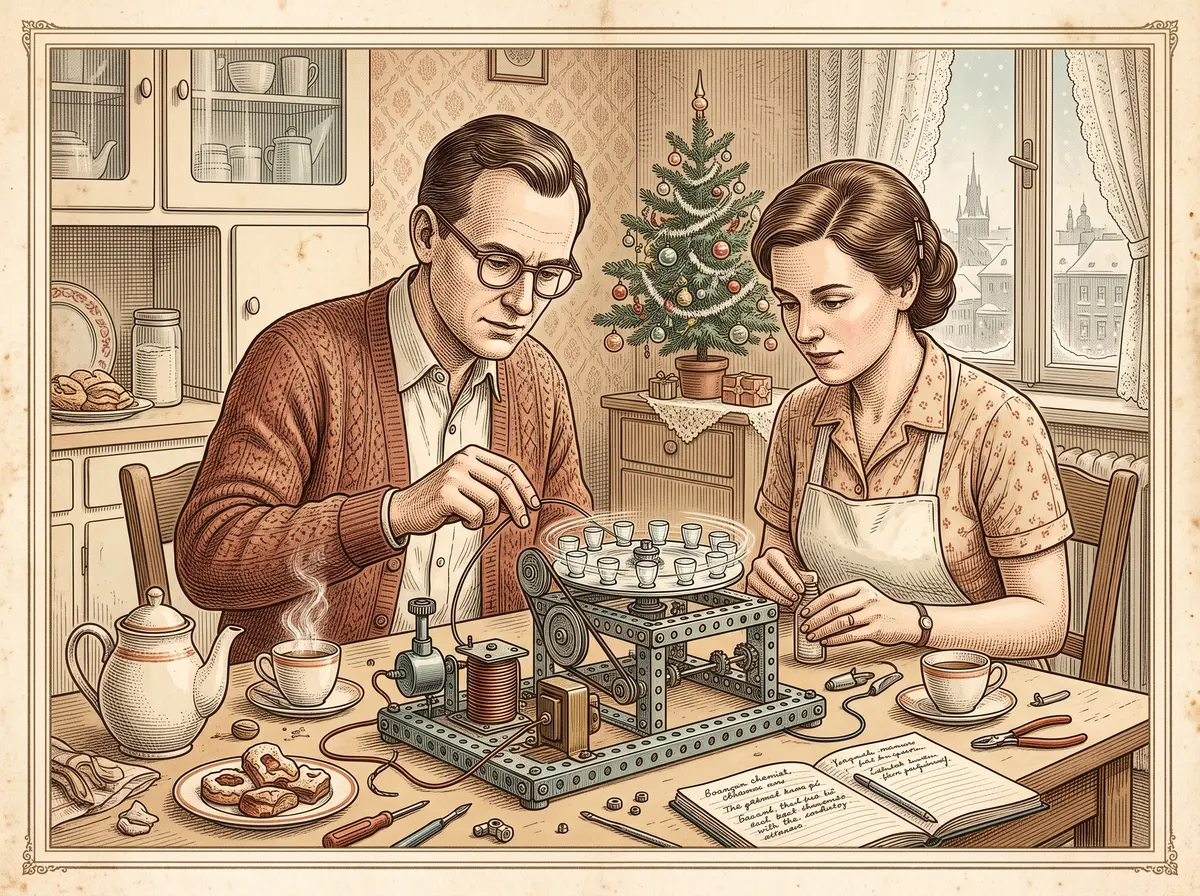
Around Christmas 1961, at a kitchen table in Prague, a chemist bolted together a whirling little machine out of his son's Merkur toy construction set, a bicycle dynamo, and a doorbell transformer. Out of it came the first four soft contact lenses, and the chemist, Otto Wichterle, tried them in his own eyes.
By the Curiosities Desk · · 5 min read · Filed under Medicine · Today’s round
What happened: Soft Contact Lenses
Otto Wichterle was a Czech organic chemist, already known for helping invent silon, Czechoslovakia’s answer to nylon, in 1941. In the early 1950s, on a train to Prague, he got talking with an ophthalmologist about materials that could sit inside the human eye. Metals and hard plastics irritated living tissue. What the body seemed to tolerate best was something soft and wet.
So Wichterle went looking for a plastic that behaved like living tissue. In the mid-1950s, working with his laboratory assistant Drahoslav Lím, he made poly(2-hydroxyethyl methacrylate), now called polyHEMA. It was clear and firm when dry, but it soaked up water, around 40 percent of its weight, and turned into a soft, flexible gel. That kind of water-swollen network of polymer chains is called a hydrogel. On 9 January 1960, Wichterle and Lím published “Hydrophilic Gels for Biological Use” in the journal Nature, and they suggested a few uses, including contact lenses.
Politics kept getting in the way. In 1958 Wichterle was pushed out of Prague’s University of Chemical Technology during a purge of “politically unreliable” staff. He landed on his feet and founded the Institute of Macromolecular Chemistry at the Czechoslovak Academy of Sciences. Then, according to Czech Radio, early in 1961 the country’s Ministry of Health canceled the contact lens research.
Wichterle kept going at home. The early lenses, cut from the gel or pressed in molds, came out with uneven edges and tore easily. He wanted a cleaner method, and he found it in spin casting. Pour a small amount of liquid starting material into a curved mold and spin it. The spinning flings the liquid outward into a smooth, bowl-shaped film, and the speed of the spin sets the curve. Let it harden into a gel and you have a lens.
What he needed was something that could spin a row of small molds steadily for hours. What he had was a Merkur set, a Czech metal construction toy of perforated strips, nuts, and bolts, much like an Erector set. According to the account summarized by the Czech Academy of Sciences archive and the biographies that draw on it, Wichterle built the apparatus from the Merkur parts, powered it with one of his sons’ bicycle dynamos run as a motor, and fed it through a bell transformer, the kind used for doorbells. Some tellings say a gramophone motor did the spinning. Czech Radio’s version says the dynamo came first and the gramophone motor later, which may explain why both turn up.
On Christmas afternoon in 1961, with his wife, Linda Wichterlová, a dentist, he got it working on their kitchen table. Those first four lenses went into his own eyes. Then the household turned into a small factory. Linda took shifts at the machine, and over the first months of 1962 the couple turned out thousands of lenses by hand.
Why it was strange: Soft Contact Lenses
Contact lenses had existed since the 1880s, first as heavy shells of blown glass and later as rigid plastic. They were the work of glassblowers and precision lathes. The version that eventually won was first made by a chemist who had been told to stop, using a children’s toy, at home, on a holiday.
The machine wasn’t really a toy, of course. Merkur parts were sturdy and precise enough to hold a spinning shaft steady, and Wichterle needed exactly that. The leap was in the material, not the hardware. Earlier lenses were hard objects that the eye had to put up with. Wichterle’s lens was mostly a water-filled gel that bent to fit the eye. If you like strange contact lens stories, there’s also The Rose-Colored Glasses Farmers Bought by the Million — for Their Chickens, whose sequel involved red contact lenses for hens.
What scientists learned: Soft Contact Lenses
The key idea is that a solid can be mostly water and still hold its shape. In a hydrogel, long polymer chains are lightly tied to one another at points called crosslinks. The ties keep the material from dissolving, while the gaps between the chains fill with water. Change how many crosslinks there are and you change how soft, how stretchy, and how wet the material is.
That made polyHEMA one of the first plastics designed on purpose to sit comfortably against living tissue, or biocompatible. Spin casting added a second lesson: a cheap, repeatable process can matter as much as the invention itself, because a lens that can’t be made in quantity never reaches anyone’s eye. For an earlier case of a new plastic upending an everyday object, see The Billiard Ball Prize That Invented Plastic.
How it reaches us today: Soft Contact Lenses
The lenses entered production in Czechoslovakia, but the bigger market was overseas. In 1965 the U.S. company National Patent Development Corporation bought the American rights and licensed them to Bausch & Lomb, and in 1971 the U.S. Food and Drug Administration approved its soft lenses for sale. Science History Institute’s Distillations magazine reports that the patent had been sold for a “relative pittance,” and that neither Wichterle nor his country made much from it. The same year, he lost his institute directorship for refusing to take back his signature on the 1968 “Two Thousand Words” reform manifesto. After the 1989 Velvet Revolution, he was elected president of the Czechoslovak Academy of Sciences.
Modern lenses use improved hydrogels, many of them blended with silicone to let more oxygen through to the eye, but they follow his basic recipe. By one 2015 estimate, soft lenses make up roughly 80 percent of the contact lens market. More household objects with unlikely beginnings live at The Ordinary Object With the Strange Origin.
Fun fact: Soft Contact Lenses
At his former institute in Prague stands a bronze tree with more than 150 branches, one for each patent in Wichterle’s name.
Sources: Soft Contact Lenses
- Wichterle, O. & Lím, D. “Hydrophilic Gels for Biological Use.” Nature 185, 117–118 (1960): https://doi.org/10.1038/185117a0
- Science History Institute, Distillations, “Politically Unreliable: The State v. Otto Wichterle”: https://www.sciencehistory.org/stories/magazine/politically-unreliable-the-state-v-otto-wichterle/
- Archives of the Czech Academy of Sciences, “Otto Wichterle” (archived): https://webarchiv.lib.cas.cz/wayback/20161105231007/http://www.mua.cas.cz/en/otto-wichterle-695
- Radio Prague International, “Contact lenses – 1961’s Christmas present to the world”: https://english.radio.cz/node/8736952
- Chemistry International (De Gruyter, 2015), “Otto Wichterle: An Eye for Hydrogels”: https://www.degruyterbrill.com/document/doi/10.1515/ci-2015-0241/html