Accidental Discoveries · Archaeology
The Golden Ghost of Goblins' Hill — and the Real Gold Cape Workmen Found Inside It
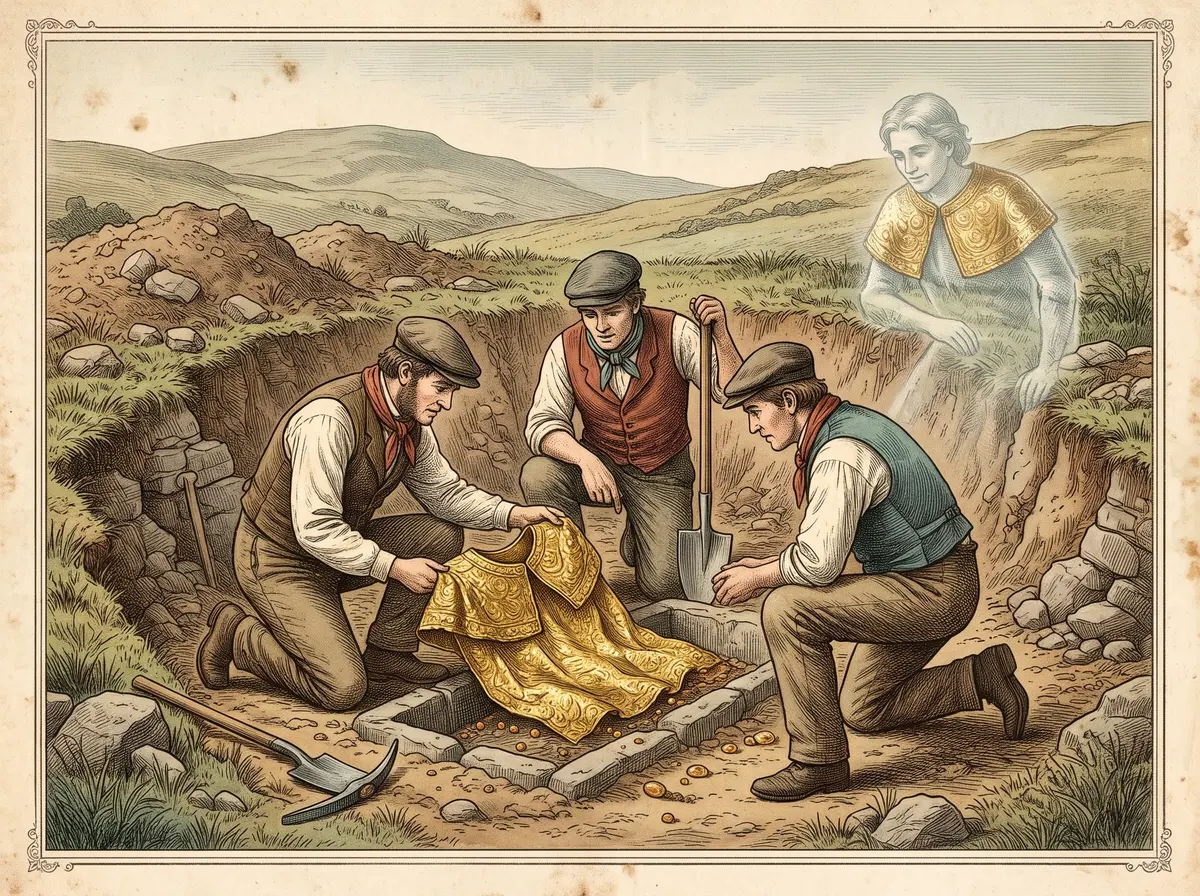
On October 11, 1833, workmen near Mold, in north Wales, were tearing apart a mound of stones and earth for road-building material when their tools turned up something that glittered. Wrapped around the crumbling bones of a long-dead person was a crushed sheet of gold. The mound already had a spooky name, Bryn yr Ellyllon, the "Goblins' Hill," and, according to the local vicar, a local woman had once claimed to see a ghost in a coat of gold walk into it.
By the Curiosities Desk · · 5 min read · Filed under Archaeology · Today’s round
What happened: The Mold Gold Cape
Bryn yr Ellyllon sat in a field about half a mile east-southeast of Mold’s parish church. In the 1830s nobody treated it as a monument. It was a convenient pile of stone, and men from the local workhouse were sent to dig it out for the roads.
Inside, they broke into a cist, a rough grave lined with stone slabs. In it lay the fragmentary remains of a skeleton with a crumpled mass of gold pressed around it. Strips of bronze, scraps of coarse cloth, a second gold object, and amber beads came out of the grave too. By some later estimates, the cape once carried two to three hundred of those beads in rows. Nearby was a pottery urn holding burnt bones.
What happened next would horrify an archaeologist today. The gold had once been fixed to a backing, probably leather, that had rotted away, so the fragile sheet broke apart as it came out. The pieces, along with many of the beads, were shared out between the workmen and Mr. John Langford, who rented the field. Some fragments were probably melted down. Of all those amber beads, exactly one ever reached a museum.
Langford held on to the largest pieces and sold three of them to the British Museum in 1836. Smaller fragments kept trickling in for well over a century. A man named George Lowe gave four gold scraps to the Grosvenor Museum in Chester in 1953, and the British Museum records other pieces from the site arriving as late as 1972.
The best early description came from the vicar of Mold, the Reverend Charles Butler Clough, who recorded what had been found. Even he had not been there when the grave was opened. As the archaeologist T. G. E. Powell pointed out in 1954, none of the three early accounts was written by an eyewitness.
Then there is the ghost. In a letter written after the discovery, Clough described an elderly woman who said she had seen a spectre “clothed in a coat of gold” cross the road and disappear into the mound. She told the story to Langford the next morning, Clough wrote, “many years ago.” It is a wonderful tale, but treat it as one. The only record of it comes after the gold was found, from a man who heard it secondhand, so there is no way to show that the sighting really came first.
Why it was strange: The Mold Gold Cape
Start with the ghost. Folklore and archaeology rarely line up so neatly: a hill named after goblins, a reported glowing figure, and then a real person buried in real gold. Whether the woman’s story was told before 1833 or polished afterward, it shows how people make sense of the old mounds in their landscape.
Then there is the object itself. For more than a century, nobody knew what it was. Some early experts thought it was a “corselet,” a piece of armor worn by a warrior. Others suggested it was a decorative covering for a pony’s chest. A crushed, scattered, half-missing piece of gold sheet is very hard to read.
The answer turned out to be stranger than either guess. For another treasure that set off rumors of a buried golden figure, see The Golden King Nobody Found Under Silbury Hill — and the Tunnels That Made It Cave In.
What scientists learned: The Mold Gold Cape
In 1954, Powell reexamined the pieces and argued that they made a cape, a garment draped over the shoulders. A major restoration at the British Museum in the 1960s confirmed it, and further work in 2002 filled in missing areas to show the complete shape.
The British Museum dates the cape to about 1900–1600 BC, in the Early Bronze Age, roughly the era when Stonehenge was still in use. It weighs about 560 grams and measures roughly 46 centimeters (18 inches) across. Its maker hammered it out of a single ingot of gold, then used repoussé, a technique of pushing a design out from the back, to raise ribs and bumps that imitate strings of beads lying among folds of cloth. Rows of tiny holes along the edges show where it was stitched to its lost lining.
The fit tells its own story. The cape would only suit a slender person, and it would have pinned the upper arms close to the body. Nobody could have worked or fought in it. It was almost certainly ceremonial, perhaps a sign of religious or political authority. So few bones survived that the wearer’s sex is unknown, but similar graves with beads and ornaments usually belong to women, so the British Museum suggests it may have been made for a young woman.
The story of how it was found also taught a lesson. Because the grave was dug for road stone, not studied, most of what could have told us who this person was has been lost for good.
More discoveries that began with someone looking for something else live in The Finds That Started on the Wrong Errand.
How it reaches us today: The Mold Gold Cape
The Mold cape is now considered one of the finest pieces of prehistoric goldwork in Europe, and it is on display at the British Museum. It also remains a point of debate. Politicians and campaigners in Wales have repeatedly called for it to return to north Wales, and in 2013 it went on loan to museums in Cardiff and Wrexham. Mold has a replica, and a plaque marks the site of the mound, where a house now stands.
The way it was scattered would also be handled differently now. Under the Treasure Act 1996, finders in England, Wales, and Northern Ireland must report gold and silver objects more than 300 years old, so a find like this would go to experts instead of being split up in the field.
For another precious find that spent years misunderstood by the people holding it, see The Roman Silver a Suffolk Family Piled With Fruit at Christmas — Because It Was Only ‘Pewter’.
Fun fact: The Mold Gold Cape
The entire cape, about 46 centimeters across and covered in ripples and bumps, was hammered out of one single lump of gold. No seams, no joins.
Sources: The Mold Gold Cape
- Cape (museum number 1836,0902.1), British Museum Collection
- Powell, T. G. E. “The Gold Ornament from Mold, Flintshire, North Wales.” Proceedings of the Prehistoric Society 19, no. 2 (1954): 161–179
- “The Mold Cape,” British Museum on Google Arts & Culture
- Bryn yr Ellyllon, Mold, Coflein (Royal Commission on the Ancient and Historical Monuments of Wales)
- Treasure Act 1996, legislation.gov.uk