Science Gone Wrong · Archaeology
The Golden King Nobody Found Under Silbury Hill — and the Tunnels That Made It Cave In
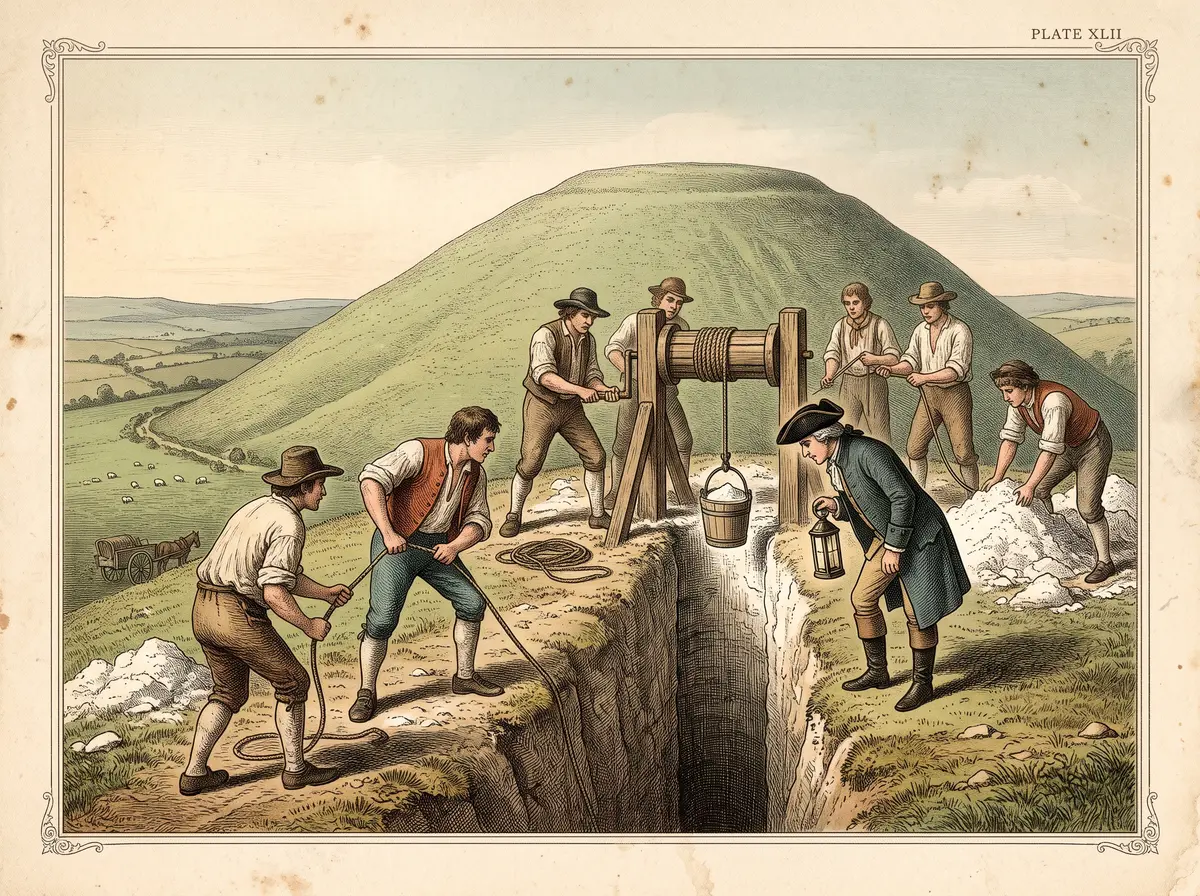
Over a holiday weekend in late May 2000, visitors to Silbury Hill, a 4,400-year-old chalk mound in Wiltshire, England, found a hole in the top of it. Soon, cavers were lowering themselves on ropes into the crater. Nothing had broken in from the outside. The hole had come from inside the hill: a shaft that treasure hunters had dug in 1776, searching for a burial that legend said came with a king made of gold.
By the Curiosities Desk · · 5 min read · Filed under Archaeology · Today’s round
What happened: The Golden King Nobody Found Under Silbury Hill — and the Tunnels That
Silbury Hill is the largest artificial prehistoric mound in Europe. English Heritage, which cares for the site, describes it as about 30 metres high and 160 metres across, built from roughly half a million tonnes of material, mostly chalk. It went up near the stone circles of Avebury at some point around 2400 BC, before the pyramids of Giza were very old.
Nobody knows what it was for, and for centuries that blank invited stories. Local legend said it was the resting place of a King Sil, buried with a life-size gold statue of himself on a golden horse. A hill that size, people reasoned, had to be covering something.
So in October 1776, with backing from Hugh Percy, Duke of Northumberland, Colonel Edward Drax brought in Cornish miners and had them sink a vertical shaft straight down from the summit to the centre. They were looking for the central burial. They found none. Accounts of the dig mention little more than a thin slip of oak wood at the bottom.
In 1849 the newly formed Archaeological Institute tried again from a different direction. Under John Merewether, dean of Hereford, miners drove a horizontal tunnel in from the side of the hill to its middle. Again, no burial. Merewether did record the old ground surface and layers of turf and soil, but the tunnel was never properly filled back in.
The third attempt was the most public. From 1968 to 1970 the BBC paid for the archaeologist Richard Atkinson to tunnel into Silbury once more, and it was broadcast as it happened; English Heritage calls it the first excavation televised as it progressed. Atkinson largely followed Merewether’s old route. Looking back years later, the people who made the programmes recalled filming on the hill with a newfangled hand-held camera, hoping that “something fantastic would happen.”
No golden king turned up. What did turn up was quieter and, to an archaeologist, more interesting: preserved turf, seeds, snails, pollen, beetles, and the remains of winged ants.
For thirty years after that, the hill looked fine. Then came the hole of May 2000. The 1776 shaft, assumed to have been safely backfilled, turned out to have reopened, its smooth sides leaving an open throat down into the mound. English Heritage says the crater on the summit was 14 metres deep. By March 2001 its mouth measured about 40 square metres, and it kept widening through the winter. It was capped with scaffolding and then plugged with blocks of white polystyrene.
Why it was strange: The Golden King Nobody Found Under Silbury Hill — and the Tunnels That
Every one of the three big digs was trying to learn what was inside Silbury Hill. Between them, they left it full of holes.
The shaft from the top and the tunnels from the side had all been left open, or only partly filled, inside a mound made largely of packed chalk. Over two centuries, rain and gravity went to work on the gaps. Surveys after 2000 showed the old tunnels were collapsing internally. The hill had kept its secret for about 4,000 years, and it took a little over 200 years of curiosity to put it at risk.
There is an old pattern here. Early excavators often dug in search of one spectacular object and treated everything else as rubble, much like The Man Who Found Troy — and Dug Straight Through It.
What scientists learned: The Golden King Nobody Found Under Silbury Hill — and the Tunnels That
The ants are the famous part. Atkinson argued that because winged ants fly in late summer, their presence in the turf meant building began in early August. It is a lovely idea, and it is still often repeated, but it should come with a caveat. Jim Leary, who directed English Heritage’s later fieldwork at the hill, has pointed out that Atkinson found ants and found wings, but not wings attached to ants. In Leary’s words, “we just don’t know what time of year people were working on the mound.”
The fix for the collapse turned into one last chance to look inside. In 2007 English Heritage and the engineering firm Skanska reopened the 1968 tunnel, recorded every exposed layer, and took hundreds of samples. Then they filled the old tunnels and voids with hundreds of tonnes of chalk, finishing in early 2008. “What we are doing inside is the last chance anyone will ever get,” Leary said at the time.
New radiocarbon dating changed the story of the hill. Rather than a few big building phases, the evidence suggested work began around 2450 BC and continued for somewhere between 55 and 155 years, perhaps four or five generations. Leary and his colleague David Field have suggested that the building itself may have mattered more than the finished hill. Moving that much chalk is an ancient puzzle in its own right, as The Bluestone Bound for Stonehenge That Sank 17 Miles Into a 240-Mile Trip shows.
How it reaches us today: The Golden King Nobody Found Under Silbury Hill — and the Tunnels That
Silbury Hill became a case study in why modern archaeology prefers to look before it digs. After 2000, English Heritage relied heavily on non-invasive methods, including seismic survey, which sends vibrations through the ground and reads the echoes, to judge how damaged the hill was before anyone went back in. Today the mound is closed to climbers, and visitors view it from a nearby viewing area to protect it.
It is also a reminder that “finding nothing” is a result. Three digs went in hoping for treasure. The lasting discoveries were beetles, snails, grass, and a much better sense of how long the work took. A similar mix of grand hopes and blunt tools runs through The Colonel Who Opened the Great Pyramid With Gunpowder — and Got His Drill Stuck in the Sphinx.
Fun fact: The Golden King Nobody Found Under Silbury Hill — and the Tunnels That
Drax’s own letters about the 1776 dig sat unnoticed in the British Library for more than 230 years. When they resurfaced in 2010, they described his miners striking a narrow cavity, about six inches wide, running down through the middle of the hill. “Something now perished must have remained in this hole to keep it open,” he wrote, which has led some researchers to suggest the mound was built around a tall wooden post.
Sources: The Golden King Nobody Found Under Silbury Hill — and the Tunnels That
- English Heritage, “History of Silbury Hill” — official site history, including dimensions, the 1776, 1849, and 1968–70 excavations, and the May 2000 collapse.
- Amanda Chadburn, Fachtna McAvoy, and Gill Campbell, “A green hill long ago”, British Archaeology (January/February 2005) — English Heritage archaeologists on the 1776 shaft, the Merewether tunnel, Atkinson’s Chronicle dig, and the 29 May 2000 hole.
- “The many faces of Silbury Hill”, Current Archaeology — Jim Leary on the winged ants, the size of the 2000 collapse, and the revised dating.
- “Silbury Hill: A last look inside”, Current Archaeology — on the 2007–08 conservation work and backfilling.
- “Silbury Hill” news report, 16 February 2010, Stone Pages Archaeo News — news summary of Drax’s rediscovered 1776 letters, including his description of the central cavity.