Impossible Inventions · Archaeology
The 70 Greek Sailors Who Tried to Burn a Ship With Mirrors — to Test Archimedes' Death Ray
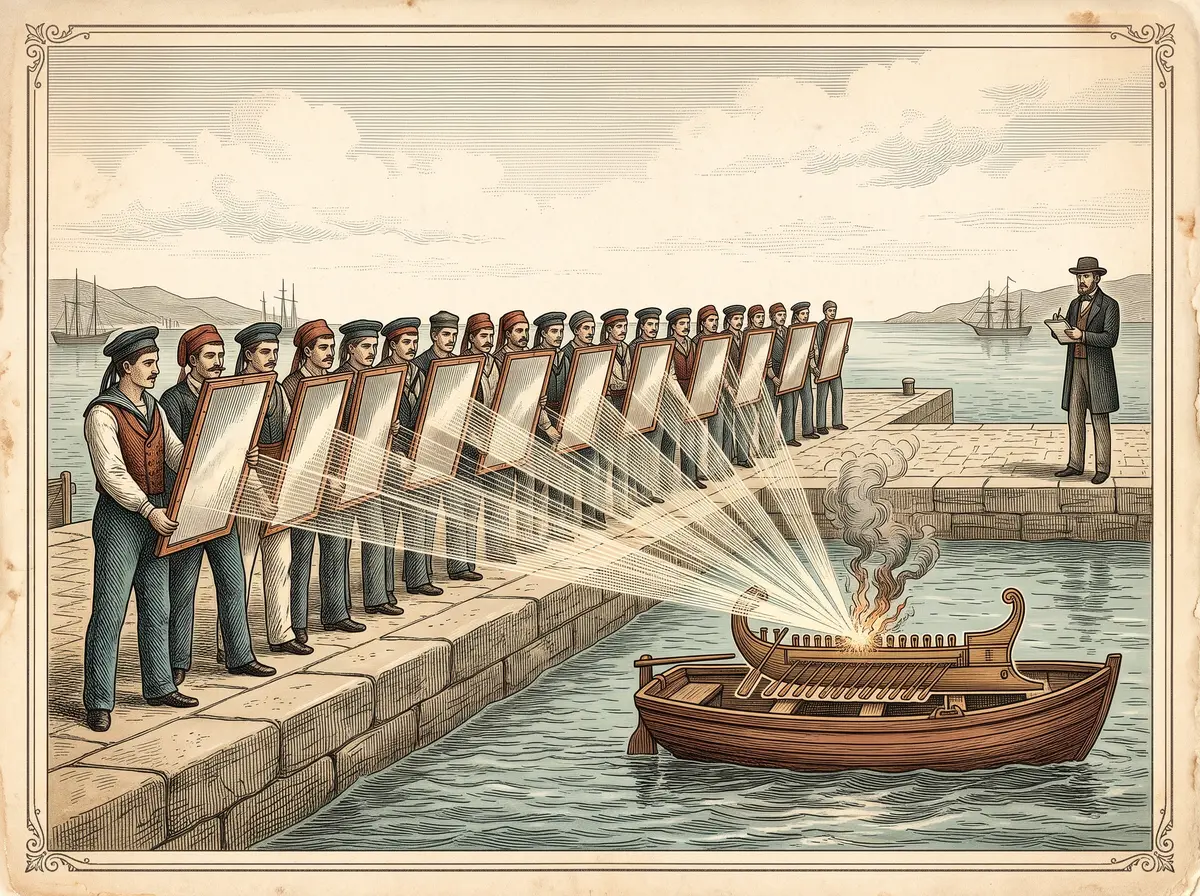
In early November 1973, at the Skaramanga naval base outside Athens, about 70 Greek sailors lined up along a pier, each holding a flat mirror roughly the size of a door. Out in the water, 160 feet away, bobbed a wooden rowboat wearing a tar-painted plywood costume shaped like a Roman warship. On a signal, the sailors tilted their mirrors toward it. According to *Time* magazine's report, the boat started smoking within two or three seconds. Soon it was in flames. The man in charge, engineer Ioannis Sakkas, was testing a 2,000-year-old legend.
By the Curiosities Desk · · 5 min read · Filed under Archaeology · Today’s round
Part of Built to Do the Impossible
What happened: The Archimedes Mirror Test
The legend begins with a real war. From 214 to 212 BC, a Roman army and fleet under the general Marcus Claudius Marcellus besieged Syracuse, a wealthy Greek city on the island of Sicily. Syracuse’s secret weapon was its most famous resident, the mathematician Archimedes, then in his seventies. He designed defensive machines that made the Roman fleet miserable.
The ancient historians who wrote closest to the siege, Polybius, Livy, and Plutarch, describe those machines in detail. Plutarch, writing about three centuries later, tells of catapults that hurled huge stones and of cranes that dropped weights onto ships. Most dramatic was a device later nicknamed “Archimedes’ claw,” an iron grapple on a beam that could seize a ship’s bow, lift it out of the water, and drop it. What none of these writers mention is mirrors.
The fire comes later. By the second century AD, writers such as the satirist Lucian were saying that Archimedes had burned the Roman ships, nearly four centuries after the siege. Explicit descriptions of mirrors appear later still, in the sixth-century engineer Anthemius of Tralles and in the twelfth-century Byzantine writers John Zonaras and John Tzetzes. Tzetzes describes a large six-sided mirror surrounded by smaller movable ones that turned the ships “into ashes” at the distance of a bow-shot. No such account survives in Archimedes’ own writings. So the “death ray” is best treated as a legend, one that grew in the telling.
People have argued over it for centuries. Around 1747 the French naturalist Georges-Louis Leclerc, Comte de Buffon, decided to test it. He mounted ordinary looking glasses, each eight by six inches, on a frame and aimed them together. With 128 of them in clear sun, he set a tarred plank alight 150 feet away.
Ioannis Sakkas, a 48-year-old engineer and solar-energy specialist who had worked for Greece’s state power company, came at the problem as a practical question. Anthemius had suggested one big hexagonal mirror, but Sakkas judged that far beyond what Archimedes’ Syracuse could build. Greeks of that era did not mass-produce glass mirrors. They did, however, have plenty of polished bronze, including soldiers’ shields. Perhaps, Sakkas reasoned, Archimedes simply lined his men up on the walls and had them aim their shields at the ships.
With encouragement from the historian Evangelos Stamatis, Sakkas persuaded the Greek navy to lend him the sailors, the site, and a target. His mirrors were flat panels about 5 feet long and 3 feet wide, each covered with a thin sheet of polished copper and light enough for one person to handle. Once the sailors had their reflections overlapping on the plywood galley, it went up quickly.
Sakkas noted that Archimedes’ defenders would have stood on high walls, not a sea-level pier. He also conceded that real Romans would hardly have sat still waiting to be set on fire.
Why it was strange: The Archimedes Mirror Test
It sounds like science fiction, yet the physics is simple. A flat mirror does not focus light. It only redirects a patch of sunlight about its own size. But dozens of patches piled onto the same spot add up. With enough mirrors and steady aim, the target heats until it chars and catches fire, the same principle used in today’s solar power towers.
What made the experiment strange is that it worked so easily. Sakkas’s ship was coated in tar, a forgiving target, and the boat sat still. Real warships move, the sun moves, and clouds drift across the sky. A demonstration showing something can happen is not proof that it did happen at Syracuse.
Archimedes wasn’t the only ancient Greek engineer whose inventions sound too clever for their time. Consider The Ancient Greek Robot Maid Who Poured Your Wine — and Then Quietly Watered It Down.
What scientists learned: The Archimedes Mirror Test
Later tests found out how much depends on the conditions. In 2005, mechanical engineering students in David Wallace’s course at the Massachusetts Institute of Technology built a mock ship section from red oak and aimed 127 one-foot-square mirrors at it from a parking-garage roof, about 100 feet away. A first try under hazy clouds produced only wisps of smoke. On the second, the oak finally burst into open flame less than ten minutes after the sun broke into a clear patch of sky.
When the MIT group repeated the test for the TV show MythBusters in 2006, on a real wooden boat in San Francisco, they managed some charring and a small flame. The show judged the death ray “busted” because it needed too much time and too-perfect weather. Ordinary flaming arrows, it noted, would have done the job faster.
The broad lesson is that a mirror array is possible in principle but finicky in practice. It needs bright sun, a target that holds still, flammable surfaces, and a lot of coordination. Whether Archimedes ever tried it remains unknown.
Ancient Greek engineering has surprised modern researchers before, most famously in The 2,000-Year-Old Computer Found in a Shipwreck.
How it reaches us today: The Archimedes Mirror Test
The thinking behind Sakkas’s pier is now a working technology. Concentrated solar power plants use fields of flat, computer-steered mirrors, called heliostats, to pile sunlight onto a single receiver. The receiver gets hot enough to make steam and generate electricity. Each heliostat is essentially one of Sakkas’s sailors, except it never gets tired and adjusts its aim as the sun moves across the sky.
The legend also lives on as a classic exercise in experimental archaeology, in which researchers test claims about the past by rebuilding ancient technology.
Mirrors have tempted bigger dreamers too. One wanted to aim one at another planet: The Poet Who Wanted to Say Hello to Mars With a Giant Mirror — and Nearly Beat Edison to the Phonograph. The test sits with the other machines asked to do the impossible, in Built to Do the Impossible.
Fun fact: The Archimedes Mirror Test
In 2010, President Barack Obama asked the MythBusters hosts to take one more crack at the legend. They recruited 500 student volunteers with mirrors to aim at a mock Roman ship about 400 feet away. The sail never got hot enough to burn.
Sources: The Archimedes Mirror Test
- Time, “Science: Archimedes’ Weapon” (November 26, 1973): https://time.com/archive/6842017/science-archimedes-weapon
- Plutarch, Life of Marcellus, chapter 15 (Archimedes’ machines at the siege of Syracuse): https://lexundria.com/plut_marc/15/prr
- MIT 2.009, “Archimedes Death Ray: Idea Feasibility Testing — Results” (2005): https://web.mit.edu/2.009_gallery/www/2005_other/archimedes/10_ArchimedesResult.html
- Greg Gbur, “Mythbusters were scooped — by 130 years! (Archimedes death ray),” Skulls in the Stars (2010), on Buffon’s experiments and the ancient sources: https://skullsinthestars.com/2010/02/07/mythbusters-were-scooped-by-130-years-archimedes-death-ray/
- Discovery Communications, “President Obama to Appear on MythBusters” (2010): https://press.discovery.com/us/dsc/press-releases/2010/president-obama-appear-mythbusters-wednesday--1003