Impossible Inventions · Archaeology
The Roman Cart That Dropped a Pebble Into a Bronze Bowl Every Mile — If It Ever Rolled at All
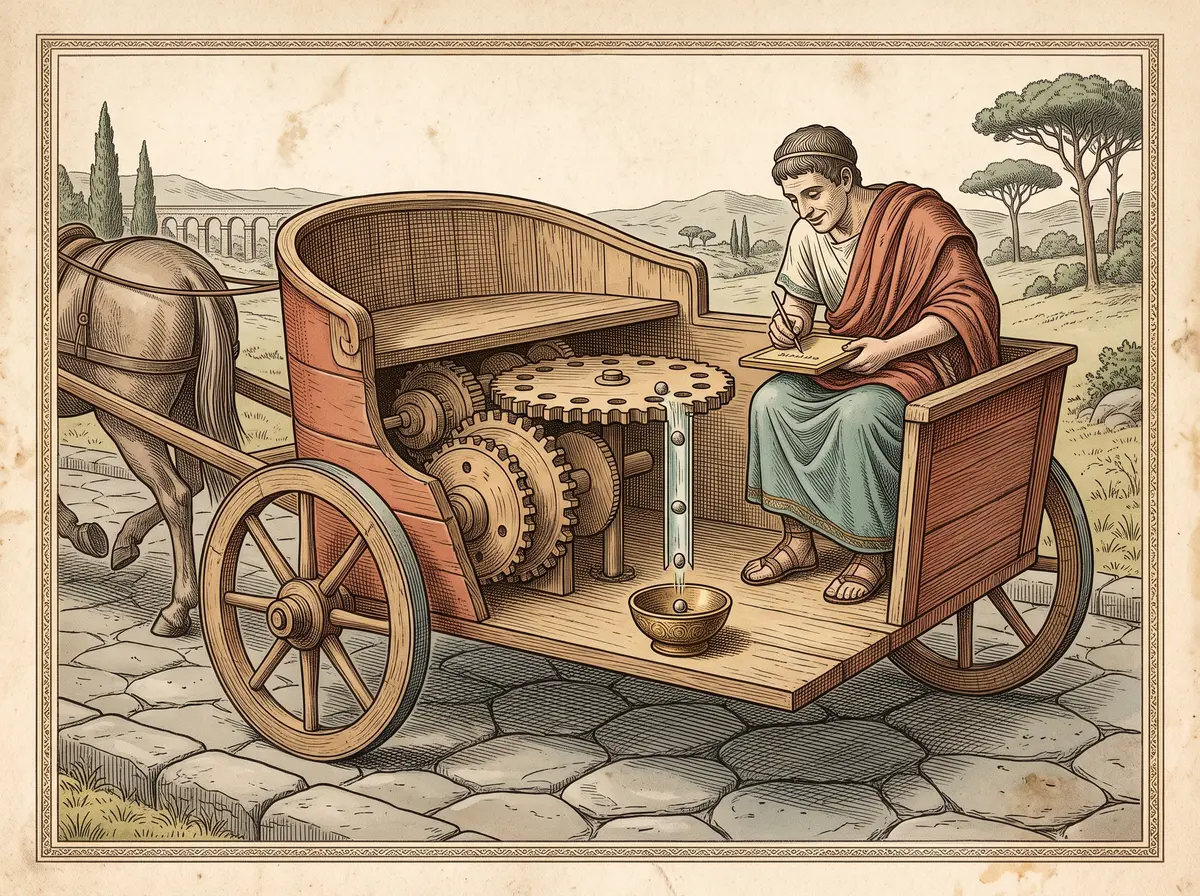
Picture the carriage the Roman engineer Vitruvius described in the decades before 1 BC, rattling down a stone road. Somewhere beneath the passenger seat, gears creak around one notch at a time. Then, every Roman mile, a small round pebble rolls out of a hole, drops down a tube, and lands with a clink in a bronze bowl. At the end of the day, you don't read a dial to learn how far you've come. You tip out the bowl and count the stones.
By the Curiosities Desk · · 5 min read · Filed under Archaeology · Today’s round
Part of Built to Do the Impossible
What happened: The Roman Odometer
The machine comes from Vitruvius, a Roman architect and military engineer who wrote De Architectura (On Architecture), a ten-book handbook dedicated to the emperor Augustus and usually dated to the decades just before 1 BC. Most of it covers temples, building materials, and city planning. But Book 10 is about machines: water wheels, pumps, siege engines. In chapter 9, Vitruvius describes what he presents as a useful and ingenious invention handed down by earlier engineers: a way of knowing, while sitting in a carriage, how many miles you have traveled.
His instructions are specific. Fit the carriage with wheels 4 feet across. Each turn of the wheel then covers, by his reckoning, 12½ feet, so 400 turns make 5,000 feet, one Roman mile (about 1.48 kilometers). Attach a drum with a single tooth to the inside of the wheel’s hub. Every time the wheel turns, that tooth nudges a second drum, set in a box above it, forward by one notch. The second drum has 400 notches, so it makes one full turn per mile.
The second drum drives a third, laid flat and drilled with a ring of holes, each holding a small round stone. Beneath it sits a fixed plate with one opening and a pipe. Each time a mile passes, a hole lines up with the opening, a stone drops through the pipe, and it falls into a bronze vessel in the body of the carriage with a sound you could hear. Counting the stones, Vitruvius says, tells you the day’s mileage.
Then he goes further. The same gearing, he writes, works at sea: mount 4-foot paddle wheels on an axle through the hull, let the water push them around as the ship moves, and the pebbles will count nautical miles too. He ends the chapter by noting that machines like these were for use and amusement in times of peace.
Did anyone actually ride one? The best evidence is thin. The Historia Augusta, a collection of imperial biographies, describes the auction of the late emperor Commodus’s belongings in 193 CE, and among his fancy carriages it lists “others that measured the road and showed the time.” The Historia Augusta is famously unreliable, though, and it describes no pebbles or gears. Hero of Alexandria, a Greek engineer of the first century CE, described a similar distance-measuring device in a surveying treatise called the Dioptra. Beyond those written descriptions, archaeologists have not identified a single surviving gear, drum, or bronze bowl from an ancient odometer.
Why it was strange: The Roman Odometer
On paper, Vitruvius’s machine is simple. Built in wood, it gets hard fast. A 400-notch drum turned by a single tooth needs to be either huge or covered in tiny, fragile teeth. That is exactly the problem Leonardo da Vinci ran into about 1,500 years later. On the first page of his Codex Atlanticus, he sketched odometers modeled on Vitruvius’s description. A 2020 study by engineers at the Polytechnic University of Marche in Italy argues that one of those sketches follows Vitruvius, while another quietly swaps the single tooth for a worm gear (a screw that turns a toothed wheel), as if Leonardo had decided the original wasn’t practical.
So for centuries the most detailed description of a Roman odometer was also a bit of a puzzle: a confident, precise recipe for a machine nobody could find, from a writer who may never have seen one himself.
For a Chinese carriage whose famous machinery got questioned too, see The South-Pointing Chariot That Needed a Man Hidden Inside to Point South.
What scientists learned: The Roman Odometer
In 1979 and 1981, the Dutch historian of technology André Wegener Sleeswyk took a closer look. He argued that the trouble lay less with Vitruvius than with how later readers pictured the teeth. Renaissance-style square teeth jam. So he built a working model with pointed, triangular teeth like those on the Antikythera mechanism, the bronze Greek gearbox recovered from a shipwreck, and reported in Scientific American that it ran. He also suggested Vitruvius’s “single tooth” might describe something more like a worm, and that the device could go back to Archimedes in the third century BC. That attribution is a hypothesis; nothing about an odometer appears in Archimedes’s surviving writings.
The deeper lesson is about how ancient engineers counted. The odometer is a gear train used for arithmetic: a wheel’s turns get divided by 400, and the result is stored as physical objects. The same idea of turning motion into countable steps runs through the Antikythera mechanism, too.
For that shipwreck gearbox itself, see The 2,000-Year-Old Computer Found in a Shipwreck.
How it reaches us today: The Roman Odometer
The word “odometer” comes from the Greek for “way measure,” and the basic logic in Vitruvius’s chapter, wheel turns to gears to a running count, survived in mechanical car odometers well into the late 20th century. Surveyors still push measuring wheels that click off distance one rotation at a time, and a ship’s log still measures speed through the water.
China built its own version independently: the “li-recording drum carriage,” on which wooden figures struck a drum every li (about half a kilometer) and a bell every ten. Different gears, same instinct to make a machine count the road.
For another Alexandrian gadget built on the same mechanical cleverness, see The Coin-Operated Holy Water Machine That Beat the Vending Machine by 1,800 Years.
Whether or not the pebble cart ever rolled, it belongs with the machines in Built to Do the Impossible.
Fun fact: The Roman Odometer
Vitruvius’s math quietly treats pi as 3.125: a 4-foot wheel actually rolls about 12.57 feet per turn, not 12½, so a cart built to his numbers would actually roll about 26 feet (8 meters) past each mile before dropping its pebble.
Sources: The Roman Odometer
- Vitruvius, The Ten Books on Architecture, Book 10, chapter 9 — trans. Morris Hicky Morgan, 1914 (primary source)
- Historia Augusta, Life of Pertinax, 8.6–8.7 — LacusCurtius, University of Chicago (primary source)
- André Wegener Sleeswyk, “Vitruvius’ Odometer” — Scientific American 245(4), October 1981
- M. Callegari, S. Brillarelli, and C. Scoccia, “Archimedes, Vitruvius and Leonardo: The Odometer Connection” — Advances in Historical Studies 9(5), 2020
- “Odometer (distance-measuring device)” — Museo Leonardiano, Vinci (model based on Codex Atlanticus f. 1r)