The Poet Who Wanted to Say Hello to Mars With a Giant Mirror — and Nearly Beat Edison to the Phonograph
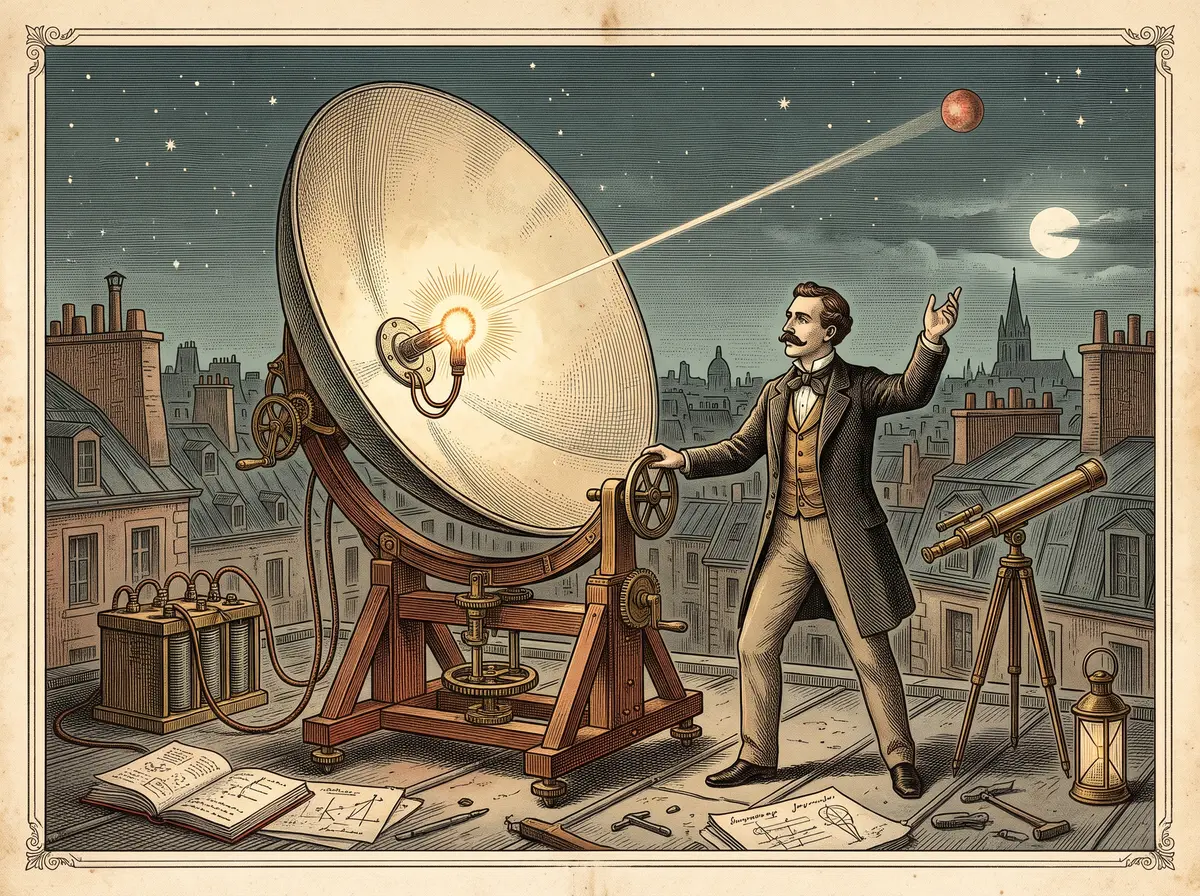
In 1869, the Paris poet Charles Cros, a medical-school dropout in his mid-twenties with a habit of inventing things, published a study with a breathtakingly simple plan for meeting the neighbors. Tiny points of light had been seen on Mars and Venus. He was fairly sure they were cities. So, he reasoned, why not build an enormous mirror, point it across tens of millions of kilometers of space, and flash them a greeting?
By the Curiosities Desk · · 5 min read · Filed under Space · Today’s round
Part of Built to Do the Impossible
What happened: Charles Cros's Mars Signal
The poet was Charles Cros, born in 1842 in Fabrezan, in southern France. He started medical studies in 1860, abandoned them, and threw himself into two careers at once: verse and invention. In literary Paris he was a friend of Paul Verlaine and part of the circle that met Arthur Rimbaud in 1871. In science, he worked on problems most people had not yet realized were solvable.
In 1869 he published Études sur les moyens de communication avec les planètes (“Studies on the Means of Communication With the Planets”). Its premise grew from what astronomers were reporting at the eyepiece: occasional bright specks on Mars and Venus. Cros was convinced these were the lights of large cities rather than sunlit clouds.
If someone over there was lighting up the night, Cros argued, Earth could answer. Accounts of his exact design differ, and it’s worth being careful here. Historian of science Florence Raulin-Cerceau, who has studied the original texts, describes Cros proposing to focus the light of electric lamps with a parabolic mirror (a dish-shaped mirror that gathers light into a tight beam, like a car headlight) and to switch it on and off so the flashes encoded a message. He admitted the planets might hold beings unable to reply, yet he still believed the “eternal isolation of the spheres” would be overcome.
A more dramatic version shows up in later retellings, popularized in the 1950s by the rocket historian Willy Ley: Cros spent years lobbying the French government for a colossal mirror that would focus sunlight onto the Martian desert and literally burn giant figures into the sand. Britannica’s summary of the book also describes a huge concave mirror fusing patterns into a planet’s surface. The burning-mirror story is now the famous one, but the details of any petitions are thinly documented, so treat the lobbying campaign as the legend’s version rather than settled fact. Either way, nothing was ever built.
Cros was not the first dreamer here. The mathematician Carl Friedrich Gauss is often credited, without firm documentation, with suggesting around 1820 that giant geometric shapes be planted in the Siberian forest. Astronomer Joseph Johann von Littrow is said to have proposed burning kerosene in vast trenches across the Sahara. Cros was among the first to suggest using light beams rather than landscaping.
Meanwhile, he kept inventing. He developed an early theory of color photography, presenting it to the French Society of Photography on May 7, 1869, the same day Louis Ducos du Hauron independently presented a similar method. And on April 30, 1877, Cros deposited a sealed envelope with the French Academy of Sciences describing a machine to record and play back sound, which he called the paleophone, “voice of the past.” He had not built one when, that December, Thomas Edison recorded his voice on a tinfoil phonograph. Edison got the patent. Cros died in Paris in August 1888, aged 45.
Why it was strange: Charles Cros's Mars Signal
Cros was not a crank on the margins. He was a serious, original thinker whose sound-recording idea was sound enough that he nearly beat Edison to it. Yet he looked at a few blurry specks through 19th-century telescopes and saw streetlights.
What makes the scheme more than a curiosity is its logic. Cros treated contact with another world as an engineering and language problem: How do you send a signal that cannot be mistaken for nature, to someone who shares none of your words? That is exactly the question modern researchers still ask.
For another idea that turned sunlight into a signal, see The Giant Space Mirror Russia Built to Turn Night Into Day — and the Antenna That Snagged the Sequel.
What scientists learned: Charles Cros's Mars Signal
First, the cities were not cities. The bright patches seen on Mars are clouds, haze, and frost catching the sunlight. Venus has its own puzzle, the “ashen light,” a faint glow sometimes reported on its night side; it has never been confirmed and may be an illusion of the eye.
Second, the physics was against the burning mirror. The Sun is not a point of light; from Earth it spans about half a degree of sky. That means no mirror can squeeze reflected sunlight into a spot smaller than about one-hundred-and-seventh of the distance it travels. At Mars’s closest possible approach, around 56 million kilometers, the “focused” spot would be more than half a million kilometers wide, dozens of times wider than Mars itself. Spread that thin, the extra light would be undetectable, let alone hot enough to melt sand.
Cros’s flashing lamps had a different problem: a lamp-and-mirror beam spreads too, and it would have to outshine a sunlit planet to be noticed. The signal idea was sound. The power was not.
Mars kept fooling observers after Cros, too: The Astronomer Who Saw Canals on Mars That Weren’t Real.
How it reaches us today: Charles Cros's Mars Signal
Cros’s core instinct, that a deliberate on-off pattern of light could carry meaning across space, is now a real research field. Optical SETI (the search for extraterrestrial intelligence using light) scans the sky for brief, powerful laser pulses that no star would produce. Lasers solve the problem that sank Cros: they can pack enormous power into a very narrow beam.
Humans have also tried sending, rather than just listening. On November 16, 1974, the Arecibo radio telescope in Puerto Rico beamed a 1,679-bit picture message toward the star cluster M13, a symbolic gesture whose signal will take about 25,000 years to arrive. Its designers faced Cros’s question: what pattern says “someone made this”?
And his other unbuilt machine lives on in name. France’s Académie Charles Cros has handed out awards for recorded music for decades.
Edison’s side of the recording story has its own oddities: The Talking Doll Edison Built With a Phonograph in Its Chest. The mirror plan sits with the other machines asked to do the impossible, in Built to Do the Impossible.
Fun fact: Charles Cros's Mars Signal
Charles Cros described a working method for recording sound in a sealed letter to the French Academy of Sciences months before Edison’s phonograph, so France’s equivalent of the Grammys is named after a man who never built his own record player.
Sources: Charles Cros's Mars Signal
- Florence Raulin-Cerceau, “Charles Cros and Nikola Tesla, Pioneers of Interplanetary Telegraphy,” 42nd COSPAR Scientific Assembly (2018), NASA ADS abstract
- Encyclopaedia Britannica, “Études sur les moyens de communication avec les planètes”
- Encyclopaedia Britannica, “Charles Cros”
- NBC News / Space.com, “Attempts to contact aliens date back 150 years” (reporting Raulin-Cerceau’s research)
- Encyclopædia Universalis, “Paléophone de Charles Cros et premier enregistrement de la voix humaine par Edison”