The Real Rocket a Film Studio Ordered for Its Moon-Movie Premiere — and Blamed the Weather When It Never Showed
In 1929, a Berlin movie studio had a plan to promote its new space film: launch a real rocket to go with it. The man it hired to build one was the most famous rocket theorist in Germany, Hermann Oberth, who had never launched a rocket in his life. The rocket never flew. The studio's press office announced that the launch had been called off because of bad weather.
By the Curiosities Desk · · 5 min read · Filed under Space · Today’s round
Part of Built to Do the Impossible
What happened: Oberth's Movie Rocket
Hermann Oberth was a schoolteacher from Transylvania with an enormous idea. In 1922 his doctoral dissertation on rockets was rejected as “utopian.” He published it himself in 1923 as Die Rakete zu den Planetenräumen (The Rocket into Planetary Space), a slim, math-heavy book arguing that liquid-fueled rockets could carry people beyond Earth’s atmosphere. To nearly everyone’s surprise, it sold, and it helped kick off a German craze for spaceflight.
The craze reached Fritz Lang, the director of Metropolis, who was making a silent science-fiction epic called Frau im Mond (Woman in the Moon). Lang hired Oberth, along with the young science writer Willy Ley, as technical advisers. Oberth worked out how a Moon rocket ought to behave and helped design the film’s sleek multistage ship, the Friede.
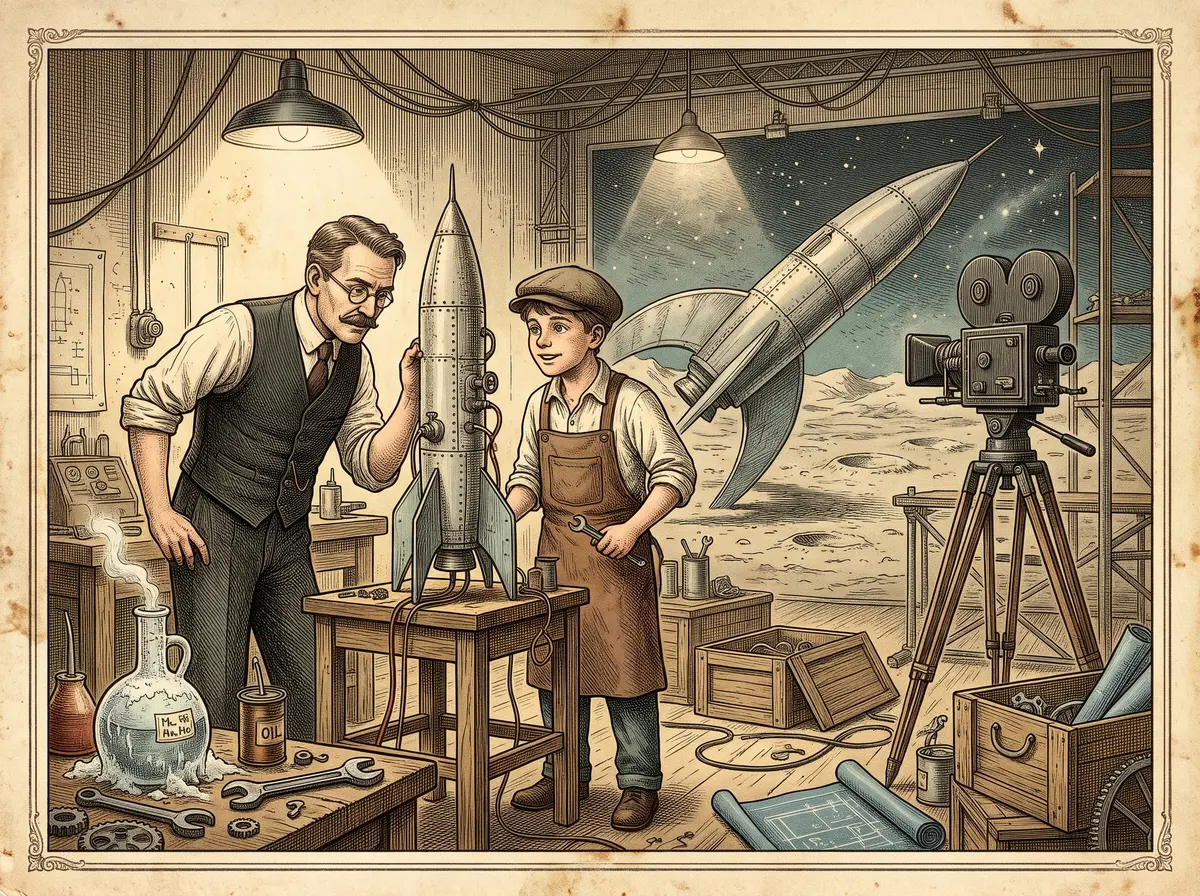
Then Ley suggested a bigger stunt. Why not build a real liquid-fueled rocket and launch it to coincide with the release? UFA (Universum Film AG), the studio behind the film, liked the idea. According to historian Amy Shira Teitel, its marketing department put up a modest sum, on condition that Oberth hand over half of any future profits from the technology. The rocket was never meant to reach the Moon. It just had to go up, high and loud, for the newspapers. Encyclopedia Astronautica records the target as a launch from Greifswalder Oie, a tiny island in the Baltic Sea, to a height of roughly 64 kilometers (about 40 miles).
The trouble was that Oberth was a theorist. He brought in Rudolf Nebel, a fellow member of Germany’s amateur Society for Space Travel and a former World War I fighter pilot, who had plenty of enthusiasm but little engineering training. They had about four months.
The fuel was liquid oxygen and gasoline, a pairing nobody had much practical experience with. During one experiment, Oberth fed a fine stream of gasoline into liquid oxygen and lit it. It exploded. Teitel writes that the blast burst his eardrums and burned the skin around his left eye, nearly costing him the eye. (Accounts disagree on how lasting the damage was; some say he lost sight in that eye.)
The work slipped. Oberth scaled back to a simpler design, then swapped that for another, and none was ready. Two days before the premiere, according to the U.S. Centennial of Flight Commission, Oberth realized the rocket would not be finished and left Berlin for Romania to calm his nerves. Frau im Mond opened on October 15, 1929, at the UFA-Palast am Zoo, to an audience of about 2,000. A launch had been planned for later that month. It never happened, and UFA blamed the weather.
Why it was strange: Oberth's Movie Rocket
It is the reverse of how we expect technology to arrive. Usually a real invention comes first and the movies follow. Here a movie studio ordered a working rocket as an advertisement, on a deadline, before anyone in Germany had flown a liquid-fueled rocket at all. (The American Robert Goddard had flown the world’s first in 1926, but he had kept the details largely to himself.)
It is also strange that the project was a failure and a turning point at the same time. The rocket never left the ground. But for a short, crucial stretch, it gave Germany’s penniless rocket amateurs something they had never had: a sponsor, a workshop, and a reason to put theory to the test.
Others who were told rockets could not work include The Newspaper That Took 49 Years to Admit Rockets Work in Space.
What scientists learned: Oberth's Movie Rocket
Oberth learned the hard way something that looks obvious only afterward: liquid oxygen and gasoline burn far faster, and far more violently, in a confined space than in the open. A rocket engine is basically a controlled explosion, and the “controlled” part is the whole engineering problem.
The engine work did not stop when the stunt died. Back in Berlin in 1930, Nebel and his colleagues got Oberth’s small engine into a proper test. Oberth called it the Kegeldüse (“cone nozzle”) because its combustion chamber was cone-shaped. On July 23, 1930, the Chemisch-Technische Reichsanstalt (the German government’s chemical and technical testing institute) certified that it produced a steady thrust of about 7 kilograms (15.5 pounds) for 90 seconds. The Smithsonian’s National Air and Space Museum, which holds a model of it, notes that one of Oberth’s assistants for these tests was an 18-year-old Wernher von Braun.
Those first moments of thrust became the seed of the amateur “Mirak” rockets that Nebel’s group flew in the early 1930s.
The story sits alongside other dreams that ran ahead of the hardware, collected in Built to Do the Impossible.
How it reaches us today: Oberth's Movie Rocket
The most visible legacy is a ritual. Because Frau im Mond was silent, Lang built suspense at liftoff with title cards counting down the seconds to “JETZT!” (“Now!”). The film is widely credited with the first countdown to a rocket launch, and Lang is usually credited with inventing it for dramatic effect. Mission control has counted backward ever since.
The darker legacy is that the amateur rocket scene the film helped energize fed straight into the German Army’s rocket program, and von Braun went on to lead development of the V-2 missile. Oberth himself later worked for his former assistant in Huntsville, Alabama, on the American rockets that led toward the Moon.
For a rocket stunt with an even louder ending, see The Rocket That Exploded on Live TV and Got Called ‘Kaputnik’.
Fun fact: Oberth's Movie Rocket
UFA never got its rocket, but according to Encyclopedia Astronautica it did keep the unfinished hardware, so the parts of Germany’s first serious liquid-fueled rocket project briefly belonged to a movie studio, and Nebel’s amateurs had to try to win them back.
Sources: Oberth's Movie Rocket
- ‘Breaking the Chains of Gravity: The Story of Spaceflight Before NASA’ (book excerpt) — Amy Shira Teitel, via Space.com, 2016
- Model, Rocket Motor, Kegeldüse — Smithsonian National Air and Space Museum
- Hermann Oberth — U.S. Centennial of Flight Commission
- Oberth sounding rocket — Encyclopedia Astronautica
- NASA Stole the Rocket Countdown From a 1929 Fritz Lang Film — Atlas Obscura