The Rain Hat That Showed NASA How to Fold a 100-Foot Balloon Into Orbit
On an October evening in 1959, people from New England to South Carolina looked up and saw the sky full of tiny flashing lights. Calls poured into police and fire departments. The glitter was NASA's new satellite, a giant aluminum-coated balloon, which had just torn itself to pieces high above the Atlantic. Part of the fix would come from an engineer's wife's rain hat.
By the Curiosities Desk · · 5 min read · Filed under Space · Today’s round
What happened: The Rain Hat That Showed NASA How to Fold a 100-Foot Balloon Into Orbit
The idea belonged to William J. O’Sullivan, an aeronautical engineer at NASA’s Langley Research Center in Virginia. In January 1956, while serving on a panel about upper-atmosphere research, he proposed a lightweight balloon to measure how dense the thin air was hundreds of miles up. A light, wide object feels drag strongly, so if you could track how fast it slowed, you could work out the density of the air it was passing through. He soon saw that a big, shiny sphere could do more. It would be bright enough for, in his words, “the whole world” to see. It could also act as a mirror in the sky, bouncing radio signals from one side of a continent to the other.
Engineers glued long, curved strips of Mylar plastic, coated with a thin layer of vaporized aluminum, into a sphere 100 feet across, about as tall as a ten-story building. The Mylar was half a thousandth of an inch thick. All of it had to be folded into a canister about 26 inches wide, ride a rocket into space, and then unfold into a smooth ball without a single tear. Project staff nicknamed it a “satelloon.”
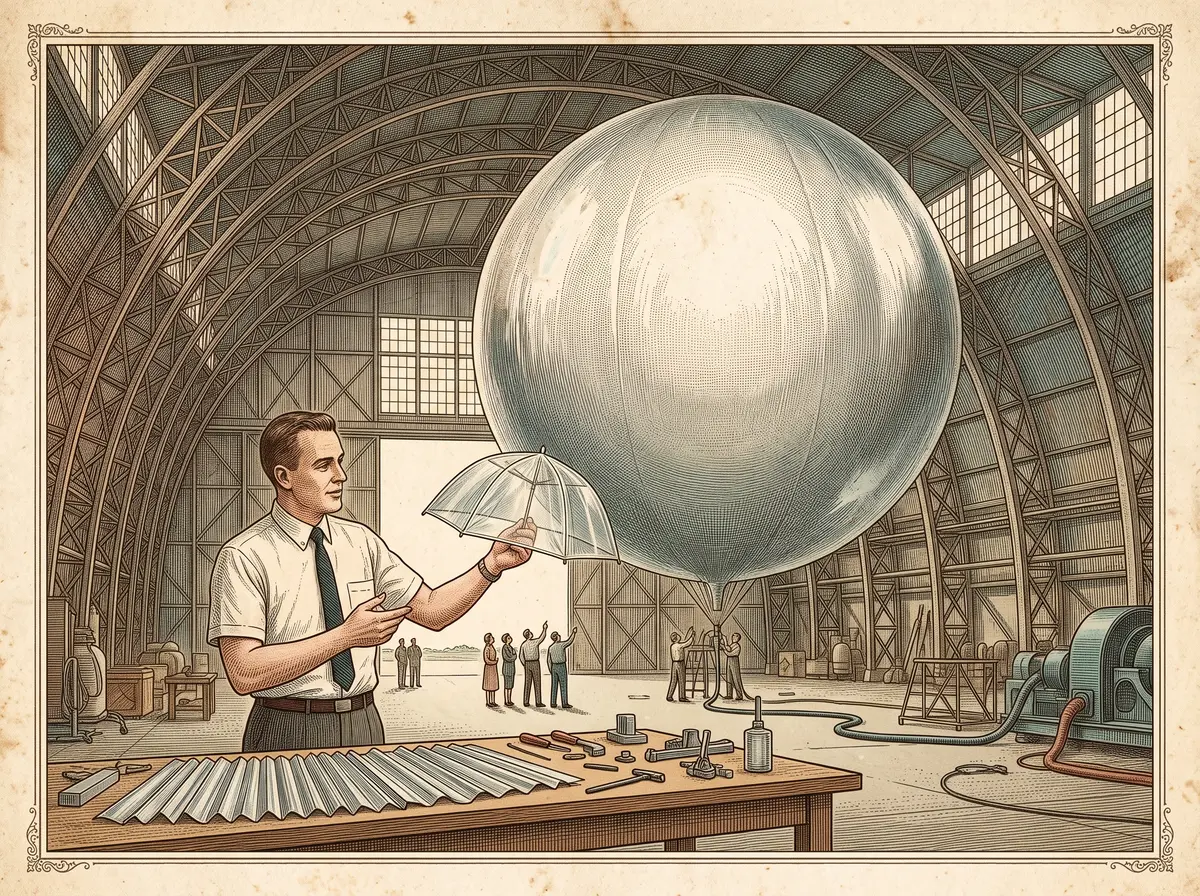
Folding turned out to be one of the hardest parts. According to Kilgore’s own account, retold in NASA’s official history of Langley, engineer Edwin Kilgore found a model at home. His wife owned a plastic rain hat that folded into a long, narrow strip and opened into a neat hemisphere that fit the head. He took it, telling her she “would have to use an umbrella or get wet.” Colleagues used the hat to build full-size folding patterns, and the packing of the balloon improved a great deal.
The first test came that October evening in 1959. A suborbital rocket called Shotput 1 carried the folded balloon up from Wallops Island, Virginia. The launch went well, but there was still air trapped in the folds. In near-vacuum, that leftover air expanded so violently that it ripped the balloon apart. Thousands of fragments caught the light of the setting sun.
Engineers punched more than 300 small holes in the material so trapped air could escape before packing, and sealed the canister under vacuum. Instead of compressed gas, the balloon would be filled by powders, such as benzoic acid, that sublimate, meaning they turn straight from solid to gas. To check the seams, the team inflated a full-size sphere inside an empty Navy blimp hangar in Weeksville, North Carolina. It took more than 12 hours. Test engineer Norman Crabill called it “another one of the tests we had to go through before we could trust the design.”
The first orbital attempt, on May 13, 1960, failed when the rocket’s upper stage malfunctioned and the payload fell into the Atlantic. On August 12, 1960, a second Thor-Delta rocket lifted off from Cape Canaveral, and Echo 1 inflated about 1,000 miles above Earth. That same day, a recorded message from President Dwight D. Eisenhower was beamed from Goldstone, California, bounced off the balloon, and received at Bell Telephone Laboratories in Holmdel, New Jersey. “This is one more significant step in the United States’ program of space research and exploration,” it began.
Why it was strange: The Rain Hat That Showed NASA How to Fold a 100-Foot Balloon Into Orbit
Every satellite before Echo was a small metal object packed with electronics. Echo was mostly empty space wrapped in a skin thinner than a human hair, and it carried no radio relay at all. It simply reflected signals the way a mirror reflects light.
The physics of orbit made this odd plan workable. On the ground, filling a sphere that size took many tons of air. In the near-vacuum of orbit, a few pounds of gas were enough to hold the same shape. The balloon itself weighed only about 132 pounds.
And it was a satellite people could find on their own. NASA published daily schedules of when Echo would pass overhead, and anyone who looked up at the right moment could see a steady, bright point of light crossing the sky.
More machines built to sound impossible: Built to Do the Impossible.
What scientists learned: The Rain Hat That Showed NASA How to Fold a 100-Foot Balloon Into Orbit
Echo proved that signals could be bounced off an object in orbit and picked up clearly thousands of miles away. Engineers used it for phone calls, facsimile (an early form of fax) and, in 1962, a live television relay.
Because the balloon was so large and so light, it was also an excellent instrument. Tracking it showed how solar activity changed the density of the upper atmosphere. It also revealed the gentle push of sunlight itself, called solar radiation pressure, which slowly stretched Echo’s orbit, the same force that solar sails use today.
The biggest lesson was that a passive mirror was not enough. Echo scattered energy in every direction, so only a sliver of a signal came back to the receiver. Engineers concluded that satellites would need to receive, amplify and retransmit signals themselves.
Another giant plan to reflect radio from orbit: The 480 Million Copper Needles America Scattered Around Earth to Build a Radio Ring.
How it reaches us today: The Rain Hat That Showed NASA How to Fold a 100-Foot Balloon Into Orbit
Nearly every satellite that carries your TV, phone calls or internet today is an active relay, built on the lesson Echo taught. Echo 1 stayed in orbit until May 24, 1968. A bigger, stiffer successor, the 135-foot Echo 2, launched in 1964 and was later used for mapping the shape of Earth.
The balloon’s most surprising legacy sat on the ground. Bell Labs built a large horn antenna on Crawford Hill in Holmdel to catch Echo’s faint reflections. A few years later, two radio astronomers used that same antenna to find the leftover glow of the Big Bang.
That story is here: The Pigeon Mess That Turned Out to Be the Echo of the Big Bang.
Fun fact: The Rain Hat That Showed NASA How to Fold a 100-Foot Balloon Into Orbit
When the Shotput 1 balloon burst, a night watchman woke Norman Crabill with a reporter’s phone call. Asked for a statement, Crabill said: “It’s three o’clock in the morning.”
Sources: The Rain Hat That Showed NASA How to Fold a 100-Foot Balloon Into Orbit
- James R. Hansen, Spaceflight Revolution: NASA Langley Research Center from Sputnik to Apollo (NASA SP-4308, 1995), Chapter 6, “The Odyssey of Project Echo”: https://www.nasa.gov/wp-content/uploads/2023/04/sp-4308.pdf
- William C. Jakes Jr., Participation of Bell Telephone Laboratories in Project Echo and Experimental Results, NASA Technical Note D-1127 (1961): https://ntrs.nasa.gov/api/citations/19980227084/downloads/19980227084.pdf
- NASA Space Science Data Coordinated Archive, “Echo 1”: https://nssdc.gsfc.nasa.gov/nmc/spacecraft/display.action?id=1960-009A
- Allison Marsh, “When a Giant Mylar Balloon Was the Coolest Thing in Space,” IEEE Spectrum (2020): https://spectrum.ieee.org/when-a-giant-mylar-balloon-was-the-coolest-thing-in-space