Impossible Inventions · Chemistry
The Green Pill That Supposedly Turned Water Into Gasoline — and the Edison Engineer Who Found What Was Really in the Tank
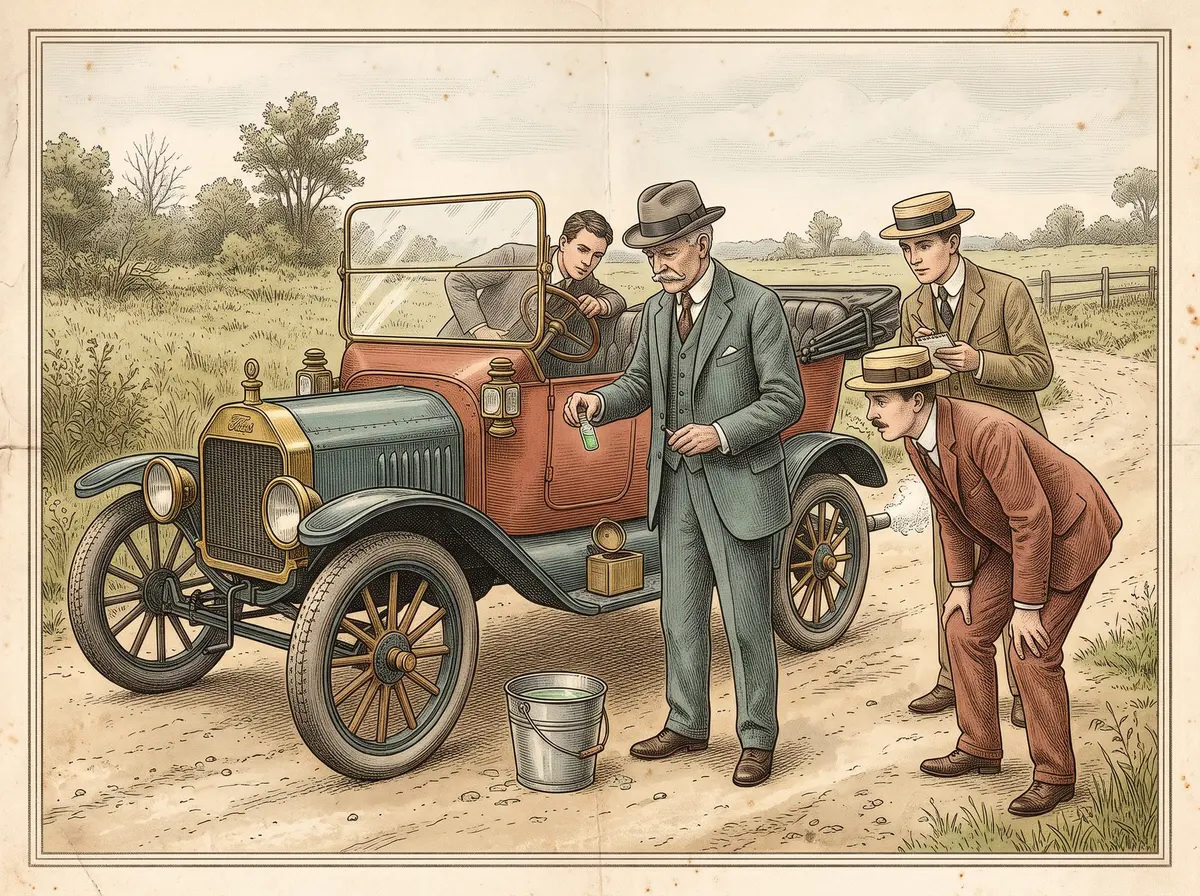
In April 1916, a gray-mustached man in his seventies stood beside a car near his home in Farmingdale, Long Island, and invited reporters to taste a pail of ordinary water. Then he dropped in a little green liquid, poured the mix into the empty fuel tank, and cranked the engine. It started. The exhaust smelled faintly of bitter almonds. His substitute for gasoline, Louis Enricht announced, could be made for a penny a gallon.
By the Curiosities Desk · · 5 min read · Filed under Chemistry · Today’s round
What happened: The Green Pill That Supposedly Turned Water Into Gasoline — and the Edison
Enricht was not a famous chemist, or really a chemist at all. Accounts describe him as a German-born inventor and promoter who had moved around a good deal before settling on Long Island. But in the spring of 1916 he had exactly the right claim at exactly the right moment. War was raging in Europe, the United States was edging toward joining it, and gasoline was something every army and every new car owner suddenly cared about.
His demonstrations followed a script. Witnesses could check that the tank was empty and that the water was just water. Then came the “automobile dope,” as one account calls it: a small dose of green fluid, roughly an ounce per gallon in some tellings. The car ran. William Haskell, publisher of the Chicago Herald, came to see for himself and, as The New York Times reported on April 17, 1916, said he had even “tasted the water before the mysterious green pill was dropped into the tank.”
Enricht guarded the formula like treasure. A Connecticut paper, the Bridgeport Evening Farmer, reported on April 21, 1916, that he was so worried about spies that he was afraid to walk into a drugstore and buy his own ingredients. He carried a pistol. “The secret is mine,” he told reporters, until somebody offered him a fair reward and promised to make the substance a public benefit.
The reward hunters came quickly. Within days, The New York Times reported that Henry Ford had visited Enricht on Long Island, spent about an hour with him, and seen no demonstration. Ford’s secretary said the carmaker thought the idea was worth following up. It went no further. The Maxim Munitions Corporation, linked to the explosives inventor Hudson Maxim, took an option on the formula in a deal newspapers described in very large numbers; Time magazine later put it at a reported $1 million. The railroad financier Benjamin F. Yoakum pursued the formula too. Accounts of what happened next differ in the details, but they agree on the shape: whenever someone pressed to see the actual recipe, Enricht had a reason they couldn’t.
Meanwhile, Miller Reese Hutchison, Thomas Edison’s chief engineer, looked into the mysterious mixture. On May 29, 1916, the Times reported his verdict. The fuel wasn’t water at all, in any useful sense. It was water carrying acetone and acetylene, two flammable chemicals. The car was burning those, and the water was just along for the ride.
Around 1920 he moved on to a new promise: making motor fuel from peat, the spongy, half-rotted plant matter dug from bogs. In December 1921 he was asked to demonstrate his peat apparatus in a Nassau County courtroom. After about three hours of assembling equipment, it failed to produce anything, and he blamed leaks in the compressor. In November 1922 a jury convicted him of grand larceny for taking an investor’s money in the peat scheme, and he was sentenced to up to seven years at Sing Sing.
Why it was strange: The Green Pill That Supposedly Turned Water Into Gasoline — and the Edison
The demonstration was real. The car really did start, the water really was water, and the witnesses were not imagining the almond smell. What made it strange was that every honest observation pointed to the wrong conclusion. People watched a car run on a tank that was mostly water and reasonably asked, “What did the pill do to the water?” The better question was, “What else was in the pill?”
That’s the trap of many impossible inventions: the part you can see works perfectly, and the impossible part is hidden inside a small, secret ingredient. Enricht’s famous secrecy wasn’t a side detail of the story. It was what held the claim together.
San Diego had its own run-in with a man selling chemical miracles from a secret recipe, told in The Sewing Machine Salesman San Diego Hired to Make Rain — Who Filled the Reservoir and Never Got Paid.
What scientists learned: The Green Pill That Supposedly Turned Water Into Gasoline — and the Edison
The core chemistry is the reason nobody needed Enricht’s formula to know something was off. Water is what you get after hydrogen burns. When hydrogen combines with oxygen, it releases energy and leaves behind H₂O. Water is, in a sense, chemical ash. To get fuel back out of it, you have to pull the hydrogen and oxygen apart again, and that takes at least as much energy as burning them released in the first place.
Hutchison’s finding fits that neatly. Acetylene is a gas that burns extremely hot, which is why welders use it in oxy-acetylene torches. Acetone, the solvent in some nail polish removers, burns too, and it can hold a remarkable amount of acetylene dissolved in it. Add that mixture to water and you have a liquid that can briefly run an engine, though Hutchison warned it would also corrode it.
Henry Ford’s interest in odd fuels and materials went further than one afternoon on Long Island, as The Car Henry Ford Tried to Grow From Soybeans — and the Axe He Swung to Prove Plastic Was Tough shows.
How it reaches us today: The Green Pill That Supposedly Turned Water Into Gasoline — and the Edison
The dream of a car that runs on water never went away. Variations on the “gasoline pill” and the water-powered engine have resurfaced for more than a century, along with a whole market of fuel additives and gadgets promising big savings. The U.S. Federal Trade Commission has warned drivers that the Environmental Protection Agency has evaluated or tested more than 100 alleged gas-saving devices and has not found any that significantly improve gas mileage.
The lasting lesson from 1916 is a practical one: when an invention seems to get energy from nowhere, look for the hidden energy source. In Enricht’s case, it was sitting in a small vial of green liquid.
For a similar story with a hidden power source, see The Perpetual Motion Machine Secretly Powered by an Old Man Upstairs Eating Bread.
Fun fact: The Green Pill That Supposedly Turned Water Into Gasoline — and the Edison
The pairing Hutchison found in Enricht’s tank is still in use today. Welding-supply acetylene cylinders are packed with a porous filler soaked in acetone, because acetylene is safest stored dissolved in that solvent rather than as free gas.
Sources: The Green Pill That Supposedly Turned Water Into Gasoline — and the Edison
- “Gas From Water; Man Seeks More Secret Chemicals,” Bridgeport Evening Farmer, April 21, 1916, p. 3 (Library of Congress, Chronicling America)
- “Tests a New ‘Gasoline’: Edison’s Man Finds Mysterious Mixture…,” The New York Times, May 29, 1916
- “Tells of Auto Run by Use of Chemical; Chicago Publisher Investigates…,” The New York Times, April 17, 1916
- “‘Gas Saving’ Products,” FTC Facts for Consumers, U.S. Federal Trade Commission (GovInfo)
- “Fuel’s Errand: Louis Enricht and the Great Gasoline Hoax of 1916,” Mental Floss