The Head Cold That Made Apollo 7 Refuse Its Helmets
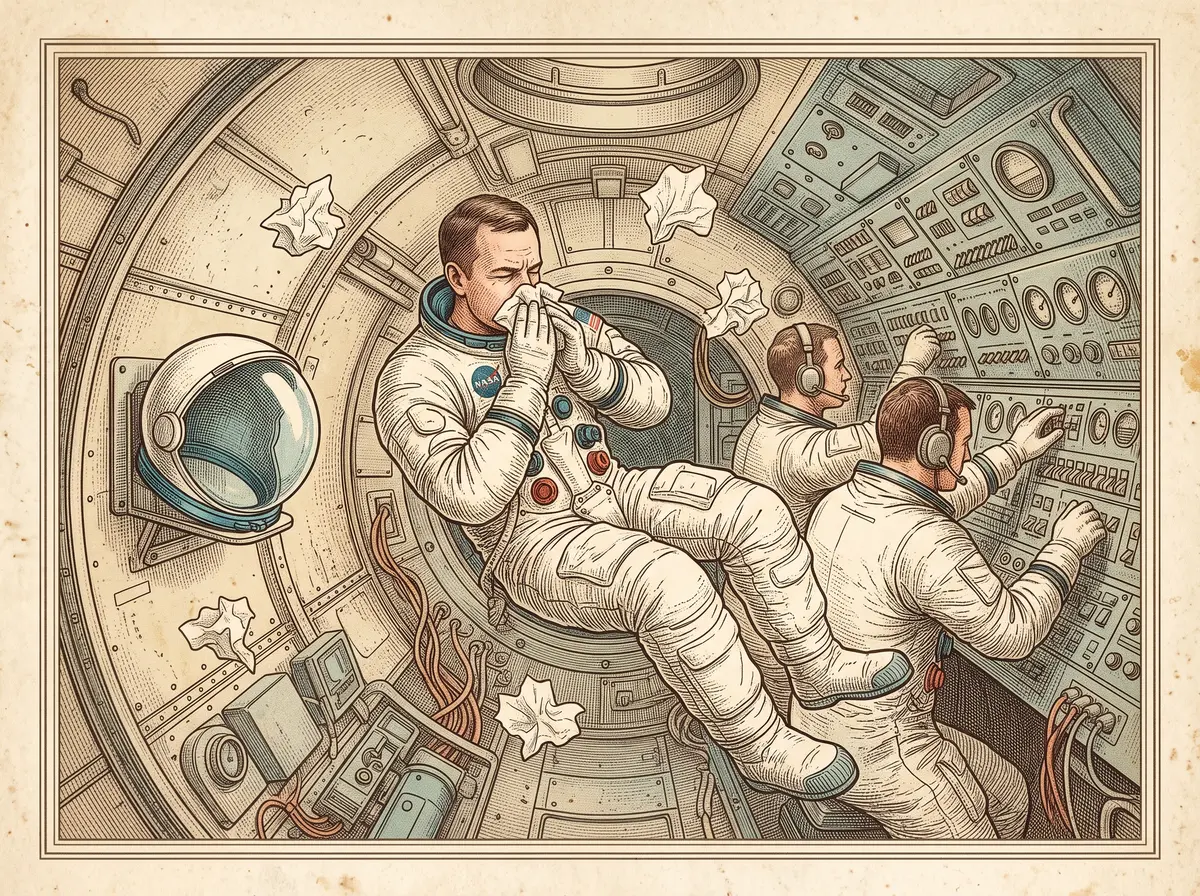
October 1968. About 15 hours into the first crewed flight of NASA's Apollo spacecraft — the machine meant to carry people to the Moon — commander Wally Schirra radios down a problem no engineer had planned for. He has a bad head cold. There is nowhere for it to drain, the tissues are piling up, and in a few days he will tell Mission Control, politely but firmly, that his crew will not be wearing their helmets home.
By the Curiosities Desk · · 5 min read · Filed under Space · Today’s round
What happened: The Head Cold That Made Apollo 7 Refuse Its Helmets
Apollo 7 launched on October 11, 1968, from Launch Complex 34 at Cape Kennedy, on a Saturn IB rocket. The stakes were enormous: it was the first crewed Apollo mission since the January 1967 fire that killed the Apollo 1 crew on the launch pad. Schirra, a veteran of the Mercury and Gemini programs, commanded. Donn Eisele was command module pilot, and Walter Cunningham was lunar module pilot.
The cold may have been brewing before launch. According to NASA’s own medical summary, Biomedical Results of Apollo, Schirra and Cunningham both had “slight nasal stuffiness” three days before liftoff. Their launch-day exams found nothing wrong, and they were certified fit to fly. Then, roughly 15 hours after liftoff, the crew reported that the commander had “developed a bad head cold.”
The flight surgeon prescribed what you might reach for at home: aspirin, plus one tablet of Actifed, an over-the-counter decongestant, every eight hours. About a day later, Eisele and Cunningham developed cold symptoms too. Cunningham later summed up the result: the cold, he said, “quickly turned our cozy little spacecraft into a used Kleenex container.” (Accounts differ a little on how sick each crewmate got, but NASA’s medical report says all three had symptoms.)
The mission itself went very well, including the first live TV broadcasts from a crewed American spacecraft. But the radio traffic grew tense. When Mission Control asked the crew to switch on the camera early, before the rendezvous work was done, Schirra pushed back, citing his cold: “I refuse to foul up our time lines this way.”
The biggest clash came at the end. NASA procedure called for helmets during reentry, the plunge back through the atmosphere, in case the cabin lost pressure. But the Apollo helmets were sealed bubbles. With one on, you can’t pinch your nose and blow to pop your ears, a move doctors call the Valsalva maneuver. The crew feared that with blocked sinuses, the pressure change on the way down could rupture an eardrum. Schirra had once nearly done exactly that during a short test-pilot flight with a cold.
Forty-eight hours before entry, the crew decided not to wear helmets or gloves. Deke Slayton, the head of astronaut flight crew operations, ordered them to put the helmets on. Schirra declined and agreed only to keep them stowed nearby in case of an emergency. Each man took a decongestant an hour before reentry. On October 22, the capsule splashed down in the Atlantic near Bermuda after 10 days and 20 hours in orbit. Nobody’s eardrums burst. According to NASA’s report, none of the crew had any trouble clearing their middle ears, and the Valsalva maneuver wasn’t even needed.
Why it was strange: The Head Cold That Made Apollo 7 Refuse Its Helmets
Spaceflight is planned down to the switch, and the Apollo 7 spacecraft performed almost flawlessly. What strained the mission was the most ordinary illness there is.
The cold also behaved differently up there. On Earth, a stuffy nose is a nuisance. In orbit, it became a real question about whether a man’s eardrums would survive the trip home, and the safety rule meant to protect the crew collided with the medical problem it hadn’t anticipated.
None of the three flew in space again. Schirra had already announced he would retire, but the episode is often cited as one reason Eisele and Cunningham never got another seat.
For another astronaut whose body became the experiment, see The Senator Who Went to Space and Came Back as a Unit of Nausea.
What scientists learned: The Head Cold That Made Apollo 7 Refuse Its Helmets
On Earth, gravity does a lot of quiet housekeeping in your head. Mucus from your sinuses drains downward, a postnasal drip carries it into your throat, and you swallow it without noticing. In weightlessness that stops. Body fluids also shift toward the head, which makes congestion worse. Schirra described the problem himself in NASA’s medical write-up: with no drainage, blowing your nose was the only way to clear anything, and it barely touched the mucus packed in the sinuses.
The ears have a related problem. Each middle ear connects to the throat through a narrow channel called the Eustachian tube, which lets air in and out so the pressure on both sides of the eardrum stays equal. A cold can swell that tube shut. Then, if the outside pressure rises quickly, as it did when the capsule’s thin in-flight atmosphere was brought back toward sea level during descent, the eardrum gets pushed inward. It’s the same reason your ears hurt on a plane’s descent when you have a cold.
NASA’s doctors also learned something about prevention. Across the Apollo flights before Apollo 14, 57 percent of crew members had some illness in the 21 days before launch. Apollo 9’s launch was postponed by three days because its crew had colds.
What happened to the crew coming home from the Moon is its own odd story: The Airstream Trailer That Was Supposed to Save Earth From Moon Germs.
How it reaches us today: The Head Cold That Made Apollo 7 Refuse Its Helmets
Starting with Apollo 14, NASA introduced the Flight Crew Health Stabilization Program, a kind of reverse quarantine. Crews were kept away from crowds before launch, and anyone allowed near them was screened. NASA’s doctors concluded it could greatly reduce infection risk, though not eliminate it. The agency still runs a health stabilization program before every crewed launch, which is why astronauts spend their final days before flight in quarantine.
There was a commercial afterlife, too. After leaving NASA, Schirra became a TV spokesman for Actifed, the decongestant he had taken in orbit. And in 2008, forty years after the flight, NASA finally awarded all three men its Distinguished Service Medal, the honor other Apollo crews had received. Two of the medals were awarded posthumously, since only Cunningham was still alive.
For another bit of Apollo-era mischief, see The Corned Beef Sandwich That Got NASA Hauled Before Congress.
If you have to fly with a cold, ask a pharmacist or doctor about protecting your ears on the descent. Your eardrums are no tougher than Wally Schirra’s.
Fun fact: The Head Cold That Made Apollo 7 Refuse Its Helmets
The same sniffling, short-tempered crew won a special Emmy Award for their daily television reports from orbit.
Sources: The Head Cold That Made Apollo 7 Refuse Its Helmets
- W. Royce Hawkins and John F. Zieglschmid, “Clinical Aspects of Crew Health”, in Biomedical Results of Apollo (NASA SP-368), NASA, 1975.
- “50 Years Ago: NASA Launched Apollo 7”, NASA History Office, 2018.
- Ben Evans, “‘From the Lovely Apollo Room’: 45 Years Since Apollo 7 Charted a Course for the Moon (Part 2)”, AmericaSpace, October 13, 2013.
- “Apollo 7: NASA’s First Mini-Mutiny in Space”, Astronomy.
- Eric Niiler, “The Apollo Mission That Nearly Ended With a Mutiny in Space”, HISTORY, October 11, 2018.