The London Bridge an American Supposedly Bought by Mistake — and Then Dug a River Under
In 1971, a 930-foot granite bridge that had carried Londoners across the Thames for nearly 140 years opened in the Arizona desert, over a channel that had been dug out from under it after it was finished. And for half a century, people have explained it with one irresistible punchline: the American who bought it thought he was getting Tower Bridge, the famous one with the towers. It's a great story. Everyone involved said it wasn't true.
By the Curiosities Desk · · 5 min read · Filed under Engineering · Today’s round
Part of The Version Everyone Remembers
What happened: London Bridge
The bridge in question was designed by the Scottish engineer John Rennie in 1799, built between 1825 and 1831, and finished after his death by his son, John Rennie the Younger. It opened on August 1, 1831. It was a handsome thing: five stone arches, the widest spanning 150 feet.
It was also slowly sinking. According to Lake Havasu City’s official fact sheet on the bridge, by 1924 its east side sat three to four inches lower than its west side. By the early 1960s it was settling into the Thames at roughly an inch every eight years, and it had never been designed for the weight of modern car and truck traffic. The City of London decided to replace it.
That might have been the end of it, except for Ivan Luckin. A member of the city council committee that looked after the bridge, Luckin had a background in advertising and newspapers, and he had an idea his colleagues reportedly found ludicrous: sell the old bridge to an American. In 1968 he traveled to the United States to pitch it, telling a New York press conference, “London Bridge is not just a bridge.”
His buyer turned out to be Robert P. McCulloch, a chainsaw and engine manufacturer who in 1963 had bought a large parcel of desert beside Lake Havasu, a reservoir on the Colorado River, and was trying to turn it into a city. He needed a reason for people to visit. With his partner C.V. Wood, McCulloch worked out a bid that HISTORY describes like this: dismantling the bridge would cost London about $1.2 million, so they doubled it, then added $60,000 — $1,000 for each year of McCulloch’s age when the bridge would reopen. On April 18, 1968, the sale closed at $2,460,000. “We poured an awful lot of scotch trying to loosen them up,” McCulloch later said of the negotiations.
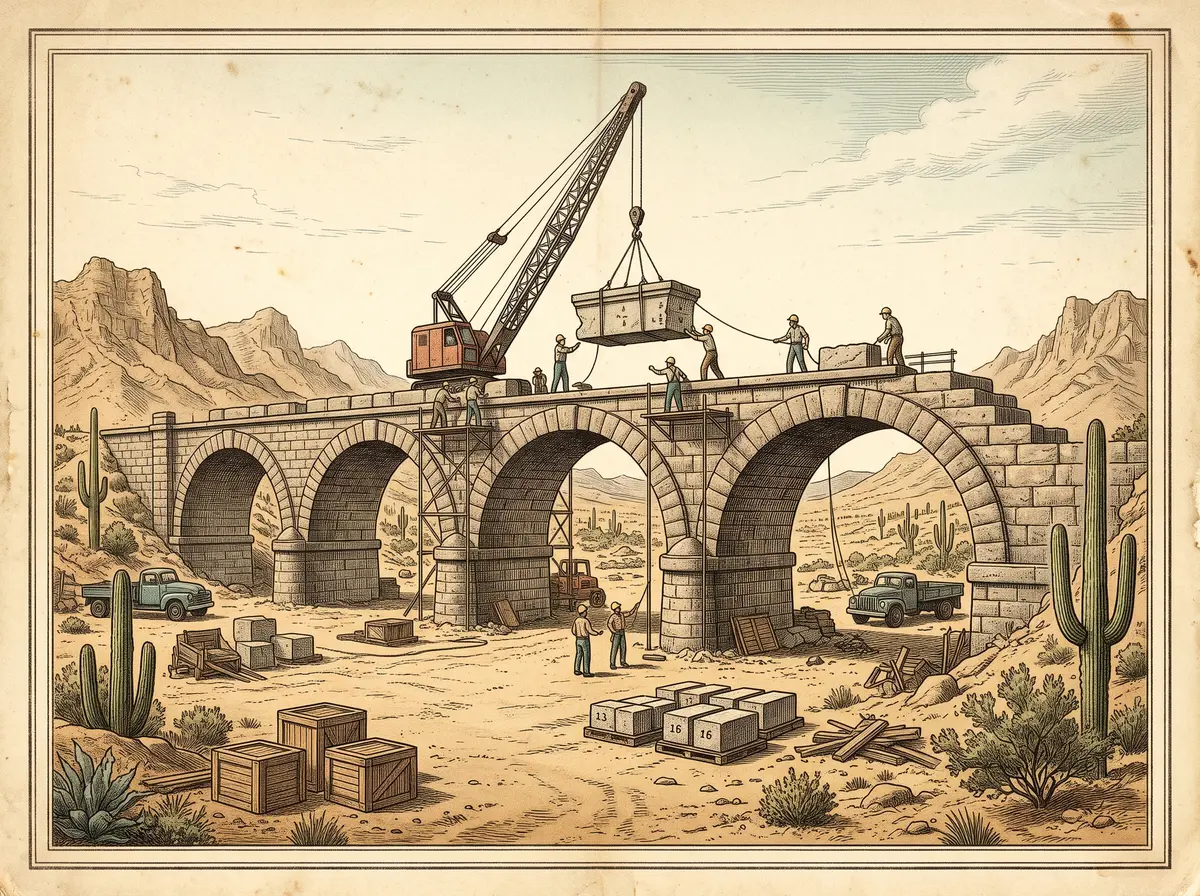
Then came the hard part. Workers labeled each exterior block by arch span, row, and position before taking the bridge apart; the city’s fact sheet counts 10,276 granite blocks. Many stones were sent to a quarry at Merrivale in Devon, where six to eight inches were sliced off their backs. The pieces sailed through the Panama Canal to Long Beach, California, and were trucked across the desert.
In Arizona, the bridge was rebuilt on dry land, across the narrow neck of a peninsula. The Lord Mayor of London re-laid the foundation stone on September 23, 1968. Only after the bridge was up did crews dredge a channel, about a mile long, beneath it and let the lake flow in, turning the peninsula into an island. Shipping, rebuilding, and dredging cost about $7 million. On October 10, 1971, the bridge was dedicated with fireworks, skydivers, and another Lord Mayor of London in attendance. A British newsman told the New York Times, “It’s a supergimmick.” Some called it “McCulloch’s Folly.”
Why it was strange: London Bridge
Because the joke is better than the facts. The Tower Bridge story has everything: a rich American, a famous landmark, and a very expensive misunderstanding. But nobody has produced evidence for it. Asked whether McCulloch thought he was buying Tower Bridge, Luckin reportedly answered, “Of course not,” and McCulloch denied it too. HISTORY calls the rumor “since discredited.”
It also doesn’t fit what McCulloch was actually doing. He wasn’t a tourist who fell for a sales brochure. He had studied the dismantling costs closely enough to build his bid around them, and he wanted a famous name to put his new city on the map. “London Bridge” gave him exactly that, towers or no towers.
The rumor belongs on the shelf of The Version Everyone Remembers.
What scientists learned: London Bridge
The real engineering story is about settlement: the slow sinking of a structure as the ground beneath it compresses. Rennie’s bridge was an enormous weight of stone resting on riverbed soil, and soft ground gives way gradually under a load like that. When one side sinks more than the other, engineers call it differential settlement, and it is usually what causes the trouble, because it twists a structure that was designed to sit level.
A stone arch carries weight by compression, with each block pressing on its neighbors and pushing the load out toward the supports. That works beautifully for centuries, as long as the supports stay put. Once they start moving and traffic loads grow heavier, the margin for error shrinks.
The Arizona rebuild handled the problem by separating the bridge’s job from its looks. The new structure is a hollow core of steel-reinforced concrete that carries the loads, and the original granite is cladding, a decorative outer layer fixed to the outside. That’s why the stones could be shaved thinner in Devon: they no longer had to hold anything up.
For a London crossing built the hard way, under the river instead of over it: The Ship-Sinking Clam That Taught an Engineer How to Dig Under the Thames.
How it reaches us today: London Bridge
The gamble worked for McCulloch’s city. HISTORY reports that Lake Havasu City grew from a few hundred residents in the early 1960s to more than 10,000 by 1974, when a chamber of commerce report said the bridge had drawn nearly two million visitors the year before. Today the city has more than 50,000 full-time residents, and boats cruise the channel dug beneath the bridge.
Back in London, the bridge’s concrete replacement opened in 1973. Rennie’s stones, meanwhile, became one of the best-known examples of a historic structure saved by being moved rather than demolished, a kind of reuse that preservationists still debate.
Another engineering legend that collapses under inspection: The Library Supposedly Sinking Because the Architect Forgot About the Books.
Fun fact: London Bridge
London Bridge wasn’t the only British landmark Americans tried to buy. In 1968, according to AARP, a group of San Diego investors offered to buy Big Ben. A city official replied that it “wasn’t for sale.”
Sources: London Bridge
- Go Lake Havasu, “London Bridge 50th Anniversary Fact Sheet” (official city tourism fact sheet: sale date and price, 10,276 blocks, 1924 settlement, rededication).
- Evan Andrews, “How London Bridge Ended Up in Arizona”, HISTORY (bid formula, McCulloch and Luckin quotes, construction, visitor figures).
- Euronews Culture, “Culture Re-View: The day London Bridge was inaugurated in Arizona” (Ivan Luckin’s role, sinking foundations).
- AARP, “London Bridge Moved to Arizona 50 Years Ago” (cost, reconstruction, Big Ben offer).
- Wikipedia, “London Bridge (Lake Havasu City)” (starting point; cites Travis Elborough, London Bridge in America, 2013, and The Arizona Republic, April 19, 1968, on the sale, the Merrivale stone-cutting, and the Tower Bridge denials).