The Moonwalker Who Tripped Over a Cable and Unplugged an Experiment on the Moon
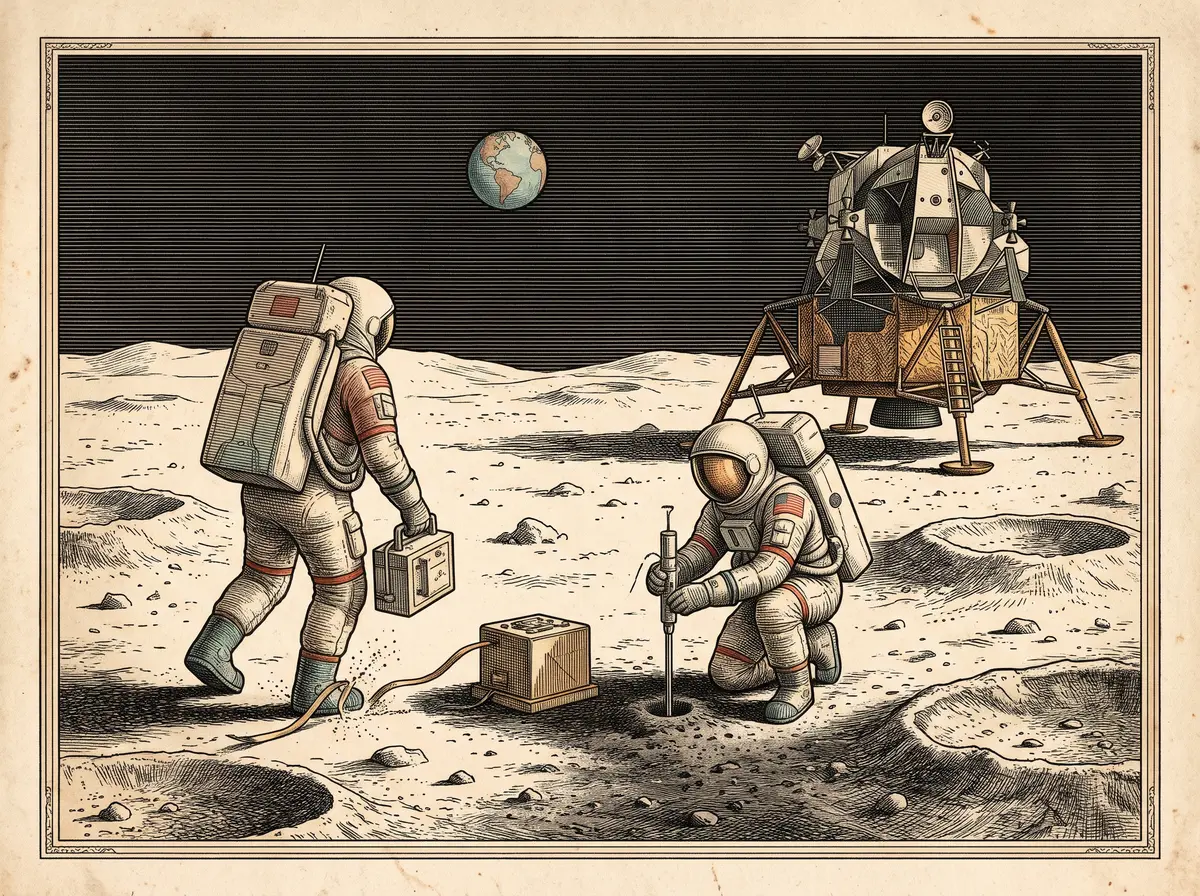
On April 21, 1972, John Young was a quarter of a million miles from home, carrying a box across the Moon's Descartes highlands, when his boot snagged something he couldn't see. "Charlie," he said. "Something happened here." Behind him, a flat ribbon cable lay on the gray dust, torn clean out of its connector. His crewmate Charlie Duke had spent the past stretch of the moonwalk carefully pushing temperature probes into holes he had drilled. In one step, without feeling a thing, Young had unplugged them from the rest of the experiment, with no way to plug them back in.
By the Curiosities Desk · · 5 min read · Filed under Space · Today’s round
What happened: Apollo 16's Moonwalk
Apollo 16 was the fifth crewed Moon landing, and like the missions before it, it carried a small science station called ALSEP, the Apollo Lunar Surface Experiments Package. It worked like a tiny weather station for the Moon: several instruments sitting out on the soil, each wired by cable to a central box with a radio that beamed their readings back to Earth for years after the astronauts left.
One of those instruments was the Heat Flow Experiment, led by Marcus Langseth, a geophysicist at Columbia University’s Lamont-Doherty Geological Observatory. The idea was simple to describe and hard to pull off. Astronauts would drill holes about as deep as a person is tall, lower long probes studded with temperature sensors into them, and leave them there. By measuring how the temperature changed with depth, scientists could work out how much heat was leaking out of the Moon’s interior.
The experiment had already had a rough ride. It was meant to fly on Apollo 13, which never landed. On Apollo 15 in 1971, David Scott found the ancient, tightly packed lunar soil so hard to drill that one of his two probes ended up only partly buried. Apollo 16 was a chance to get a clean second site.
During the first moonwalk, Duke drilled the holes and was ramming the probes home. According to NASA’s Apollo Lunar Surface Journal, he reported the first probe “all the way in,” and had the second partly placed. Meanwhile, Young lifted a mortar package (part of a separate seismic experiment) off the top of the central station and turned toward the equipment pallet. His trailing foot caught the heat flow cable.
The cable didn’t pull the box over. It simply broke at the connector. “That’s the heat flow,” Duke told him. “You’ve pulled it off.” Young answered, “I don’t know how it happened.” Duke, looking at the probe in his hands, added, “Well, I’m wasting my time.” Then he asked Mission Control to “tell Mark we’re sorry.”
Engineers in Houston looked at whether the astronauts could splice the connection. A repair was considered, but accounts of the mission say it would have taken hours of precious surface time, so it was dropped. The experiment never sent home a single useful reading.
Why it was strange: Apollo 16's Moonwalk
Spaceflight failures are usually imagined as explosions, computer alarms, or a part breaking under extreme heat or cold. This one was a man walking across a room and catching his foot on a cord, the most ordinary household accident there is, happening on another world.
The suit made it almost inevitable. A pressurized spacesuit stiffens the body, and the helmet blocks much of the view of your own feet. Young simply couldn’t see the ground he was stepping on, and his thick boots didn’t let him feel the cable either. “It was my fault,” he said in the crew’s debrief afterward. “I didn’t know I did it.” Duke replied, “It wasn’t your fault.” Young also pointed at the hardware: “That cable, evidently, was really flimsy.” Before launch, the two had warned engineers that deployed cables that didn’t lie flat on the ground could cause exactly this kind of trouble.
Another Moon mission rescued by improvised fixes rather than lost to a small snag is The Moon Buggy Fender Fixed With Duct Tape and Four Maps.
What scientists learned: Apollo 16's Moonwalk
The Heat Flow Experiment eventually got its answer, just not from Apollo 16. On Apollo 17 in December 1972, both holes were drilled and both probes were installed without trouble. Together with the Apollo 15 site, the probes recorded temperatures from 1971 until NASA shut the stations down in 1977.
The measurements suggested the Moon leaks heat at roughly 17 thousandths of a watt per square meter, a small fraction of what flows out of Earth. That number matters because heat is a fingerprint of what a world is made of and how it formed. Much of a rocky world’s internal heat comes from radioactive elements like uranium and thorium slowly decaying, so a heat flow figure helps scientists estimate how much of those elements the Moon holds and how hot it is deep inside.
Two landing sites is a thin sample for an entire world, which is why a third would have been so valuable. Scientists still debate how representative the Apollo 15 and 17 sites are, since both sit near the edges of large lunar basins.
Small things undoing big missions is a theme with its own shelf: The Missions Undone by One Small Thing.
How it reaches us today: Apollo 16's Moonwalk
The surviving data held one more surprise. In the 2010s, a team led by Seiichi Nagihara of Texas Tech University tracked down archived Apollo heat flow tapes and logs that had never been fully studied. In a 2018 paper in the Journal of Geophysical Research: Planets, they reported that the Moon’s surface at the landing sites had warmed by about 1 to 2 °C during the years the probes were running. The cause was the astronauts themselves. Their boots and rover wheels had churned up the soil and darkened it, so it absorbed more sunlight. Orbital images from NASA’s Lunar Reconnaissance Orbiter show those darkened patches around the sites.
“It doesn’t take much disturbance to get that very subtle warming on the surface,” Nagihara said. That lesson is now part of planning for new lunar instruments: where you walk, and where your cables run, can change what you measure.
For another space mission undone by a single overlooked detail, see The Genesis Capsule That Crashed Because a Switch Was Installed Backward.
Fun fact: Apollo 16's Moonwalk
Some of the Moon’s long-missing temperature readings turned up decades later on 440 archival tapes stored at the Washington National Records Center in Suitland, Maryland.
Sources: Apollo 16's Moonwalk
- Eric M. Jones, ed., “Heat Flow,” Apollo 16 Lunar Surface Journal, NASA (transcript and crew debrief commentary).
- Marcus G. Langseth et al., “Lunar Heat-Flow Experiment” (final report), NASA Technical Reports Server, 1977.
- S. Nagihara et al., “Examination of the Long-Term Subsurface Warming Observed at the Apollo 15 and 17 Sites Utilizing the Newly Restored Heat Flow Experiment Data From 1975 to 1977,” Journal of Geophysical Research: Planets (2018).
- “Scientists Solve Lunar Mystery With Aid of Missing Moon Tapes,” American Geophysical Union via Phys.org, June 2018.
- Ben Evans, “Intruders in a Foreign Land: 45 Years Since Apollo 16 Almost Didn’t Land on the Moon (Part 2),” AmericaSpace, April 2017.