The Nuclear Blast Honolulu Hotels Threw Rooftop Parties to Watch — and the Satellites It Quietly Switched Off
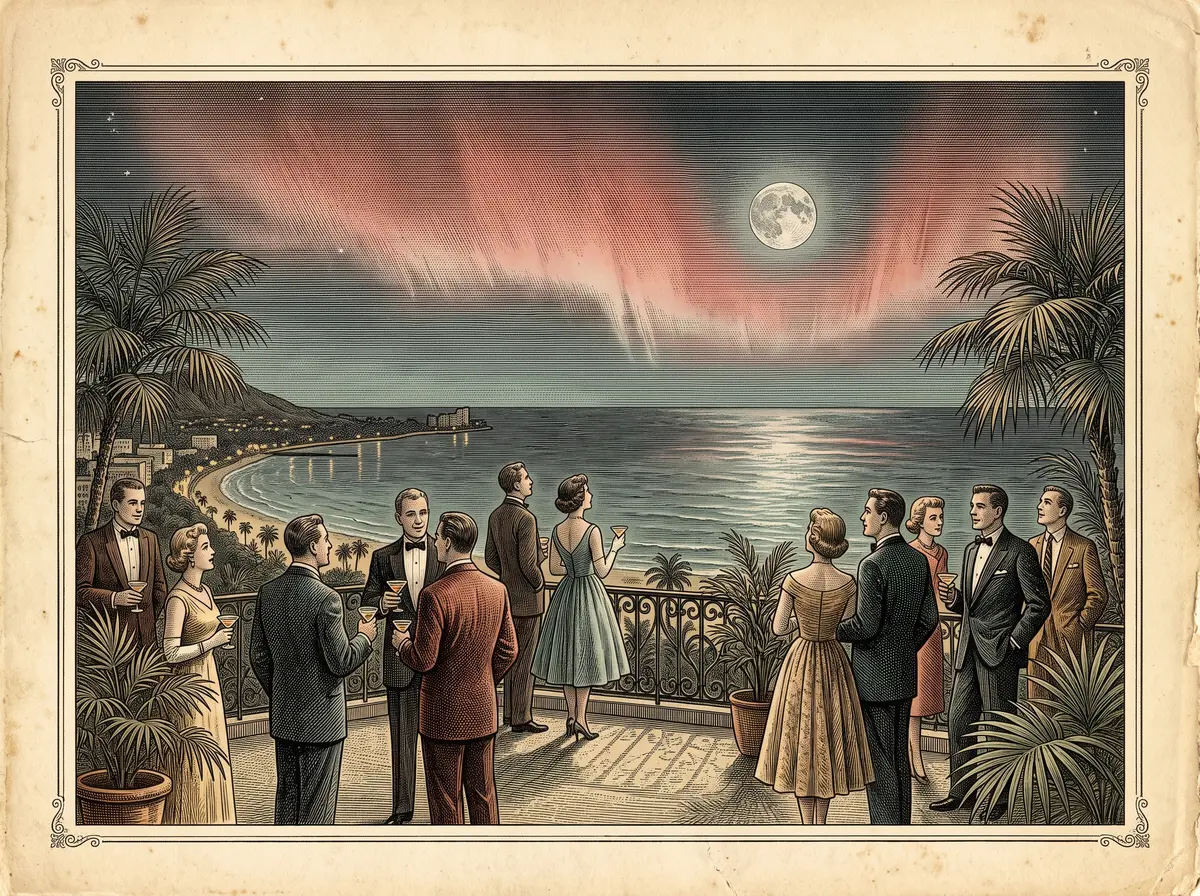
A little after 11 p.m. on July 8, 1962, guests on Honolulu hotel rooftops raised their drinks toward the southwest and waited. They had been promised a show. Some 900 miles away and 250 miles up, a hydrogen bomb went off, the night sky flushed red and pink, and around Oahu a few hundred streetlights blinked out.
By the Curiosities Desk · · 5 min read · Filed under Physics · Today’s round
Part of When Atoms Got Away From Us
What happened: Starfish Prime
The test was called Starfish Prime. It was part of Operation Fishbowl, a series of American nuclear explosions set off high above the Pacific during the summer and fall of 1962, at the height of the Cold War. Military planners wanted to know what a nuclear blast at the edge of space would do to radar, radio, and anything orbiting nearby, and the quickest way to find out was to try it.
Getting a bomb that high proved hard. A Thor rocket carrying the first Fishbowl shot, Bluegill, was lost when radar tracking failed and it had to be destroyed in flight. On June 20, the first try at Starfish went worse. The Thor’s engine cut out about a minute after launch, the missile was blown apart, and debris, some of it contaminated with plutonium, rained down on Johnston Atoll, the tiny U.S. island base about 900 miles southwest of Hawaii.
The second try worked. On July 9, 1962, at 09:00 Greenwich time, which was 11 p.m. on July 8 in Hawaii, a Thor lifted off from Johnston Atoll carrying a W49 thermonuclear warhead. Thirteen minutes and 41 seconds later, the warhead exploded about 250 miles (400 km) up with a yield of roughly 1.4 megatons, around 100 times the power of the bomb dropped on Hiroshima.
Nobody had kept it secret. The Honolulu Advertiser had run a front-page headline that afternoon: “N-Blast Tonight May Be Dazzling: Good View Likely.” According to NPR and Smithsonian magazine, Honolulu hotels hosted rooftop and veranda viewing events, some billed as “Rainbow Bomb Parties.”
The view delivered. A Honolulu reporter, quoted by Smithsonian, described the moon “centered in a sky partly blood-red and partly pink.” A woman on Maui watched lights shift from yellow to red to icy blue to white. Artificial auroras glowed over the test site and, far to the south, over New Zealand, where electrons from the blast spiraled down Earth’s magnetic field lines and lit up the upper air.
Then things on the ground started acting up. On Oahu, streetlights went dark, burglar alarms went off, and a telephone company microwave link that carried calls between Kauai and the other islands was damaged. Hawaii was hundreds of miles from the blast, far beyond the reach of its heat or shock wave.
Why it was strange: Starfish Prime
Because a bomb that exploded in near-empty space reached down and flipped switches on an island that was barely in view of it.
The scale of the electrical trouble has been debated ever since. One later analysis by physicist Mario Rabinowitz counted only 10 to 30 tripped fuses, each controlling about 10 lights, out of more than 10,000 streetlights on Oahu. That works out to roughly 1 to 3 percent, and the Hawaiian Electric Company reported no line breakdowns. In 1989, Sandia National Laboratories physicist Charles Vittitoe revisited the puzzle in a report titled Did High-Altitude EMP Cause the Hawaiian Streetlight Incident? The modest answer is that something real happened in Hawaii that night, but it was a nuisance, not a blackout.
The bigger surprise was overhead, and it took weeks to show up. If you enjoy Cold War plans to light up the sky, see The Plan to Set Off a Nuclear Bomb on the Moon So Everyone Could Watch.
What scientists learned: Starfish Prime
Two big lessons, one fast and one slow.
The fast one was the electromagnetic pulse, or EMP: a brief, powerful surge of radio energy. When a nuclear weapon explodes high above the atmosphere, its gamma rays slam into air molecules many miles below and knock electrons loose. Earth’s magnetic field bends those fast-moving electrons into curving paths, and the whole sheet of swerving charge radiates a pulse across a huge area at once. Starfish Prime gave scientists real measurements of an effect that until then had mostly lived in equations.
The slow lesson was about space itself. Since 1958, scientists had known that Earth is wrapped in the Van Allen belts, zones where its magnetic field traps charged particles. Starfish poured about 10²⁹ electrons into those belts, raising the electron count in the inner belt by several orders of magnitude, meaning a thousandfold or more. Glenn Seaborg, then chairman of the Atomic Energy Commission, later wrote, “To our great surprise and dismay, it developed that Starfish added significantly to the electrons in the Van Allen belts.”
Those electrons went to work on satellites. Within months, at least half a dozen spacecraft were damaged or shut down early, mostly because the radiation degraded their solar cells and electronics. Victims included the Navy’s Transit 4B and TRAAC, Britain’s first satellite, Ariel 1, and Telstar 1. Some of the extra radiation lingered at detectable levels for several years. Another Cold War project that cluttered orbit is The 480 Million Copper Needles America Scattered Around Earth to Build a Radio Ring.
How it reaches us today: Starfish Prime
Starfish Prime was one of the reasons the United States, the Soviet Union, and the United Kingdom signed the Limited Test Ban Treaty in August 1963. It banned nuclear tests in the atmosphere, underwater, and in outer space. The last high-altitude shots by either superpower came in the fall of 1962, and none have been set off since.
The test also shaped how engineers build things. “Radiation hardening,” designing electronics to survive bursts of high-energy particles, became a standard part of spacecraft engineering, and Starfish data still feeds models of how a modern high-altitude blast could damage today’s crowded orbits. Military planners in several countries still study EMP protection for power grids and communications, using lessons drawn from a few hundred dark streetlights in Honolulu. For more stories of nuclear experiments that did more than expected, browse When Atoms Got Away From Us.
Fun fact: Starfish Prime
Telstar 1, the world’s first commercial communications satellite, launched on July 10, 1962, the day after Starfish Prime, and flew straight into the new radiation. It still managed to relay the first live television pictures across the Atlantic that summer, before its electronics failed and it went silent in February 1963.
Sources: Starfish Prime
- Smithsonian Magazine, “Going Nuclear Over the Pacific” (Gilbert King): https://www.smithsonianmag.com/history/going-nuclear-over-the-pacific-24428997/
- U.S. Defense Nuclear Agency, Operation Dominic I – 1962 (Berkhouse et al., 1983), DTRA Nuclear Test Personnel Review: https://www.dtra.mil/Portals/61/Documents/NTPR/2-Hist_Rpt_Atm/1962_DNA_6040F.pdf
- E. G. Stassinopoulos, NASA Goddard Space Flight Center, “The STARFISH Exo-atmospheric, High-altitude Nuclear Weapons Test” (HEART 2015 conference notes): https://nepp.nasa.gov/files/26652/2015-561-Stassinopoulos-Final-Paper-Web-HEART2015-STARFISH-supplemental-TN26292.pdf
- T. I. Gombosi et al., “Anthropogenic Space Weather,” Space Science Reviews (2017): https://arxiv.org/abs/1611.03390
- NPR, Robert Krulwich, “A Very Scary Light Show: Exploding H-Bombs in Space” (2010): https://www.npr.org/sections/krulwich/2010/07/01/128170775/a-very-scary-light-show-exploding-h-bombs-in-space