Accidental Discoveries · Engineering
The Phantom Radar Rings That Rippled Across Essex Every Dawn — and Turned Out to Be Starlings Leaving for Breakfast
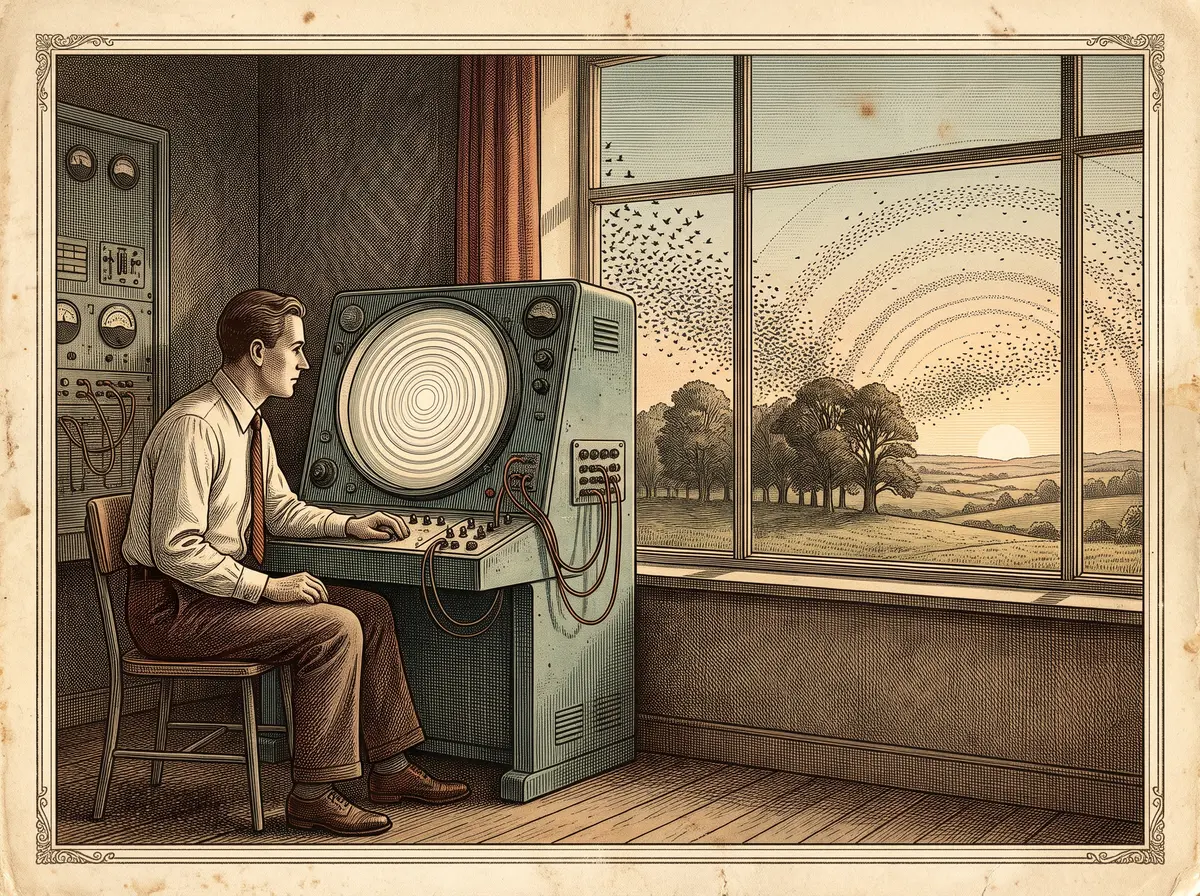
Around sunrise on February 17, 1959, a radar screen at Marconi's research station in Essex, England, showed something no aircraft could make. A bright dot appeared, then swelled into a perfect ring. Another ring followed it, and another, spreading outward like ripples from a pebble dropped in a pond. By the time it was over, eighteen rings had bloomed across the screen, the largest about 20 miles wide. Echoes like these had a name among radar crews: "angels."
By the Curiosities Desk · · 5 min read · Filed under Engineering · Today’s round
What happened: The Marconi Radar Rings
Radar had been seeing ghosts almost from the start. In 1940, operators at a coastal station at Happisburgh, Norfolk, traced some mystery echoes to a flock of geese crossing the sea. In September 1941, the biologist George Varley, working for the British Army’s operational research team, confirmed that echoes over the sea at Dover came from gannets flying alone. That finding sat in a secret report until 1945, when Varley and the ornithologist David Lack published it in Nature under the plain title “Detection of Birds by Radar.”
Still, many unexplained blips stayed unexplained. British operators lumped them together as “angels,” “ghosts,” or “phantoms.” Some came from weather. Others moved in ways that seemed to defy any explanation at all.
The strangest kind was the “ring angel.” In 1957, an American observer named F. C. Elder reported rings spreading across a radar screen at Ypsilanti, Michigan, at sunset. He suggested the cause might be a “gravity shear wave,” a kind of ripple in the atmosphere itself. A year later, the meteorologist Myron Ligda found a more down-to-earth culprit: a flock of red-winged blackbirds near Texarkana, Texas, had produced an expanding ring on his display.
Enter Eric Eastwood, Director of Research at the Marconi Company’s laboratory at Great Baddow, Essex. He had worked on RAF radar during the war, and now he had access to a powerful experimental set at nearby Bushy Hill. According to Marconi’s own history, it transmitted 2 megawatts at peak on a 23-centimeter wavelength and could follow a single seagull 70 miles away.
From August 1958, Eastwood’s team pointed a film camera at the radar display and recorded it day after day, covering about 5,000 square miles of southeast England. Playing the film back at 16 frames per second sped events up roughly 240 times. Suddenly, the rings became easy to watch: a point echo, then a ring, then more rings at nearly equal intervals. In the February 1959 example, the 18 rings arrived about two and a half minutes apart.
In 1959, Eastwood teamed up with David Lack, by then at Oxford’s Edward Grey Institute of Field Ornithology. By 1962, the Marconi group had published a 26-page paper in the Proceedings of the Royal Society with the answer in its title: “Radar ring angels and the roosting behaviour of starlings.”
The ghosts were starlings heading out for the day. Each ring was a wave of birds leaving one of their huge winter roosts at sunrise and flying out in every direction to find food.
Why it was strange: The Marconi Radar Rings
For years, careful people had proposed atmospheric waves to explain what turned out to be breakfast. The rings looked so regular and so large that a living cause seemed unlikely. A 20-mile circle drawn in near-perfect symmetry doesn’t look like the work of birds.
And birds are small radar targets. A starling is a few ounces of feathers and water. Radar engineers were building their sets to find metal bombers, not songbirds. That a powerful radar could see a flock of starlings, and even trace its morning schedule, surprised the people who had built it.
The starlings were also doing something nobody had measured. They weren’t leaving at random. They left in waves, as if on cue.
To see how starlings ended up on the wrong side of another famous story, read The Starlings America Blamed on Shakespeare — and the One Sentence That Invented the Story.
What scientists learned: The Marconi Radar Rings
The 1962 paper turned the radar into a bird-watching instrument with a 5,000-square-mile view. Among its findings:
- In calm weather, the birds left in concentric rings, flying at around 150 feet. In wind, the rings warped into arcs that drifted downwind.
- The departing birds averaged about 37 knots (roughly 43 miles per hour). They flew faster in winter (40 knots) than in summer (32 knots), though the authors noted the difference might reflect different populations of birds.
- The gap between waves was most often about 3 minutes, and each wave flew slightly slower than the one before.
- Departure times tracked the light. Cloud cover shifted them, and roosts many miles apart emptied at roughly the same moment.
- Based on the strength of the echoes, one large roost in February 1961 held around 500,000 birds.
- The rings followed the seasons. Ring activity peaked in late summer, declined through autumn and winter as flocks merged into bigger roosts, and stopped completely during the breeding season.
The team even linked the waves to cycles in the roost’s chatter, suggesting the birds’ noise rose and fell along with each departure. Eastwood went on to write a book, Radar Ornithology (1967), and the field had its name.
That search for one thing that turned up another belongs on the shelf with the other stories in Found While Looking for Something Else.
How it reaches us today: The Marconi Radar Rings
Radar engineers learned to filter birds out. Later systems ignored slow, nearby targets so air-defense operators could see aircraft instead of flocks. Ornithologists learned to keep the birds in.
Today, the United States runs more than 140 NEXRAD weather radars, and researchers mine their data for birds. The BirdCast project, run by the Cornell Lab of Ornithology and partners, uses these radars and machine learning to track and forecast nighttime migration across the country. Roost rings are still spotted regularly. Purple martins leaving their late-summer roosts make rings on weather radar that look a lot like the ones that puzzled Essex in 1959.
The same idea helps airports watch for flocks that could cause bird strikes. A wartime nuisance became one of the best tools scientists have for watching birds move across an entire continent at night.
For another story where secret wartime radar got a cover story, see The Night-Fighter Ace Whose Secret Radar Got Blamed on Carrots.
Fun fact: The Marconi Radar Rings
Marconi’s Bushy Hill radar was sensitive enough to follow a single seagull 70 miles away.
Sources: The Marconi Radar Rings
- E. Eastwood, G. A. Isted, and G. C. Rider, “Radar ring angels and the roosting behaviour of starlings,” Proceedings of the Royal Society of London B 156 (1962): 242–267 (primary source)
- E. Eastwood, J. D. Bell, and N. R. Phelp, “‘Ring Angels’ over South-East England,” Nature 183 (1959): 1759–1760 (primary source)
- D. Lack and G. C. Varley, “Detection of Birds by Radar,” Nature 156 (1945): 446
- Hugh Griffiths, “The History Column: Ring Angels” — IEEE Aerospace and Electronic Systems Society
- “Radar Ornithology” — BirdCast (Cornell Lab of Ornithology and partners)