Accidental Discoveries · Engineering
The Cat on a Foggy Fence That Supposedly Invented the Road Reflector
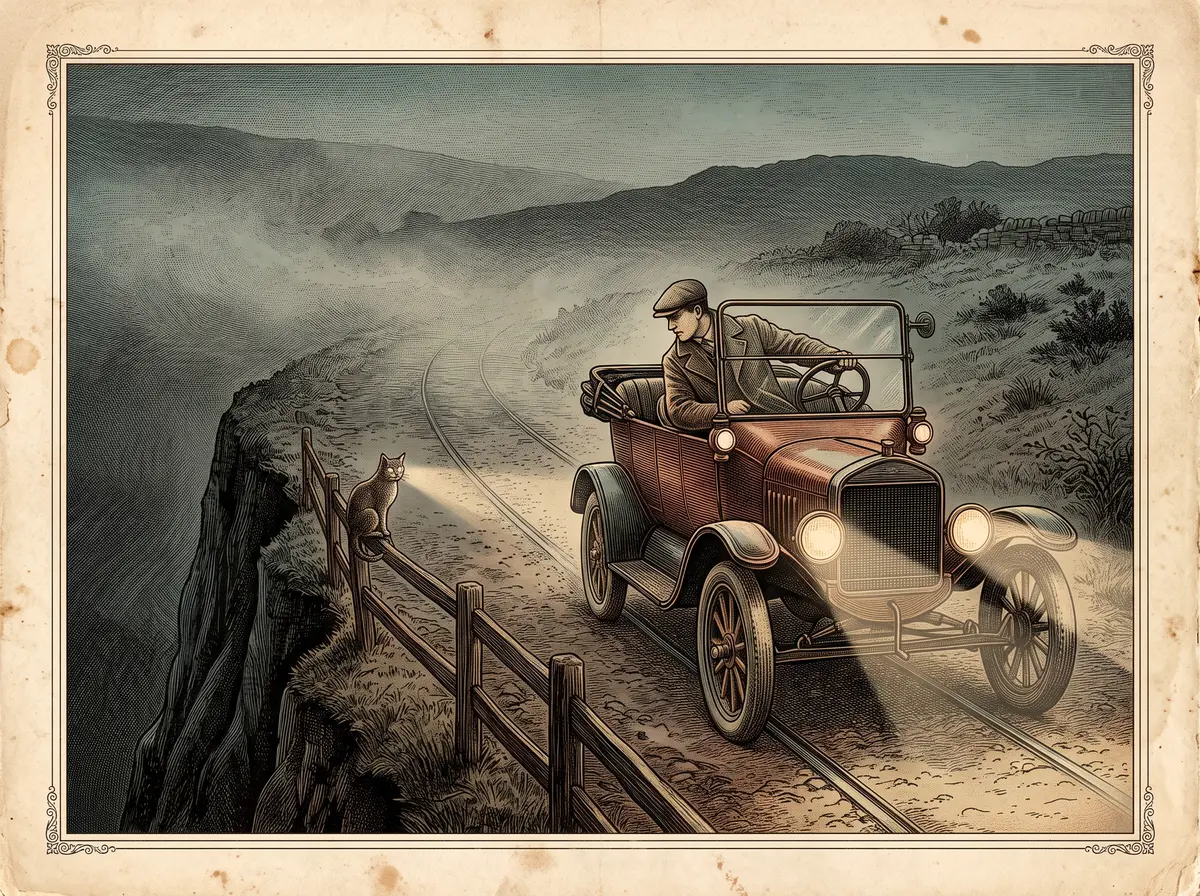
On a foggy night in the early 1930s, a Yorkshire road mender named Percy Shaw was driving home over a dark hill road outside Halifax, England, with a steep drop on one side. Then two small points of light flashed at him out of the murk. As the story goes, they belonged to a cat sitting on a fence, catching his headlights. Shaw realized he had drifted toward the edge, steered back, and went home with an idea that would end up in roads across Britain and around the world.
By the Curiosities Desk · · 5 min read · Filed under Engineering · Today’s round
What happened: The Cat's Eye
Percy Shaw was born in Halifax on April 15, 1890, and spent nearly his whole life in the same neighborhood, Boothtown. He left school at 13 and worked at everything from wire-making for textile looms to welding and fixing cars. By around 1930 he ran a small business laying asphalt and tar for private roads and garden paths. He knew roads well, and he spent a lot of time driving them at night.
The road he used most, between Queensbury and Boothtown, was a tricky one. According to Calderdale Museums, it had a sheer drop that Shaw nicknamed “the death drop,” and on dark nights the only guide was the pair of tram rails running down the middle, which he said shone in his headlights “like twin silver ribbons.”
What happened next is where the legend begins, and Shaw himself didn’t help settle it. The best-known version is the cat: on a foggy drive home, the eyes of a cat on a fence reflected his headlights and warned him he was heading off the road. But Shaw told the broadcaster Alan Whicker a less charming version, saying the idea came from wanting to move the reflectors used on road signs down onto the road surface itself. And schoolchildren who toured his factory in the late 1970s were told it was the polished tram rails, not a cat, that showed him the way. Historians don’t know which version is true.
What is documented is the patent work. On April 3, 1934, Shaw filed three British patent applications. The first, GB436290, published in 1935, describes a road-marking block: a metal holder with a springy rubber filling, fitted with reflectors, that sits slightly above the road and sinks flush with the surface when a wheel rolls over it. He built test rigs himself, including an optical test tunnel made from an old oil drum, according to an industrial-history profile on Grace’s Guide.
In 1935 he formed a company, Reflecting Roadstuds Ltd, and registered the trademark “Catseye.” Then he had to convince someone to buy them. At his own expense, he installed 50 studs at a foggy crossroads between Leeds and Bradford as a demonstration. Sales were slow.
The Second World War changed that. Under the blackout rules that began in 1939, drivers had to dim and shade their headlights so German bombers couldn’t spot towns from the air. Night driving became more dangerous, and a small stud that bounced faint headlight beams straight back at the driver became valuable. Orders surged. Calderdale Museums reports that the small workshop received orders for 40,000 studs a week. After the war, a Ministry of Transport committee gave the studs firm government backing, and Shaw’s firm grew to make more than a million a year, exporting them worldwide. He was awarded an OBE (an honor from the British crown) in 1965 for services to exports.
Why it was strange: The Cat's Eye
The most famous road safety device in Britain may owe its name and origin to a cat, and nobody can say for sure. Shaw told the story different ways, and the cat version won mostly because it was the best story.
Shaw himself was hardly a typical industrialist. He stayed in the house he’d lived in since he was two. He stripped out most of the carpets and curtains. He kept four televisions running side by side with the sound turned down, so visiting friends could watch whatever channel they liked. When his factory needed to expand, he wouldn’t allow a sycamore tree he’d known since childhood to be cut down, so the extension was built around it, and the tree grew up through the roof.
For another time a cat’s-eye story was told to the public in place of the real one, see The Night-Fighter Ace Whose Secret Radar Got Blamed on Carrots.
What scientists learned: The Cat's Eye
Whatever inspired it, the device works because of a principle called retroreflection, in which light is sent back toward the direction it came from instead of scattering in all directions. A real cat’s eye does this with the tapetum lucidum, a reflective layer behind the retina that bounces incoming light back out. That’s why cats’ eyes glow in headlights.
Shaw didn’t invent the optics. In 1927, an English accountant named Richard Hollins Murray patented a retroreflecting lens for advertising signs, and Shaw acknowledged that Murray’s work fed into his own. Shaw’s real advance was mechanical. The studs had to survive being hammered by truck tires every day, and they had to stay clean on muddy, rainy roads.
His solution was the rubber housing. When a wheel presses the stud down, the glass reflectors sink below the road, and a fixed rubber wiper cleans their surfaces like an eyelid blinking. The base also holds rainwater, which makes the wiping work better. The dirtiest weather, when drivers most need the studs, is when they clean themselves best.
Glass is the quiet hero of the design; for its longer backstory, see From a Beach Bonfire to a Cake in a Battery Jar: A Short History of Glass.
How it reaches us today: The Cat's Eye
Drive on a British motorway at night and you’ll still see them: a line of glowing dots tracing every lane. The UK even color-codes them. White studs mark lane lines and center lines, red marks the left edge of the carriageway, amber marks the edge next to the central reservation, and green marks places where you can cross, such as slip roads.
The common U.S. equivalent, the raised plastic pavement marker, doesn’t have Shaw’s self-cleaning rubber. Newer versions include solar-powered LED studs that glow on their own. But the basic job hasn’t changed since 1934: send a driver’s own headlight beam back, and show them where the road is.
For another accidental breakthrough in everyday engineering, see The Overheated Glass Plate That Bounced Off the Floor — and Became CorningWare.
However the idea arrived, the stud is one of the finds in Found While Looking for Something Else.
Fun fact: The Cat's Eye
Percy Shaw’s first patent for the cat’s eye included a version shaped like a Maltese cross, designed to sit in the middle of a crossroads.
Sources: The Cat's Eye
- Percy Shaw, “Improvements relating to blocks for road surface marking,” British patent GB436290 — filed April 3, 1934 (primary source)
- “Percy Shaw” — Calderdale Museums, Halifax
- “Percy Shaw” — Grace’s Guide to British Industrial History
- “Percy Shaw: the Yorkshire inventor who patented the reflective road stud or cat’s eye in 1934” — The Yorkshire Post
- “Percy Shaw: The inventor of Catseyes” — MyLearning (Yorkshire museums education resource)