The Scientist Behind It · Engineering
The Physicist Who Fought Poison Gas With a Fan She Tested by Burning Paper in Her Drawing Room
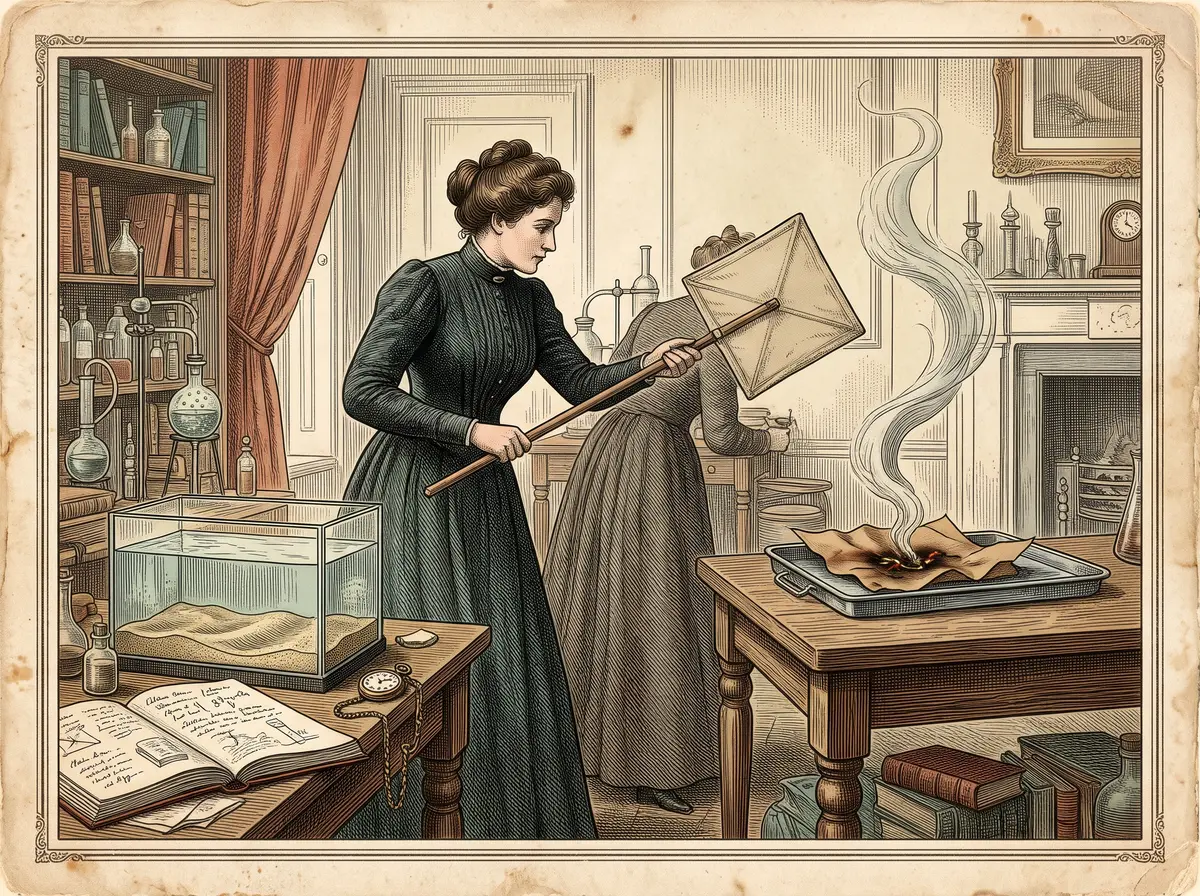
In May 1915, in a London house, Hertha Ayrton set a pile of brown paper smoking and started flapping at it. Hertha Ayrton wasn't panicking. She was timing how fast she could chase the smoke out of the room, because she believed that a plain canvas fan, swung the right way, could clear poison gas out of the trenches of the Western Front.
By the Curiosities Desk · · 5 min read · Filed under Engineering · Today’s round
Part of The Person Who Would Not Drop It
What happened: Hertha Ayrton
Hertha Ayrton was born Phoebe Sarah Marks in Portsea, near Portsmouth, on 28 April 1854. By the turn of the century she was one of Britain’s leading experts on the electric arc, the hot, hissing spark that lit streetlamps of the day. In 1899 she became the first woman elected a member of the Institution of Electrical Engineers. The Royal Society was harder to crack. When her paper on the arc was presented there in 1901, a man, the engineer John Perry, had to read it for her. When she was nominated for a fellowship in 1902, the Society’s council ruled that married women were not eligible.
Then, on a seaside stay in Margate in 1903, she noticed the ripples that waves leave in sand. According to the historian Patricia Fara, she was soon making her own small sea in a zinc bath, rocking water back and forth over sand to watch the ripples form. In 1904 she read her own ripple paper before the Royal Society, the first woman to do so. In 1906 the Society awarded her its Hughes Medal for her work on the arc and on ripples, the first time it went to a woman.
Her water tanks taught her how swirling eddies form when moving water meets an obstacle. That knowledge became suddenly practical on 22 April 1915, when the German army released a cloud of chlorine gas near Ypres in Belgium. Chlorine is heavier than air, so it rolled into trenches, dugouts and shell holes and lingered there.
Ayrton later wrote that on 6 May 1915 she “conceived the idea” that soldiers might drive the gas off themselves. She tested the principle at home with burning brown paper. By mid-May she had a working model, which she tried out in the Kensington back garden of her friend Ernestine Mills, an enamel artist and fellow suffragette.
The design she settled on was humble. The Imperial War Museum’s surviving example is a square blade of waterproof canvas, roughly 15 to 16 inches across, stiffened with cane and mounted on a wooden handle about 3½ feet long. It weighs under a pound and folds small enough to tuck behind a soldier’s pack.
Persuading the army took a year. The British Army’s Inventions Committee turned the idea down in 1915. Ayrton wrote letters, argued in the press and found allies who took the case to David Lloyd George and Field Marshal Douglas Haig. A trial was finally held in France, and from 1916 about 104,000 “Ayrton fans” went to British troops on the Western Front. When American forces arrived in 1918, the US Army ordered 50,000 more.
Why it was strange: Hertha Ayrton
Most anti-gas ideas of the time leaned on chemistry: soaked pads, masks and filters. Ayrton’s answer was pure physics, a tool closer to a carpet beater than to a laboratory. It came from someone the scientific establishment had kept at arm’s length, using knowledge she had gathered by watching sand in a bathtub.
It also turned out to be fiercely disputed. Major General Charles Foulkes, who commanded Britain’s gas troops, called the fan “actually worse than useless.” According to the Australian War Memorial, more than 60 divisional gas officers he surveyed late in the war agreed it served “no useful purpose whatever” against an oncoming gas cloud. Waving a big fan while wearing a gas mask was exhausting, and the effort used up a respirator faster. One account even suggests the wooden handles sometimes ended up as emergency fuel. Other veterans disagreed: in 1920 a Major H. J. Gillespie wrote to The Times praising the fan and criticizing how long the army took to adopt it.
Ayrton’s work belongs on the same grim timeline as The Chemist Who Fed the World and Gassed the Trenches, the scientist who pushed for using chlorine in the first place.
What scientists learned: Hertha Ayrton
Ayrton’s key idea was that a sharp flap doesn’t simply push air forward. It sets off a whirling eddy that rolls along the ground, shoving heavy gas ahead of it and pulling fresh air in behind. Her tank experiments had shown the same kind of rolling eddies in water. In November 1917, the Nobel laureate Lord Rayleigh refereed her Royal Society paper “On a new method of driving off poisonous gases” and recommended it for publication. It appeared in the Society’s Proceedings in 1919.
The arguments over whether the fan “worked” mostly come down to which job it was given. The Science Museum Group notes that early versions only worked in winds below about nine miles per hour. No soldier could fan back an entire advancing cloud against the breeze. Clearing gas that had already settled into a trench, crater or dugout was a smaller, more realistic job. That is the use the Imperial War Museum’s records describe: making a position safe within minutes rather than hours or days.
How it reaches us today: Hertha Ayrton
Ayrton fans are now museum pieces, but her career helped change who science allowed in the room. The Royal Society didn’t elect its first women Fellows until 1945, more than two decades after her death on 26 August 1923, and her story is often told as part of how that rule fell. Her fans also sit in the long line of wartime gear that civilians reinvented, alongside The Gas Mask Filter That Became a Makeup Wipe — Until America Started Blowing Its Nose in It.
The physics outlived the war. The Institution of Mechanical Engineers notes that her approach was later adapted to improve ventilation in mine shafts. And the basic lesson behind her fan — that air moves in rolling eddies, not straight lines — is part of how engineers think about clearing smoke and fumes from enclosed spaces today. She belongs with the other people who would not put the work down, in The Person Who Would Not Drop It.
Fun fact: Hertha Ayrton
When Lord Rayleigh refereed Ayrton’s gas-fan paper in 1917, he didn’t just approve it. He added that it was “very desirable” for the paper to be published right away.
A note: this story touches on the deaths of soldiers in a chemical-weapons war. If history like this weighs on you, it’s okay to step away for a while or talk it through with someone you trust.
Sources: Hertha Ayrton
- Imperial War Museums — Ayrton anti-gas fan, object record (catalogue 30028167)
- Science Museum Group Journal — The life and material culture of Hertha Marks Ayrton (1854–1923): suffragette, physicist, mathematician and inventor
- The Royal Society, Making Science archive — Referee’s report by Lord Rayleigh on “A new method of driving off poisonous gases” by Hertha Ayrton (RR/24/5, 1917)
- Australian War Memorial — Ayrton Fan: Lieutenant Colonel J B St Vincent-Welch, 13 Field Ambulance, AIF
- History Today — How Hertha Ayrton Made Waves