Failed Experiments · Engineering
The Propeller-Driven Train That Hung Above a Railway Line — and Never Carried a Paying Passenger
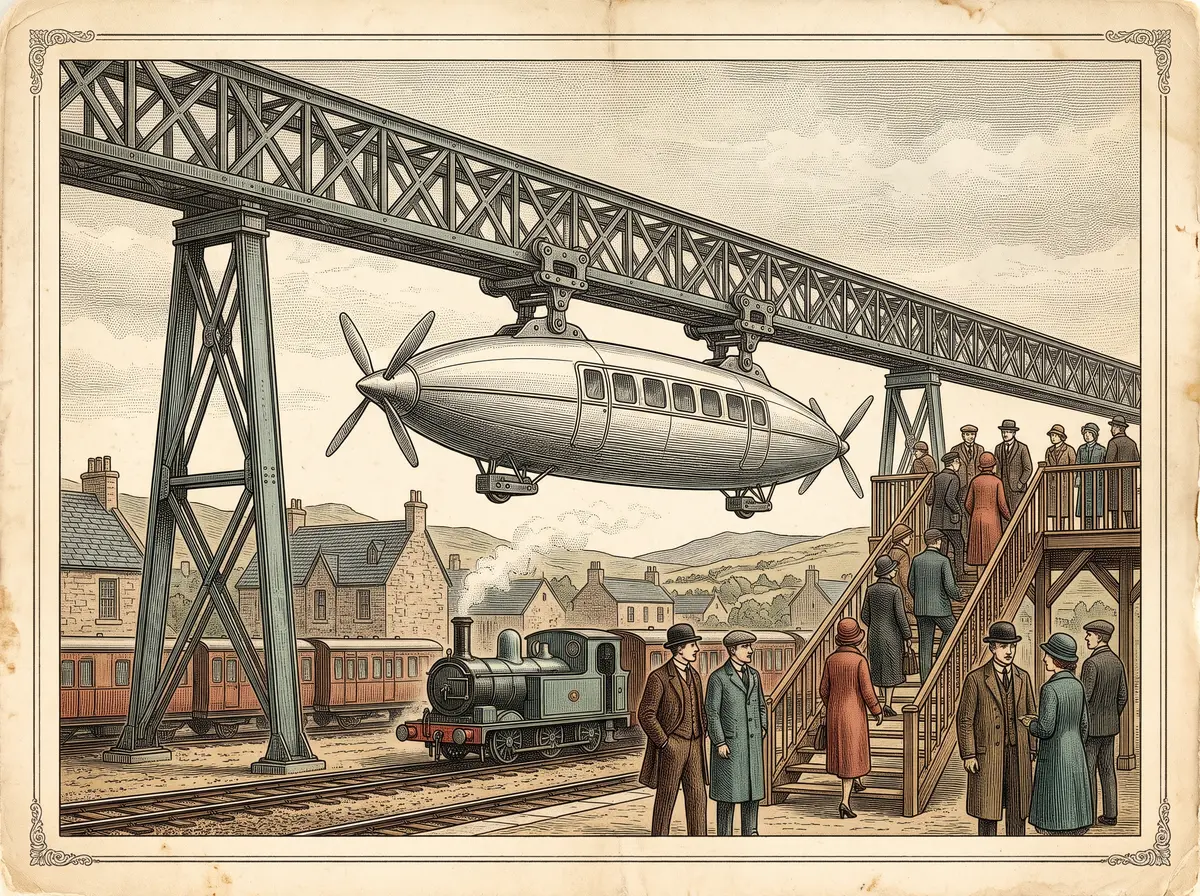
On July 8, 1930, in the small town of Milngavie just outside Glasgow, invited guests climbed a staircase and stepped into a silver, airship-shaped carriage hanging from a steel girder. Inside were plush seats and stained-glass windows. At each end of the carriage was an aircraft propeller. Below it, on the ordinary railway line, sat the trains it was meant to leave behind.
By the Curiosities Desk · · 5 min read · Filed under Engineering · Today’s round
What happened: The Propeller-Driven Train That Hung Above a Railway Line — and Never
The man behind the strange machine was George Bennie, born in 1891 near Glasgow (some records say 1892) and raised in a well-off family. Bennie had no formal engineering training, but he had a big idea. Britain’s railways were crowded with slow freight trains and stopping local services. Why not build a second, faster railway on top of the first one?
By 1921 he had applied for a patent on what he called the “Railplane,” a high-level suspended monorail, and it was granted in 1923. The plan was for passenger cars to hang beneath a single overhead rail strung on tall steel frames above existing tracks. Freight and local trains would keep running underneath, while express passengers, mail, and perishable goods zipped along overhead. Because the line would sit above railway land that already existed, Bennie argued, there would be little need to buy new ground.
The cars would not be pushed by their wheels like a normal train. They would be pulled through the air by propellers.
Bennie hired consultant engineer Hugh Fraser to turn the concept into a working design, and he paid for much of the prototype himself. The steel test track was built over a freight siding that served the Burnbrae Dyeworks in Milngavie. It was short: about 130 yards (roughly 120 meters), with spans of about 80 feet and around 16 feet of clearance above the rails below. The carriage was built by William Beardmore & Company at its Dalmuir works, using aircraft techniques. It was about 52 feet long, weighed around six tons, and had a skin of duralumin, a light aluminum alloy. Electric motors fed through the rail turned a two-bladed propeller at each end, and to stop, the car could reverse its propellers.
The press and invited public got their first rides on July 8, 1930. Reports described the ride as smooth, and the launch drew real excitement. Bennie claimed the system could reach 120 miles per hour. But on a track the length of a few football fields, the prototype never had room to prove it; the national heritage record for the site notes that the test line allowed no more than about 50 mph.
Then came the hard part: money. Bennie proposed lines from Glasgow to Edinburgh, from Southport to Blackpool, and in the south of France. In 1931 he announced he had raised enough to build a line from central London to Croydon Airport, but the Southern Railway, whose own trains served Croydon, opposed it. None of the lines was built, and the Railplane never carried a single paying passenger. According to one history of the project, Bennie spent about £150,000 of his own fortune on the Railplane.
In May 1936 he was removed from the board of the company set up to promote it. In 1937 he was declared bankrupt. The carriage stayed where it was, hanging over the siding in Milngavie and slowly weathering, until 1956, when the car and its track were scrapped. Bennie died the following year, in 1957.
Why it was strange: The Propeller-Driven Train That Hung Above a Railway Line — and Never
At first glance, the Railplane looks like a joke: a train with propellers, dangling above another train. But its logic was serious. Railways in the 1920s faced exactly the problem Bennie described: fast and slow traffic sharing the same tracks. Stacking them was a clever way around the cost of buying land for a whole new line.
The strangest part is that the Railplane mostly worked. It carried people, ran smoothly, and stopped when asked. It failed not because the machine broke but because nobody would pay to build a real one. Even the plan to save money by building over existing railways had a catch: it meant asking those railway companies for permission to build a faster competitor right above their heads.
Another railway that looked brilliant in trials and still didn’t last: The Railway That Ran on Suction — and the Rats Blamed for Eating It.
What scientists learned: The Propeller-Driven Train That Hung Above a Railway Line — and Never
The Railplane was a test of a simple trade-off. A conventional train moves by friction: its powered wheels push against the rails. That works well, but it also means power has to travel through wheels and gears to the track. A propeller instead pushes the vehicle by throwing air backward. It needs no grip at all, which is why airplanes and airboats use it.
Hanging the car below the rail had another advantage. A suspended vehicle swings outward on curves, a bit like a pendulum, which can make turns feel gentler to passengers. To keep the Railplane from swaying too much, Fraser’s design added a second guide rail underneath the car, with wheels to limit its sideways motion.
The trouble is that a track only 130 yards long could never show what the system might do at full speed. The prototype answered the question “Can it run?” but not the more expensive one: “Is it worth building for hundreds of miles?”
Britain tried to make other vehicles fly in odd ways, too: The Jeep Britain Tried to Fly Like a Kite — and Got It Off the Ground Behind a Bentley.
How it reaches us today: The Propeller-Driven Train That Hung Above a Railway Line — and Never
Bennie never gave up. In 1946 and 1951 he formed new companies to promote “airspeed railways,” with proposals for airport links and routes in the Middle East. None went ahead.
Still, the Railplane’s core ideas did not vanish. Suspended monorails carry passengers today, most famously in Wuppertal, Germany, whose line opened back in 1901, and in Chiba, Japan. Elevated people movers above existing roads and rail corridors are now a standard way to squeeze new transit into crowded cities. And the dream of a fast, dedicated line separated from slow traffic is the basic principle behind modern high-speed rail.
The Railplane’s story sits with the other trials that didn’t turn out as planned in The Experiment That Did Not Come Out.
Fun fact: The Propeller-Driven Train That Hung Above a Railway Line — and Never
The Railplane carriage was luxurious for a test vehicle: its interior was fitted out by Waring & Gillow, a high-end furniture firm, and its doors had stained-glass windows. The wooden goods shed beside the test site still stands in Milngavie, now part of a timber yard.
Sources: The Propeller-Driven Train That Hung Above a Railway Line — and Never
- University of Glasgow Archives & Special Collections, “George Bennie Railplane” — the university’s archive of Bennie’s Railplane records, with the patent, launch, bankruptcy, and scrapping dates
- Canmore (Historic Environment Scotland), “Milngavie, Bennie Railplane” — the national heritage record of the test track’s structure, dimensions, and speed limits
- Malcolm Thwaite, “The George Bennie Railplane and Hugh Fraser Airrail Systems of Transport,” Transactions of the Newcomen Society 75 (2005) — the most detailed scholarly history of the project
- Old Machine Press, “Bennie Railplane” (2014) — technical specifications of the car, propellers, and July 8, 1930 opening
- Ian Visits, “Unbuilt London: The High-Speed Railplane Monorail” (2016) — the Croydon Airport proposal and Bennie’s estimated spending