Failed Experiments · Engineering
The Scientists' Joke Club That Tried to Drill a Hole to Earth's Mantle
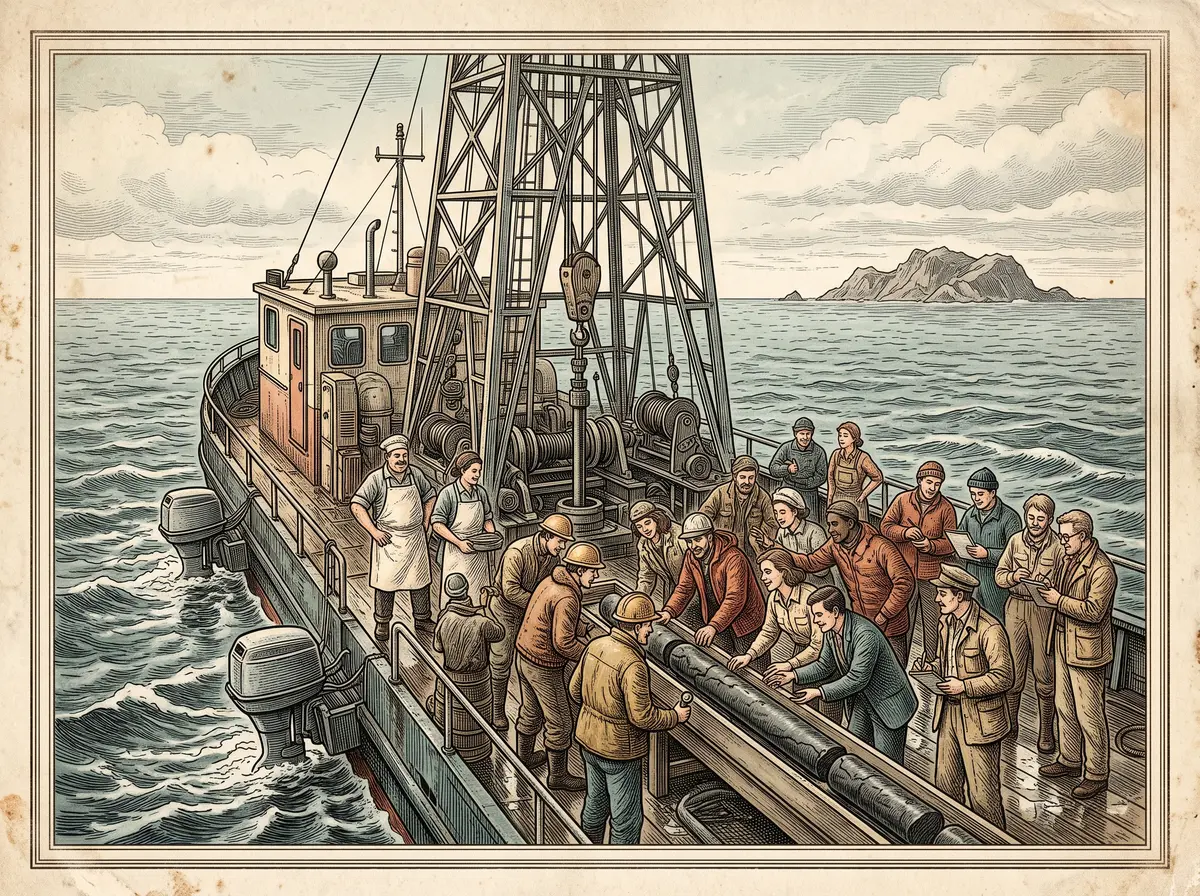
In April 1961, on a rolling barge 40 miles off Mexico's Guadalupe Island, a crowd of cooks, deckhands, drillers, and scientists pressed in around a short core of dark rock that had just come up through almost 12,000 feet of water. It was basalt from beneath the seafloor, the first oceanic crust anyone had ever held. The novelist John Steinbeck, aboard as a reporter, called it more precious to him than any jewel. The venture had been launched by a club of scientists so informal it kept no membership list, and its goal was to drill all the way to Earth's mantle.
By the Curiosities Desk · · 5 min read · Filed under Engineering · Today’s round
What happened: The Scientists' Joke Club That Tried to Drill a Hole to Earth's Mantle
In 1909 the Croatian seismologist Andrija Mohorovičić noticed that earthquake waves sped up sharply at a certain depth. He had found the boundary between the Earth’s crust and the denser mantle beneath it, now called the Mohorovičić discontinuity, or “Moho” for short. Under the continents it lies about 30 kilometers down. Under the oceans, the crust is far thinner, only about 5 kilometers of rock, but it sits beneath miles of water.
In March 1957, at the end of a National Science Foundation meeting to review Earth-science grant proposals, the oceanographer Walter Munk suggested an audacious idea: drill all the way to the Moho and bring back a piece of the mantle. The Princeton geologist Harry Hess loved it. They took it to the American Miscellaneous Society, or AMSOC, an informal circle of Earth scientists gathered by Gordon Lill of the Office of Naval Research. AMSOC had been created, half in jest, to handle “miscellaneous” research proposals that fit nowhere else. It kept no membership list; anyone could join whenever two or more members were together. Its mock-Latin motto was Illegitimi non carborundum, roughly “Don’t let the bastards grind you down.”
That whimsical group became, with the National Academy of Sciences, the sponsor of Project Mohole. The name was a pun: a hole to the Moho.
The engineering problem was enormous. Offshore rigs of the 1950s worked in a few hundred feet of water. Mohole would have to drill in water miles deep from a ship that could not be anchored. Under technical director Willard Bascom, the team borrowed CUSS I, an oil-exploration barge built by a consortium of Continental, Union, Superior, and Shell oil companies. They fitted it with four large outboard motors and surrounded it with sonar and radar buoys. A pilot watching the signals used a joystick to steer the barge, holding it within a circle about 600 feet across while the drill pipe dangled below. Steinbeck, writing for Life, said the barge had all the sleek lines of an outhouse standing on a garbage scow.
It worked. In March and April 1961, in about 11,700 feet of water, CUSS I drilled five holes. The deepest went 601 feet into the seafloor, through layers of ancient sediment and into about 44 feet of basalt. President John F. Kennedy sent a message to the heads of the National Academy of Sciences and the NSF calling it “an historic landmark in our scientific and engineering progress.”
Then came the part that never worked. Phase II was supposed to build a giant new drill ship to go all the way down. In 1962 the NSF chose Houston’s Brown & Root as prime contractor, a company with no ocean-drilling experience but close ties to Texas congressman Albert Thomas and Vice President Lyndon Johnson. Many saw the choice as political. Costs ballooned toward $125 million for the ship alone. In 1963, AMSOC’s own Mohole chairman, Hollis Hedberg, warned that the project could become either a great scientific venture or “a foolish and unjustifiably expensive fiasco.” AMSOC dissolved itself in early 1964. After Representative Thomas died in February 1966, and with Vietnam War spending squeezing the budget, Congress cut off the money that year. About $57 million had been spent. Not a foot of new hole had been drilled toward the Moho.
Why it was strange: The Scientists' Joke Club That Tried to Drill a Hole to Earth's Mantle
Most failed experiments fail at the experiment. Mohole did the opposite. The science test was a triumph: it proved that a ship floating over miles of water could hold still and drill. What failed was everything around it: the contract, the budget, the politics, and the argument over what to build next. Munk later suggested that the first phase’s very success helped doom the project. Decades later he wrote that he had been “trying to forget” Mohole for twenty years.
And it is hard not to smile at the cast: a club with no membership list, a pun for a name, and a fake-Latin motto briefly pulled off something no one had ever done.
Another expedition that aimed at the planet’s insides: The Army Captain Who Asked Congress to Fund a Trip Inside the Earth.
What scientists learned: The Scientists' Joke Club That Tried to Drill a Hole to Earth's Mantle
The cores confirmed what seismologists had predicted: beneath the ocean sediments lay basalt, a dark volcanic rock. The drill also reached sediments from the Miocene epoch, 5 to 23 million years old.
The bigger lesson was in engineering. The outboard-motor trick became dynamic positioning, the technique of holding a vessel in place with computer-controlled thrusters instead of anchors. That opened the deep ocean to drilling. Former Mohole scientists formed the JOIDES partnership in 1964, and the Deep Sea Drilling Project’s ship Glomar Challenger began work in 1968. Its cores from the Atlantic showed that the seafloor gets older the farther it is from the Mid-Atlantic Ridge, strong evidence for seafloor spreading and plate tectonics.
Earth’s surface has fooled engineers before: The Drilling Rig That Pulled the Plug on a Lake — and Then Got Sucked Down the Drain.
How it reaches us today: The Scientists' Joke Club That Tried to Drill a Hole to Earth's Mantle
Dynamic positioning now holds deep-water oil rigs, cable-laying vessels, and research ships steady around the world. Mohole’s scientific heirs, such as the JOIDES Resolution and Japan’s Chikyu, have drilled thousands of holes that record Earth’s climate and history.
The mantle itself is still out of reach by the direct route. No hole has ever been drilled down through the crust and across the Moho. Scientists have found a shortcut, though. In 2023, the JOIDES Resolution drilled at the Atlantis Massif on the Mid-Atlantic Ridge, where mantle rock has been pushed up to the seafloor, and recovered about 1,268 meters of nearly continuous mantle rock, described in Science in 2024.
For more ambitious tests that did not go to plan, visit The Experiment That Did Not Come Out.
Fun fact: The Scientists' Joke Club That Tried to Drill a Hole to Earth's Mantle
The same playful society that launched Mohole also handed out the Albatross Award, a stuffed albatross from the Scripps natural history collection, to oceanographers for making conceptual leaps on the scale of an ocean. Walter Munk was one of its winners.
Sources: The Scientists' Joke Club That Tried to Drill a Hole to Earth's Mantle
- John F. Kennedy, “Message to Detlev W. Bronk and Alan T. Waterman Regarding the Success of the First Phase of Project Mohole” (April 1961), The American Presidency Project, UC Santa Barbara.
- “Benchmarks: March 1961: Project Mohole undertakes the first deep-ocean drilling,” EARTH Magazine (American Geosciences Institute), including Steinbeck’s description of CUSS I.
- “‘A Foolish and Unjustifiably Expensive Fiasco’: the beginnings of ocean drilling,” JOIDES Resolution / International Ocean Discovery Program, on AMSOC, costs, Hedberg’s warning, and Munk’s later reflection.
- Woods Hole Oceanographic Institution, “Rocks recovered from mantle could reveal sources of volcanoes and origins of life on Earth” (2024), on the Expedition 399 mantle core published in Science.
- “Project Mohole,” Wikipedia, as a guide to D. S. Greenberg’s 1964–1966 Science reporting, Willard Bascom’s A Hole in the Bottom of the Sea (1961), and Steinbeck’s April 14, 1961 Life article.