Failed Experiments · Engineering
The Jeep Britain Tried to Fly Like a Kite — and Got It Off the Ground Behind a Bentley
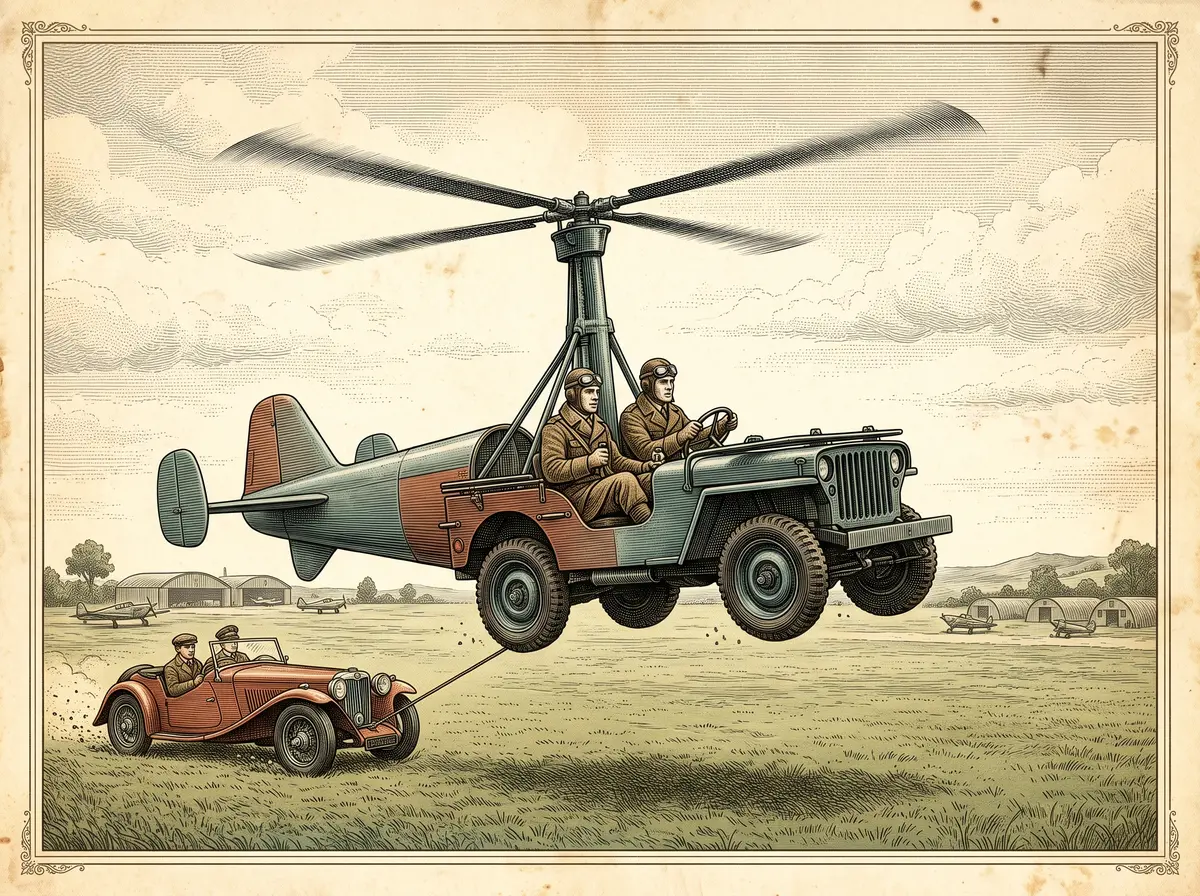
On November 27, 1943, at an English airfield, a supercharged Bentley sports car roared down the runway towing an army jeep on a rope. The jeep had a two-bladed rotor more than 40 feet across bolted to its roof, a tail with fins stuck on its back end, and two men inside — one to drive it, one to fly it. As the Bentley picked up speed, the jeep's wheels left the ground.
By the Curiosities Desk · · 5 min read · Filed under Engineering · Today’s round
What happened: The Rotabuggy
In 1943, Britain’s Airborne Forces Experimental Establishment, or AFEE, had a delivery problem. Paratroopers could drop behind enemy lines, but once they landed they were on foot. The AFEE’s job was to test new ways of getting soldiers and equipment into battle by air, and one of its designers, the Austrian-born engineer Raoul Hafner, already had a strange success on his hands: the Rotachute, a one-man rotor kite meant to carry a soldier to the ground under a spinning rotor instead of a parachute.
If a rotor could carry a soldier, Hafner reasoned, why not a soldier’s car? Under an Air Ministry specification for a “Special Rotating Wing Glider,” the firm R. Malcolm & Co. built a single prototype at White Waltham. It was a standard Willys jeep fitted with a rotor on a tall mast, a streamlined tail fairing, and fins. It was first nicknamed the “Blitz Buggy” and later renamed the Rotabuggy. The plan: a bomber would tow it into the sky, release it, and the jeep would glide down under its spinning rotor. On landing, the crew would simply drive away.
Before anyone fitted a rotor, the engineers checked whether a jeep could survive the landing. They dropped a standard jeep from heights of up to about 7.7 feet (2.35 meters) and found it came through undamaged.
Getting it airborne was harder. The first trial, on November 16, 1943, used a Diamond T truck as the tow vehicle. The truck simply wasn’t fast enough to spin the rotor up to flying speed. So the team found a faster tug: a supercharged 4.5-litre Bentley. According to a Yorkshire aviation history archive that documents the airfield at Sherburn-in-Elmet where the tests were flown, the Bentley belonged to the test pilot himself, Ian Little. On November 27, the jeep flew.
Then it shook. Above about 45 mph, the vibration was severe. The team kept adjusting the design and switched to a much stronger tug, an Armstrong Whitworth Whitley bomber. By early 1944 the Rotabuggy had reached 70 mph. The testing had costs: the same Yorkshire archive records that on February 23, 1944, during the thirtieth test flight, the Rotabuggy tipped over on landing and smashed its rotor blades. The pilot walked away, but his passenger suffered broken ribs and a concussion.
The jeep was repaired. In September 1944 it made its final and best flight: released by the Whitley, it flew for about ten minutes at 400 feet and 65 mph, then landed safely. The test team’s verdict on its handling was “highly satisfactory.”
And then the project was cancelled.
Why it was strange: The Rotabuggy
The Rotabuggy didn’t fail because it couldn’t fly. It failed because something more ordinary did the job better. By 1944, Britain had large gliders such as the Airspeed Horsa and the Waco Hadrian that could carry a jeep inside them — no rotor, no flying car, no second pilot needed. A flying jeep that worked was still less useful than a box that could hold one.
It’s a very common way for experiments to end: not with a crash, but with a quieter, better idea arriving first. Hafner even sketched a larger sequel, the “Rotatank,” which would have hung a rotor over a Valentine tank. It never left the drawing board.
Britain’s wartime engineers tried to build other improbable machines too: The Aircraft Carrier Britain Tried to Build Out of Ice.
What scientists learned: The Rotabuggy
The Rotabuggy wasn’t a helicopter. It had no engine driving its rotor at all. Instead, it relied on autorotation: when air flows up through a rotor that’s free to spin, the blades turn on their own, like the seed of a sycamore tree spinning to the ground. A spinning rotor creates lift, so a forward pull from a tow vehicle — or a steady fall through the air — keeps it turning and keeps the load aloft.
That is why the slow truck failed and the Bentley worked. A rotor kite’s lift depends on how fast air is moving through the blades, so the faster the tow, the more lift. It also explains the vibration: a big two-bladed rotor spinning freely on top of a heavy, stubby vehicle is a hard thing to balance, and every bump in airspeed was passed straight down the mast to the crew.
Another wartime British experiment that worked better on paper than in practice: The Nuclear Landmine Britain Planned to Keep Warm With Live Chickens.
How it reaches us today: The Rotabuggy
The Rotabuggy itself left no descendants, but its designer did. In 1944 Hafner became chief designer of the new helicopter division at the Bristol Aeroplane Company, where his team produced the Bristol Sycamore, one of the first British-designed helicopters to go into service. The dream of delivering vehicles by rotor came true in a different form: today, helicopters routinely carry jeeps and light vehicles slung underneath them.
The autorotation physics the Rotabuggy relied on is also a lifesaver. A helicopter that loses its engine can still descend under a freely spinning rotor and land, the same way the flying jeep came down. And gyroplanes — small aircraft whose unpowered rotors spin in the airflow while an engine pushes them forward — still fly on Hafner’s principle.
A full-size replica of the Rotabuggy is on display at the Museum of Army Flying in Middle Wallop, England.
Another vehicle that was supposed to fly and mostly hovered instead: The Flying Saucer the Air Force Built That Maxed Out at 35 MPH.
A jeep that left the ground behind a sports car sits with the other trials that did not become the plan in The Experiment That Did Not Come Out.
Fun fact: The Rotabuggy
Ian Little, the pilot who flew the jeep, later became an Oxford economist. He described his wartime job as being “a sort of James Bond trying out Q’s inventions” — and one of the doctoral students he later supervised at Oxford was Manmohan Singh, the future Prime Minister of India.
Sources: The Rotabuggy
- Yorkshire Aircraft, “Hafner Rotabuggy RD123, Sherburn-in-Elmet” — local aviation history archive with the test timeline, the Bentley, and the February 1944 accident
- Christopher Bliss and Vijay Joshi, “Ian Malcolm David Little 1918–2012,” Biographical Memoirs of Fellows of the British Academy XIII (2014) — Little’s test-flying career and his “James Bond” description
- Steven J. Zaloga, Jeeps 1941–45 (Osprey, 2005), pp. 37–38 — the drop tests, tow trials, and cancellation
- Nuffield College, Oxford, “Dr Manmohan Singh (1932–2024)” — Singh’s DPhil under Ian Little
- Vertical Flight Society, biography of Raoul Hafner — Hafner’s move to Bristol’s helicopter division in 1944