Weird Medical History · Chemistry
The Senator's Vitamin Tonic That Was 12 Percent Alcohol — 'as a Preservative'
In 1951, on Groucho Marx's quiz show, the comedian asked a Louisiana state senator the obvious question about the tonic he sold: what was it good for? The senator, Dudley J. LeBlanc, grinned and answered, by the most-repeated account, that it had been good for about five million dollars for him last year. (Retellings disagree on whether it was five million or five and a half.) The tonic was Hadacol, a murky brown "dietary supplement" that was about 12 percent alcohol, which the label said was there "as a Preservative."
By the Curiosities Desk · · 5 min read · Filed under Chemistry · Today’s round
Part of Medicine, Before It Was Sure
What happened: The Senator's Vitamin Tonic That Was 12 Percent Alcohol — 'as a Preservative'
Dudley LeBlanc, born in 1894 near Youngsville, Louisiana, was a proud Cajun, a World War I sergeant, a radio newscaster in English and French, and a politician who served in the Louisiana House and, off and on, the state Senate. He was also a lifelong salesman. Before Hadacol he sold tobacco, shoes, burial insurance, and Happy Day Headache Powders. Federal officials seized a shipment of those powders in Virginia in 1940 and had it condemned for misbranding.
LeBlanc’s own origin story for Hadacol, which historians treat with caution because he loved a good yarn, goes like this: in the early 1940s a pain that started in his big toe crept up his leg until he could barely walk. A country doctor gave him vitamin injections, he felt better, and he set out to make a version he could sell. By one account he mixed early batches behind his barn in Abbeville, stirring them with boat oars. The name came from his Happy Day Company plus the “L” in LeBlanc. When people asked about it, he liked to joke, “Well, I hadda call it something!”
Hadacol hit the market around 1945. The recipe was a mix of B vitamins (thiamine, riboflavin, and niacin), iron, calcium, phosphorus, honey, dilute hydrochloric acid, and that 12 percent alcohol. The directions called for a tablespoon four times a day. An 8-ounce bottle cost $1.25; the 24-ounce “family economy size” cost $3.50. Time magazine described it as tasting “something like bilge water.”
None of that slowed it down. LeBlanc flooded Southern radio with testimonials, and by 1950 he was reportedly spending close to $1 million a month on advertising. Sales that year reached at least $20 million across about 22 states, according to historian James Harvey Young.
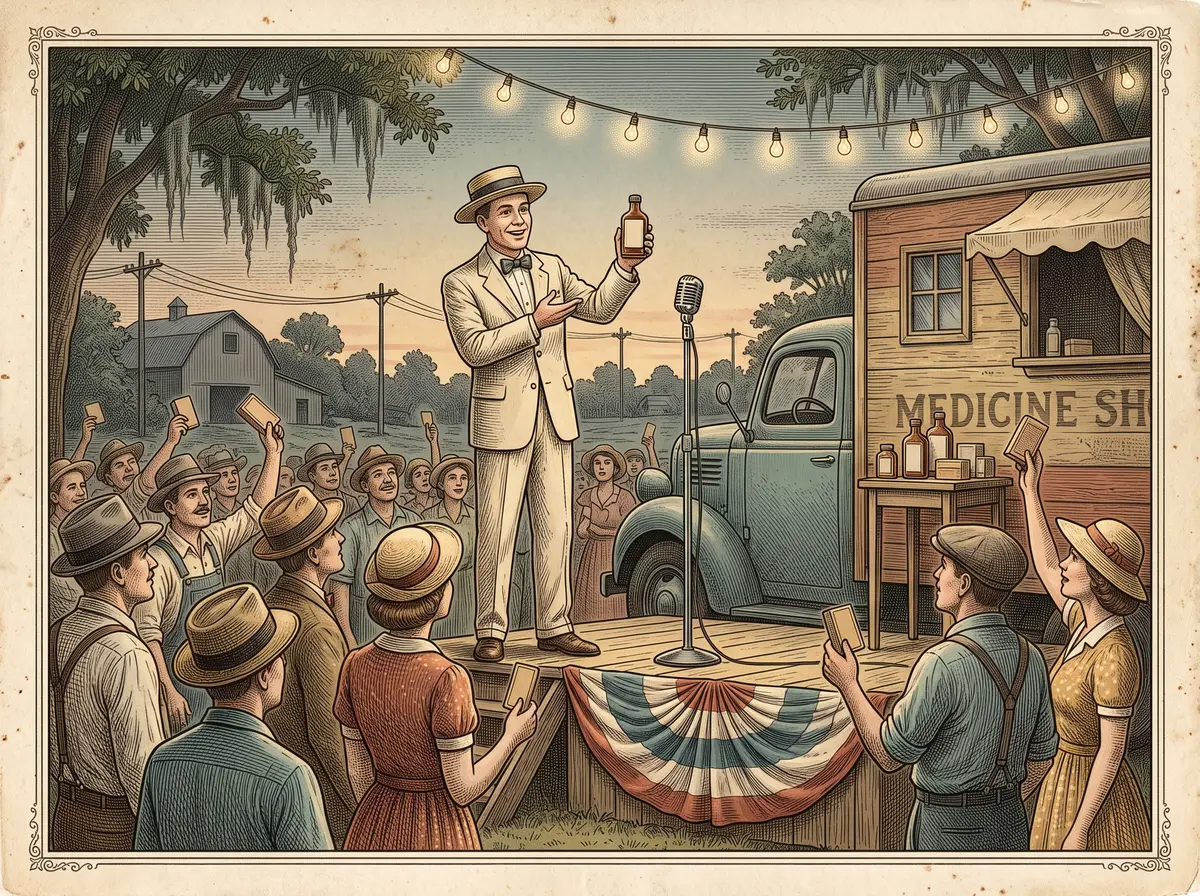
Then came the Hadacol Caravan, which Young and others describe as the last great American medicine show. In 1950 a convoy of about 130 vehicles traveled roughly 3,800 miles through 18 cities. Admission was paid in Hadacol box tops. The lineup over two summers included Hank Williams, Bob Hope, Mickey Rooney, Carmen Miranda, Minnie Pearl, and Chico Marx, and crowds of around 10,000 a night came to watch.
The bubble burst fast. In 1950 LeBlanc signed an agreement with the Federal Trade Commission to stop claiming Hadacol did more than correct vitamin and mineral deficiencies; in 1951 the FTC filed a complaint saying his ads had kept going anyway. The American Medical Association declared that “Hadacol is not a specific medication.” In August 1951, LeBlanc sold the business to New York investors for a reported $8 million, only about $250,000 of it in cash. The buyers soon found roughly $2 million in unpaid bills and about $650,000 in back taxes, and that much of the “accounts receivable” was unsold tonic being shipped back. The company went bankrupt. LeBlanc’s verdict was characteristically folksy: if you sell a cow and the cow dies, you can’t do anything to the man who sold it. He ran for governor in 1952 and finished seventh.
Why it was strange: The Senator's Vitamin Tonic That Was 12 Percent Alcohol — 'as a Preservative'
Hadacol sat in a gray zone that its inventor seemed to enjoy. It was sold as a vitamin supplement, not a drink, yet it was strong enough that dry counties in the South reportedly sold it by the shot glass. In Northbrook, Illinois, sales were restricted to liquor stores, and the Illinois House passed a resolution asking LeBlanc to stop running testimonials from children, citing the alcohol.
The stranger part is that the vitamins were real. This wasn’t a bottle of colored water. It was a real nutrient formula wrapped in claims that went far beyond what any nutrient could do, from arthritis to diabetes. The AMA cited a case in Arkansas where a man with diabetes stopped his insulin for Hadacol and nearly died. Hadacol belongs on the shelf of Medicine, Before It Was Sure, next to The Tomato Pills That Cured Everything — and Contained No Tomato.
What scientists learned: The Senator's Vitamin Tonic That Was 12 Percent Alcohol — 'as a Preservative'
Hadacol’s timing was no accident. For decades the rural South had suffered from pellagra, a disease of skin rashes, diarrhea, and, in bad cases, mental confusion. In 1915 Joseph Goldberger of the U.S. Public Health Service showed in a Mississippi prison experiment that pellagra came from a poor diet heavy on corn, not from a germ. In 1937 biochemist Conrad Elvehjem found that nicotinic acid, now called niacin and one of the B vitamins, prevented and cured the canine version of the disease. It worked in people too.
So a tonic with niacin in it could help someone who was truly deficient. The problem was the leap from “corrects a deficiency” to “cures whatever ails you.” Vitamins fix the specific shortage they belong to and do little for a well-fed person. The dilute hydrochloric acid came from an older idea about helping people with low stomach acid. As for the alcohol, the label dose worked out to roughly an ounce of alcohol spread over four days. That was not much, unless you drank more than the label said, which some customers clearly did. Hadacol also used radio the way The Goat-Gland Surgery That Ended Up Rewriting American Radio Law did a generation earlier.
How it reaches us today: The Senator's Vitamin Tonic That Was 12 Percent Alcohol — 'as a Preservative'
Hadacol’s fall fed a long argument over how to police health products that aren’t quite drugs. In the United States, supplements are still regulated differently from medicines. Since the 1994 Dietary Supplement Health and Education Act, a label that claims a product supports the body has to add that the FDA hasn’t evaluated the claim, and it can’t say the product treats or cures a disease. The FTC still goes after misleading health ads, the same job it tried to do with Hadacol in 1950.
The celebrity medicine show didn’t vanish either. It moved to television, infomercials, and influencer videos.
Fun fact: The Senator's Vitamin Tonic That Was 12 Percent Alcohol — 'as a Preservative'
Asked why Hadacol tasted so bad, LeBlanc had a ready answer: it was full of vitamins, vitamins come from the dirt, and so it tasted like dirt.
Sources: The Senator's Vitamin Tonic That Was 12 Percent Alcohol — 'as a Preservative'
- James Harvey Young, The Medical Messiahs, Chapter 15 (Princeton University Press, 1967; reproduced by Quackwatch) — the scholarly history of Hadacol, including the FTC stipulation, the AMA statement, sales figures, and the Caravan
- Hadacol (object 2005.0100.060) — Smithsonian National Museum of American History (primary source: an original bottle and its label text)
- Dudley J. LeBlanc Collection — University of Louisiana at Lafayette Special Collections (biographical record)
- Goldberger’s war on pellagra — PBS, A Science Odyssey (pellagra, Goldberger, and Elvehjem’s niacin finding)
- Hadacol — Wikipedia (overview with citations to contemporary Time coverage)
Hadacol’s alcohol was easy to overlook because it came in a medicine bottle. If you or someone you love is struggling with alcohol, the SAMHSA National Helpline (1-800-662-4357) is free, confidential, and open around the clock.