Weird Medical History · Chemistry
The Antiseptic Mist That Sprayed Queen Victoria in the Face — and That Its Inventor Later Said He Was Ashamed Of
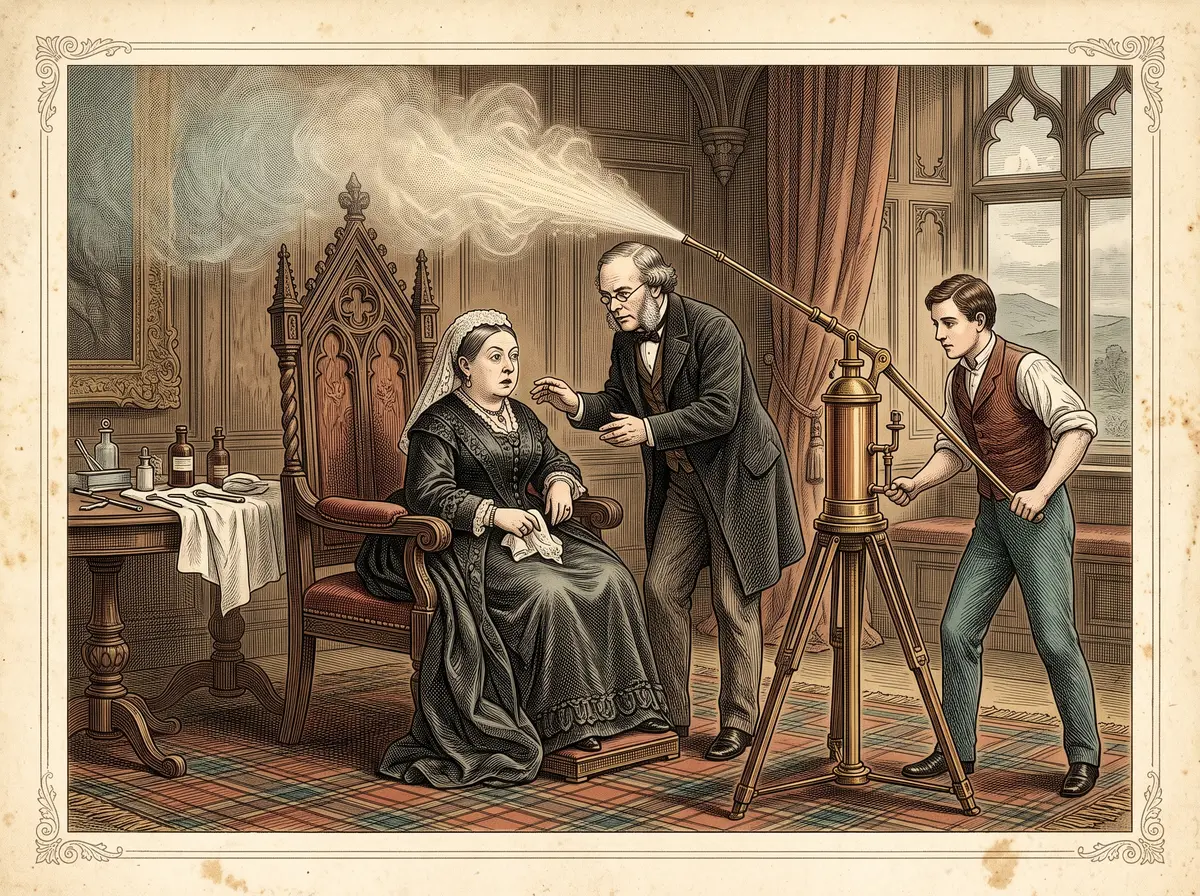
Balmoral Castle, 1871. Queen Victoria has a painful, swelling abscess under her arm, and the surgeon Joseph Lister has come to drain it. Beside him, an assistant works the handle of a machine that pumps a fine, sharp-smelling mist of carbolic acid over the patient to kill any germs in the air. According to Lister's biographer Lindsey Fitzharris, the mist went somewhere it wasn't meant to go: straight into the Queen's face.
By the Curiosities Desk · · 5 min read · Filed under Chemistry · Today’s round
What happened: The Antiseptic Mist That Sprayed Queen Victoria in the Face — and That Its
In the 1860s, surgery was frightening for reasons that had little to do with the knife. Patients who survived an operation often died days later from infected wounds. In 1865, Joseph Lister, then a professor of surgery in Glasgow, read Louis Pasteur’s work showing that fermentation and rot were caused by living microorganisms. Lister guessed that the same tiny life might be what turned wounds septic, meaning infected and putrid.
He needed something to kill it. He settled on carbolic acid, the substance chemists now call phenol, a coal-tar chemical that was already being used to treat sewage. That August he dressed a boy’s compound fracture (a break where the bone pierces the skin) with carbolic-soaked dressings instead of amputating. The wound healed. In 1867 he published his results in The Lancet and the British Medical Journal, describing a whole antiseptic system: carbolic on the wound, the dressings, the instruments, and the surgeons’ hands. Lister reported that deaths after his operations at Glasgow Royal Infirmary fell from about 45 percent to about 15 percent.
But Lister believed many germs drifted in through the air, so the air itself had to be treated. Around 1870 he began spraying it. The first sprayer was little more than a rubber bulb you squeezed by hand. Next came a larger machine on a tripod, a bit over a meter tall, which an assistant pumped with a long handle. Students called it the “donkey engine.” The final version ran on steam: a spirit lamp boiled water, and the steam drew carbolic solution up a tube and blasted it out as mist. Operating rooms often needed several sprayers at once.
Working inside that mist was miserable. The Science Museum describes it as a yellow fog with a “sickeningly sweet, tar-like smell.” It stung eyes, made people cough, and cracked surgeons’ hands. Some patients vomited. Staff breathing it day after day could develop dark urine, a sign that phenol was being absorbed into the body. In London, many surgeons treated the whole routine as fussy and excessive, and the spray was one of the main reasons.
Then came the royal patient. In 1871 Lister, the nearest leading surgeon to Balmoral, was summoned to treat Victoria’s abscess. He drained it, improvising a drainage tube from the rubber tubing of a chloroform inhaler, and the Queen recovered. The spraying mishap comes to us through later retellings rather than an official record, so it’s best treated as a well-loved story. Fitzharris’s verdict on the Queen’s reaction: “She was not amused.”
Why it was strange: The Antiseptic Mist That Sprayed Queen Victoria in the Face — and That Its
The spray was the most famous object of Lister’s method, the thing people pictured when they heard “antiseptic surgery.” It was also one of his shortest-lived ideas, and the person who killed it was Lister himself.
Through the 1880s, bacteriologists found that germs floating in clean air were usually not the dangerous kind. The real threat came from what touched the wound: hands, instruments, sponges, and dressings. At the International Medical Congress in Berlin in 1890, Lister told the world’s surgeons he was giving up the spray. His words are usually quoted this way: “I feel ashamed that I should have ever recommended it for the purpose of destroying the microbes in the air.”
Few inventors publicly disown their signature device. Lister did it because the evidence had changed.
For another surgeon who fought for clean hands, see The Doctor Who Discovered Handwashing — and Was Locked Away for It.
What scientists learned: The Antiseptic Mist That Sprayed Queen Victoria in the Face — and That Its
The spray was wrong about the route but right about the enemy. Lister’s core insight held up: microorganisms cause wound infection, and killing them saves lives. What changed was where to fight them.
Phenol works by damaging the proteins and membranes of microbes. The trouble is that it also damages human cells, which is why it burned skin and could poison the people breathing it. That trade-off pushed surgery from antisepsis, killing germs with chemicals, toward asepsis, keeping germs out in the first place. By the 1890s, work from Robert Koch’s circle showed that heat and steam could sterilize instruments as well as chemicals, without poisoning anyone.
Lister’s era tells the story in miniature: From Laughing Gas Parties to the Operating Room: A Short History of Anesthesia.
How it reaches us today: The Antiseptic Mist That Sprayed Queen Victoria in the Face — and That Its
Modern operating rooms descend from the system Lister built, minus the fog. Instruments go through steam sterilizers called autoclaves, surgical teams scrub and wear sterile gowns, and drapes isolate the wound. Rubber surgical gloves arrived around 1890, introduced in the United States by surgeon William Halsted partly because antiseptic chemicals were so hard on hands.
Lister wasn’t entirely wrong about the air, either. Operating rooms today still filter and control their airflow, especially for operations like joint replacements, where even a few stray bacteria can cause trouble. The difference is that clean air is now one layer of protection instead of the main event.
His name also ended up on a bathroom shelf: The Floor Cleaner That Taught America to Fear Its Own Breath.
If you’re facing surgery and worried about infection, your surgical team can walk you through the precautions they take. They’re happy to explain.
Fun fact: The Antiseptic Mist That Sprayed Queen Victoria in the Face — and That Its
Phenol, the same chemical that once fogged Victorian operating theaters, is still sold today as the active ingredient in some over-the-counter sore-throat sprays, in far gentler doses.
Sources: The Antiseptic Mist That Sprayed Queen Victoria in the Face — and That Its
- Joseph Lister, “On the Antiseptic Principle in the Practice of Surgery”, British Medical Journal, September 21, 1867.
- “Carbolic Spray Dispenser”, King’s College London Archives, Lister exhibition.
- “Joseph Lister’s Antisepsis System”, Science Museum, London.
- “Lister Carbolic Spray”, Royal College of Physicians and Surgeons of Glasgow Heritage.
- “The Butchering Art: How a 19th-Century Physician Made Surgery Safer”, NPR Fresh Air interview with Lindsey Fitzharris, October 2017.