Strange Animals Scientists Studied · Chemistry
The Skunk Smell Chemists Got Wrong for 79 Years — and the Lab Recipe That Finally Saved a Coworker's Cat
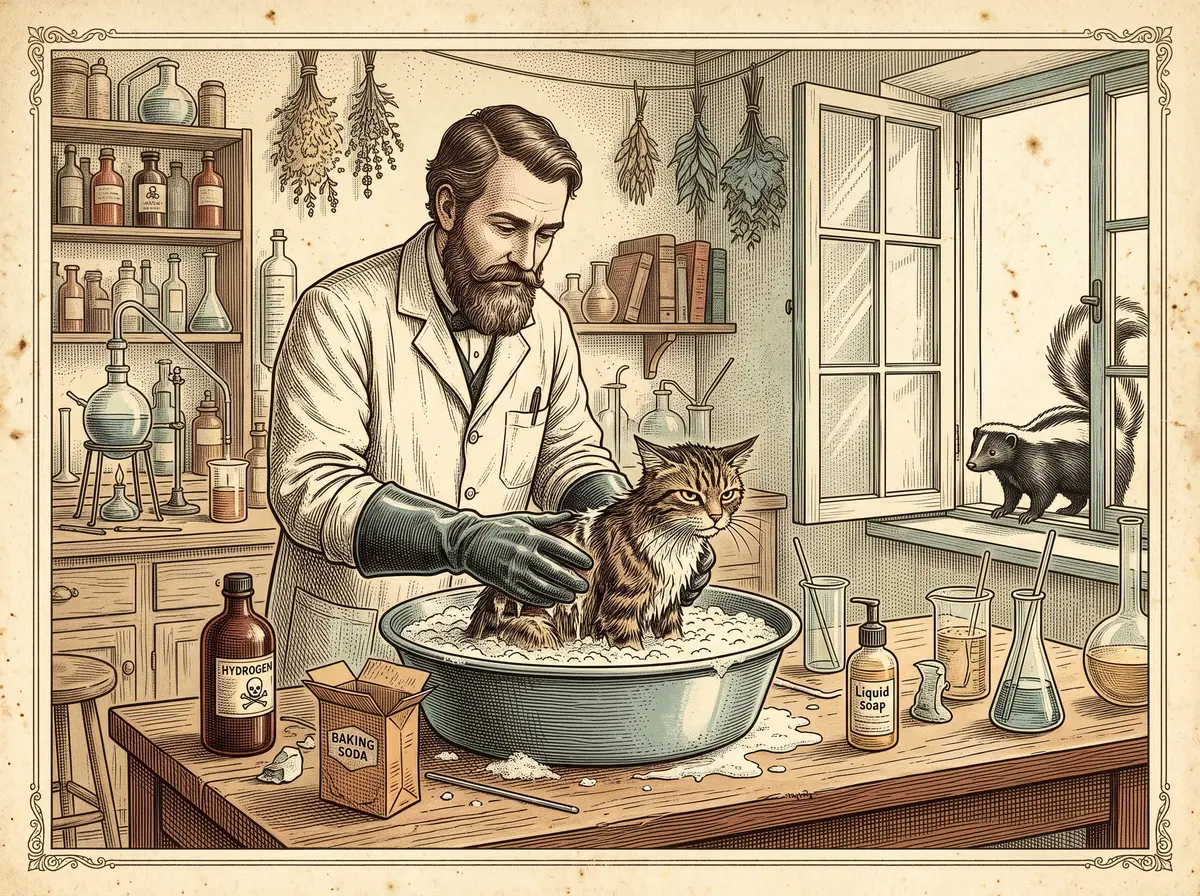
In 1993, a colleague of chemist Paul Krebaum in Lisle, Illinois, had a problem: his cat had lost an argument with a skunk, and tomato juice hadn't helped. Krebaum suggested something unusual. Bathe the cat in a gentle version of the chemical mix his lab used to scrub rotten-egg gas out of its exhaust. The next day, the colleague reported back. It worked. The cat was allowed back in the house.
By the Curiosities Desk · · 5 min read · Filed under Chemistry · Today’s round
Part of Creatures That Changed Science
What happened: The Skunk Smell Chemists Got Wrong for 79 Years — and the Lab Recipe That
People have been trying to figure out what makes skunks smell for a long time. In 1862, the German chemist Friedrich Wöhler got hold of some skunk secretion and passed it to a colleague, Dr. Swarts of Ghent, for analysis. Swarts found that the liquid was loaded with sulfur, the same element behind the smell of rotten eggs. Wöhler also noted the obvious occupational hazard: anyone who works with the stuff ends up smelling of skunk for days.
In 1896, Thomas B. Aldrich published a careful chemical study of skunk secretion in the very first volume of The Journal of Experimental Medicine. Working partly from sulfur measurements, he proposed that one of its key ingredients was butyl mercaptan, a small sulfur molecule. A mercaptan, also called a thiol, is any molecule with a sulfur atom bonded to a hydrogen atom, and thiols are some of the smelliest compounds known. Aldrich’s answer was repeated for decades.
It was wrong. In 1975, chemists Kenneth Andersen and David Bernstein ran skunk spray through gas chromatography, a technique that separates a mixture into its individual molecules, and checked the pieces with modern spectroscopy. The main stinkers turned out to be two different thiols: (E)-2-butene-1-thiol and 3-methyl-1-butanethiol. Butyl mercaptan wasn’t there at all. Aldrich’s answer had stood for 79 years, and it named the wrong molecule.
The story still had a twist left. In 1990, William F. Wood, a chemist at Humboldt State University in California, analyzed striped skunk spray fresh, often within minutes of collecting it, before it could break down. His paper in the Journal of Chemical Ecology listed seven major components: two thiols, two thioacetates, and three compounds related to quinoline. He also reported that several sulfur compounds earlier chemists had found “could not be confirmed.” They were likely leftovers created as the spray decayed during handling.
Those thioacetates turned out to matter a great deal. Then came the cat.
Krebaum’s lab had a smell problem of its own. Its manufacturing process gave off hydrogen sulfide, a toxic gas that smells like rotten eggs, so the team bubbled the waste air through a strong solution of hydrogen peroxide and sodium hydroxide. That mixture also destroyed leftover thiols. Since skunk spray is mostly thiols, Krebaum reasoned the same chemistry should work on fur. The lab-strength version was far too harsh for an animal, so he toned it down. In October 1993, Chemical & Engineering News printed his pet-safe recipe: one quart of 3% hydrogen peroxide from the drugstore, half a cup of baking soda, and a teaspoon of liquid soap, followed by a rinse with tap water.
Why it was strange: The Skunk Smell Chemists Got Wrong for 79 Years — and the Lab Recipe That
Skunk spray seems like the simplest chemistry question in nature. The smell is unmistakable, and it was studied by some of the best chemists of the 19th century. Yet the textbook answer was wrong for most of the 20th century. The tools just weren’t good enough to sort out a mixture of fragile, reactive molecules, some of which changed before anyone could measure them.
And the best fix didn’t come from a wildlife lab or a pet company. It came from an industrial plant’s exhaust system, adapted because a coworker’s cat needed a bath.
For another animal that turned its chemistry into a weapon, see The Beetle That Explodes Inside a Predator’s Stomach — and Walks Away.
What scientists learned: The Skunk Smell Chemists Got Wrong for 79 Years — and the Lab Recipe That
The thiols are the instant blast. Wood’s thioacetates are the slow-release reserve. On their own, thioacetates don’t smell like much. But when they meet water, they slowly break apart and release fresh thiols. That explains a frustration many dog owners know: a sprayed pet seems clean after a bath, then smells skunky again the next rainy day.
Krebaum’s recipe works by oxidation. Hydrogen peroxide attaches oxygen atoms to the sulfur in the thiols, turning them into sulfonic acids, which have almost no odor and wash away in water. Baking soda keeps the mixture mildly alkaline, which speeds up the reaction and helps break down the thioacetates too. The soap helps lift the oily spray out of fur.
Tomato juice, by contrast, doesn’t destroy the thiols. A common explanation for why it seems to help is olfactory fatigue: after a while, your nose stops registering the skunk smell, and the strong tomato smell fills in. The skunk molecules are still there. On light-colored dogs, the juice can also leave a pink tint.
Smell chemistry can go wrong in the lab, too. See The Molecule So Foul a Waitress Sprayed Deodorant at the Chemists Who Made It.
How it reaches us today: The Skunk Smell Chemists Got Wrong for 79 Years — and the Lab Recipe That
Krebaum’s recipe is now the standard de-skunking advice from veterinarians, wildlife agencies, and the American Chemical Society. One practical warning matters: the mixture releases oxygen gas as it works, so it should be made fresh and used right away, never sealed in a bottle where pressure can build. Keep it out of a pet’s eyes, and rinse well. It can also lighten dark fur.
Wood went on to compare other species. His later work found that spotted and hog-nosed skunks use different chemical blends. The hog-nosed skunk’s spray, for instance, lacks one of the striped skunk’s two main thiols.
Another case of an animal mess that science had to clean up: The 7,500 Pounds of Hagfish That Slimed Five Cars and Closed a Highway.
A skunk, a molecule chemists named wrong for 79 years, and the recipe that finally worked sit with Creatures That Changed Science.
Fun fact: The Skunk Smell Chemists Got Wrong for 79 Years — and the Lab Recipe That
Spotted skunks often give a warning before they spray: they do a handstand on their front paws.
Sources: The Skunk Smell Chemists Got Wrong for 79 Years — and the Lab Recipe That
- Aldrich, T. B. (1896). “A Chemical Study of the Secretion of the Anal Glands of Mephitis mephitica (Common Skunk), with Remarks on the Physiological Properties of this Secretion.” The Journal of Experimental Medicine 1(2): 323–340. doi:10.1084/jem.1.2.323
- Wood, W. F. (1990). “New components in defensive secretion of the striped skunk, Mephitis mephitis.” Journal of Chemical Ecology 16: 2057–2065. doi:10.1007/BF01020516
- Reese, K. M. (1993). “Lab method deodorizes a skunk-afflicted pet.” Chemical & Engineering News, October 18, 1993 (Newscripts). PDF
- University of Bristol School of Chemistry, Molecule of the Month. “Skunk Spray.” chm.bris.ac.uk
- Lehner, E. “The Chemistry of Skunk Spray.” NOVA, PBS (2016). pbs.org