The Spacesuit Gloves That Loosened Astronauts' Fingernails — Mostly in a Houston Swimming Pool
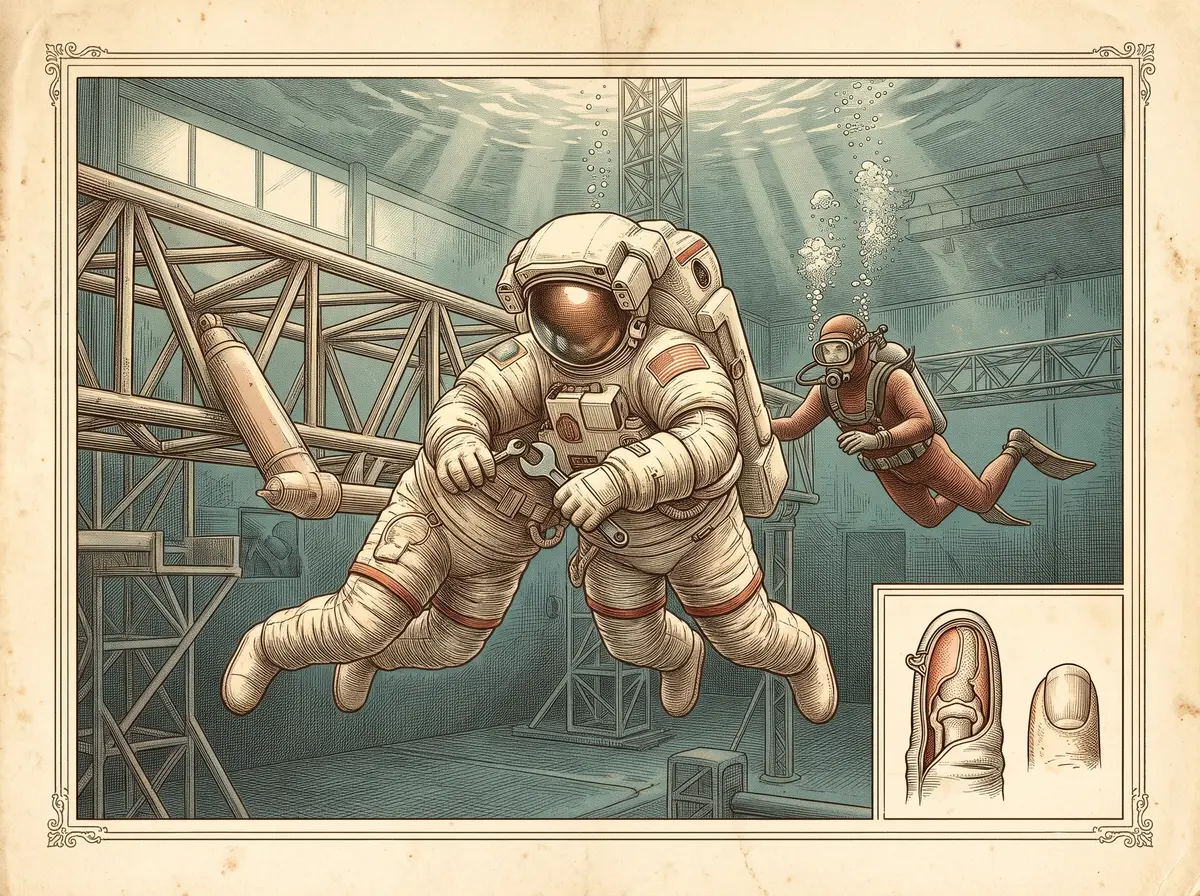
In 2004, forty feet under the water of a giant pool in Houston, astronauts in full spacesuits spent hours tightening bolts on a full-size model of the space station. When the gloves finally come off, a fingernail may be lifting away from the finger underneath it. NASA has a name for this, a medical file for it, and, for a while, a drugstore bottle of nail hardener to fight it. What it didn't have was permission to take that bottle to space.
By the Curiosities Desk · · 5 min read · Filed under Space · Today’s round
Part of Medicine, Before It Was Sure
What happened: Astronauts' Fingernails
A spacesuit glove is one of the hardest pieces of clothing ever designed. It has to hold air against the vacuum of space at about 4.3 pounds per square inch, resist punctures, and still let a person grip tools for hours. Veteran spacewalker Stephen Robinson once described a pressurized glove as being “like a little balloon.” Every time an astronaut squeezes a wrench, they are squeezing against that balloon too.
By the early 2000s, NASA’s doctors knew that hands were taking the brunt of it. A NASA study of suited training by S. Strauss, published in 2004, followed sessions in the Neutral Buoyancy Laboratory, the 6.2-million-gallon pool at Johnson Space Center where astronauts rehearse spacewalks underwater. Out of 770 suited test events, 352 symptoms were reported, and 166 of them, about 47 percent, involved the hands. Of the 18 astronauts followed for hand complaints, 13 had fingernail delamination, which is the nail plate separating from the skin beneath it. Doctors call this onycholysis (from Greek words meaning “nail” and “loosening”).
The report traced most hand complaints, 55 percent, to the fingertips and nails pressing hard against the inside of the glove during long reaches and strong grips. It also blamed sweat. A glove is a sealed space with nowhere for moisture to go, and nails that stay damp for hours get softer and come loose more easily. Nurses and dishwashers who wear wet gloves all day can get the same condition.
In 2010, a team led by MIT researcher R. A. Opperman, with professor Dava Newman, looked at injury records and hand measurements for 232 crew members. Twenty-two had reported at least one nail injury. Their surprise finding was that hand width, not finger length, seemed to matter most. Astronauts whose hands measured more than about 9 inches (22.8 centimeters) around the knuckles had roughly a 19.6 percent chance of nail injury on a spacewalk, compared with 5.6 percent for smaller hands. Newman called hand injuries spacewalkers’ biggest nuisance, and told National Geographic she had “heard of a couple people who’ve removed their fingernails in advance” of a spacewalk. That remains secondhand; NASA’s own clinical guidance recommends trimming nails short, not removing them.
The twist came later. A NASA-led analysis by Christopher Reid, Jacqueline Charvat, and colleagues combed through about three decades of records, from 1981 to 2010, covering 179 astronauts and more than 12,000 glove-wearing events. They found 31 nail injuries among 22 astronauts. Only four happened during an actual spacewalk. The other 27 happened in training, mostly in that pool, where suited runs are both far more common and often several hours long.
Why it was strange: Astronauts' Fingernails
Space is supposed to be the dangerous part. Yet the place astronauts were most likely to lose a nail was a swimming pool in Texas, because they spend vastly more hours suited up there than they ever do outside a spacecraft.
There’s a second surprise. The 2010 study pointed to hand size, but the later NASA model found that body measurements were “not related to injury” in its data. Instead, the strongest signals were how long a session lasted, which glove model was used, and how well the glove fit each finger. Two careful studies with overlapping data reached different answers, which is a reminder of how hard it is to pin down a cause from a few dozen injuries.
Another everyday nuisance that held up a space mission shows up in The Woodpeckers That Grounded a Space Shuttle — and the Plastic Owls NASA Sent to Guard It.
What scientists learned: Astronauts' Fingernails
A fingernail is attached to the nail bed by a fairly thin layer of tissue. Three things working together can pry it loose. First, moisture softens the nail and weakens that attachment. Second, pressure pushing straight down the length of the finger, which engineers call axial loading, presses the fingertip into the glove. Third, a tight glove may squeeze the knuckles and reduce blood flow to the fingertips; MIT researchers suggested this could explain the hand-width link.
The good news is that the injury usually heals itself. According to NASA’s clinical summary, tissue regains strength in about six weeks, and a new nail can take up to three months to grow out fully. Serious infections are rare, and the condition has never ended a mission.
For a longer look at the suit around those gloves, see From a Pilot Cut Out of His Own Suit to Moonwalks Sewn by a Bra Company: A Short History of the Spacesuit.
How it reaches us today: Astronauts' Fingernails
The countermeasures sound like they came from a first-aid drawer, because many of them did. NASA’s guidance lists short nails, clean and dry hands, Band-Aids, moleskin, tape, a clear film dressing called Tegaderm, and Dermabond, a medical skin glue. Glove designers have experimented with ventilation tubes that blow air into the fingers, moisture-wicking liner gloves, and better fitting. Newman’s group at MIT went further, developing skintight “mechanical counterpressure” suits that squeeze the body with fabric instead of inflating around it like a balloon.
The question matters more now that NASA and private companies are designing new suits for walking on the Moon, where astronauts may spend days doing hands-on work.
The suit’s sweaty gloves are another strange chapter in Medicine, Before It Was Sure.
If you ever notice a nail lifting from its bed, keeping it short, clean, and dry usually helps; see a doctor if it becomes painful, swollen, or discolored.
Fun fact: Astronauts' Fingernails
NASA found that a drugstore nail hardener worked well during pool training, but its toxicologists wouldn’t approve Sally Hansen Hard As Nails for flight, so it never got the chance to go to space.
Sources: Astronauts' Fingernails
- Christopher R. Reid, Jacqueline M. Charvat, et al., “Modeling Occupational Fingernail Onycholysis Disorders in the Population of US Astronauts Who Have Engaged in Extravehicular Activity”, NASA/KBR research article.
- S. Strauss, Extravehicular Mobility Unit Training Suit Symptom Study Report, NASA/TP-2004-212075, NASA Johnson Space Center, 2004.
- NASA Integrated Medical Model, “Fingernail Delamination Secondary to Extravehicular Activity” clinical finding form.
- R. A. Opperman, J. M. Waldie, A. Natapoff, D. J. Newman, and J. A. Jones, “Probability of Spacesuit-Induced Fingernail Trauma Is Associated With Hand Circumference”, Aviation, Space, and Environmental Medicine 81 (2010): 907–913.
- “Astronauts’ Fingernails Falling Off Due to Glove Design”, National Geographic, September 2010.