The Suitcase GE Designed to Foam an Astronaut Home From Orbit
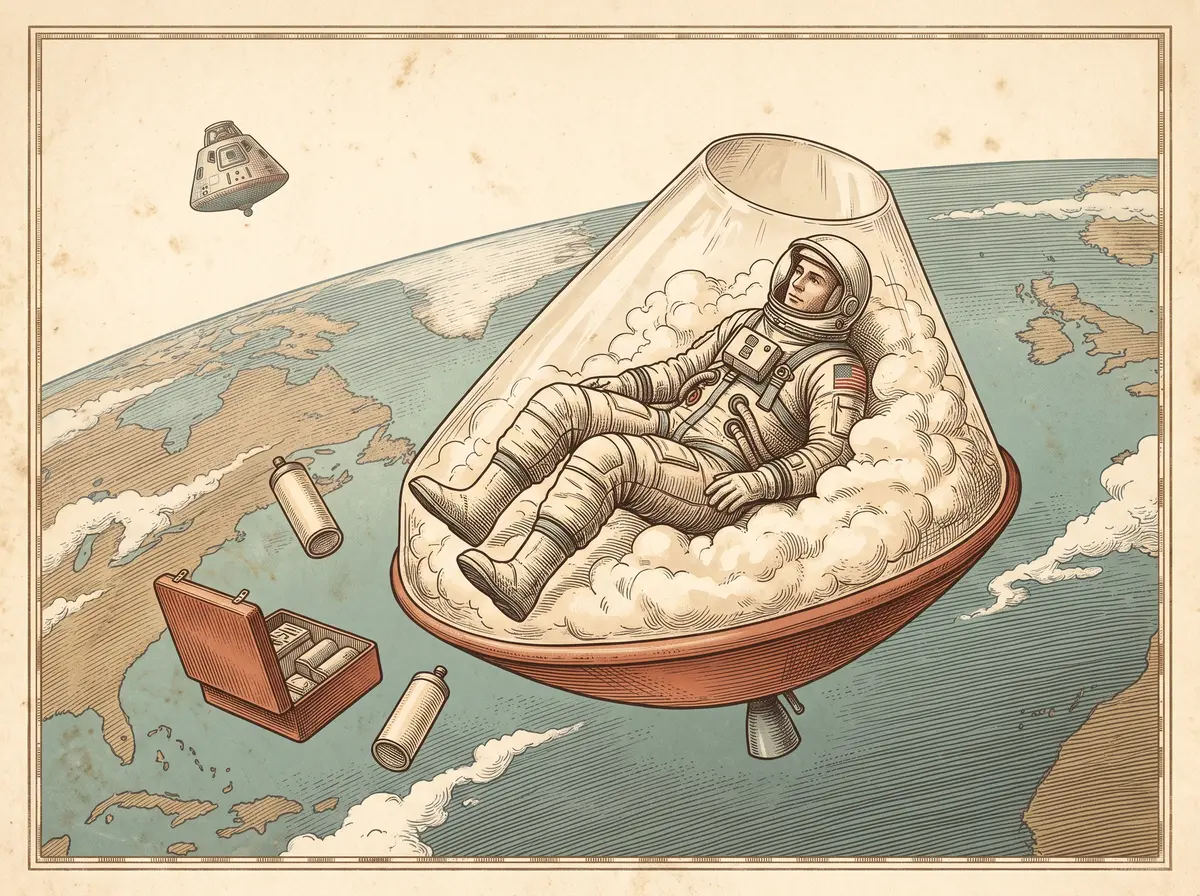
In 1963, General Electric's plan put an astronaut outside a crippled spacecraft, hundreds of kilometers above the Earth, unzipping a plastic bag about six feet long and climbing inside. He pulls a cord. Two canisters hiss, and the bag swells with expanding foam until he is packed in it like a figurine in a shipping box, his back pressed against a heat shield. Then he lights a small rocket and falls home. That was the plan for MOOSE, a General Electric design whose original name told you exactly what it hoped to be: "Man Out Of Space Easiest."
By the Curiosities Desk · · 5 min read · Filed under Space · Today’s round
Part of Built to Do the Impossible
What happened: The MOOSE Reentry Vehicle
In the early 1960s, the United States was planning for a future with people living and working in orbit for weeks at a time. The U.S. Air Force was developing the X-20 Dyna-Soar, a small rocket-launched spaceplane, and studying military space stations. Engineers began asking an uncomfortable question: if something went badly wrong up there, how would a crew member get home?
A space capsule is heavy. A spare one, parked for emergencies, is heavier still. So several companies sketched personal “bail-out” systems instead, small enough to stow aboard and use one person at a time. Douglas Aircraft proposed the Paracone, an inflatable cone. General Electric, whose space division was based near Valley Forge, Pennsylvania, came up with something even more compact. The Encyclopedia Astronautica dates the study to 1963.
MOOSE packed into a suitcase-sized container and weighed about 200 pounds (roughly 90 kilograms). Inside were a folded, cone-shaped bag made of PET film, a tough plastic related to the material in modern drink bottles, plus a flexible heat shield, two pressurized canisters of polyurethane foam, a small solid-fuel rocket, a parachute, a radio beacon, and a survival kit.
The sequence, as GE and later historians describe it, went like this. The astronaut, already in a pressure suit, would leave the spacecraft, unpack the kit, and climb into the bag. The foam would flood in and harden around him, forming a rigid, blunt cone with the heat shield on the bottom and the astronaut lying on his back above it. A small handheld thruster would point the whole bundle the right way. Then the rocket would fire, slowing him just enough to drop his orbit into the upper atmosphere.
The heat shield would take the fiery part of the ride. At around 30,000 feet (about 9 kilometers), a parachute would open and slow the descent to about 17 miles per hour (roughly 27 kilometers per hour). The foam would cushion the landing and, if he came down at sea, serve as a raft. The radio beacon would tell rescuers where to find him.
GE did real tests on the ground. According to the Encyclopedia Astronautica, samples of the shield material were blasted in the company’s supersonic arc tunnel to measure how they held up under extreme heat. Volunteers were foamed into the bag. The foam got hot as it set, topping 100°C at its core, though testers reportedly didn’t feel that heat through the material. In the most memorable test, someone in a MOOSE shell was dropped about 6 meters from a bridge into a river, landed on his back as designed, and floated off downstream. Accounts disagree on the details: some say it was a dummy, others a test pilot, and some place the bridge in Massachusetts rather than near Valley Forge.
Then the customers disappeared. On December 10, 1963, Secretary of Defense Robert McNamara cancelled the X-20 Dyna-Soar, and the military space stations MOOSE was meant to serve never flew either. Neither the Air Force nor NASA picked the design up, and it was quietly shelved. Nobody ever rode one home from orbit.
Why it was strange: The MOOSE Reentry Vehicle
Every spacecraft that brings people back from orbit is, at heart, an elaborate heat shield with seats. Mercury, Gemini and Apollo capsules weighed thousands of kilograms. MOOSE proposed to shrink that whole idea down to something you could lift, with the astronaut’s own body inside the shape that would survive reentry.
It also flipped the usual order of building. Instead of a capsule made on the ground, you would make your reentry vehicle on the spot, in orbit, by spraying it into existence around yourself. And its testing produced at least one problem no spacecraft designer had faced before: according to the Encyclopedia Astronautica, engineers found they had to add a little castor oil to the foam recipe so the test subject could actually pull himself free afterward.
Another space idea that grew from soft, foldable materials: The Rain Hat That Showed NASA How to Fold a 100-Foot Balloon Into Orbit.
What scientists learned: The MOOSE Reentry Vehicle
MOOSE rested on two real pieces of reentry science.
The first is that getting out of orbit takes surprisingly little push. An object in low orbit travels at about 7.8 kilometers per second. To come down, you don’t have to cancel that speed with a rocket. A small braking burn lowers the bottom of the orbit into the thin upper atmosphere, and air drag does the rest. That’s why a rocket small enough to carry by hand could, in principle, start the trip home.
The second is how to survive the heat that drag creates. In the early 1950s, researchers at the National Advisory Committee for Aeronautics, NASA’s predecessor, worked out that a blunt shape survives reentry better than a pointed one. A blunt face pushes a shock wave out ahead of the vehicle, and much of the heat stays in that layer of compressed air instead of soaking into the craft. MOOSE’s broad, shallow cone followed the same rule.
Its shield was meant to be ablative, meaning it is designed to char and wear away slowly, carrying heat off with the material it sheds. Mercury capsules used the same principle.
What MOOSE never proved was the hard part: whether a person could stay correctly oriented, conscious, and uninjured through the real thing. The ground tests suggested it was possible. Only a flight could have shown it.
The suitcase that never flew sits with the other machines in Built to Do the Impossible.
How it reaches us today: The MOOSE Reentry Vehicle
The problem MOOSE tried to solve never went away; the answer just got bigger. Instead of personal bail-out bags, crewed stations keep full spacecraft docked as lifeboats. Aboard the International Space Station, the Soyuz and crew vehicles that carry astronauts up stay attached so everyone has a seat home if the station must be abandoned.
Pieces of MOOSE’s thinking still appear in reentry research, especially the idea that a heat shield doesn’t have to be rigid. NASA has tested inflatable heat shields that pack small and expand into a broad, blunt cone before hitting the atmosphere, the same basic shape GE’s engineers wanted foam to make.
Foam also made a different kind of space-age leap into everyday life: The Crash-Test Foam That Invented Your Mattress.
Fun fact: The MOOSE Reentry Vehicle
When the name “Man Out Of Space Easiest” was later swapped for the more official-sounding “Manned Orbital Operations Safety Equipment,” the acronym stayed exactly the same: MOOSE.
Sources: The MOOSE Reentry Vehicle
- “MOOSE”, Encyclopedia Astronautica — technical summary of the 1963 GE study, including mass, dimensions, foam and arc-tunnel tests.
- Oberg, James. “Pod People”, Air & Space/Smithsonian (November 2003) — history of 1960s personal reentry and bail-out concepts, including MOOSE and the Paracone.
- Teitel, Amy Shira. “The Wearable Reentry Spacecraft of Yesteryear”, Discover (October 12, 2017).
- General Electric. “Gravity: Forgotten Space Escape Pod Could Bring Sandra Bullock Home Safe”, GE Reports (March 1, 2014) — the company’s own account of the design.
- “Paracone/MOOSE/SAVER/AIRMAT: Escape Pods from Orbit”, False Steps (2012) — reproduces NASA-published diagrams of the MOOSE sequence.