The Thirsty Ravens Who Pecked Ice Off a Gravitational-Wave Detector — and Showed Up in the Data
In the summer of 2017, at the LIGO detector in Hanford, Washington, one of the most sensitive measuring machines ever built, a detector that can register a change in length a thousandth the width of a proton, kept picking up a strange signal on hot afternoons. It wasn't colliding black holes. When a physicist played back a microphone recording from the far end of the machine, he heard something much closer to home: tap, tap, tap. Ravens were pecking at the ice on a pipe.
By the Curiosities Desk · · 5 min read · Filed under Physics · Today’s round
Part of When the Experiment Left the Lab
What happened: LIGO Hanford
The machine was the Laser Interferometer Gravitational-Wave Observatory, or LIGO, and the sound was coming from its site at Hanford, in the dry shrub-steppe of south-central Washington. LIGO listens for gravitational waves, ripples in space itself that Albert Einstein’s general theory of relativity predicted. Each LIGO detector is an L-shaped instrument with two arms 4 kilometers (about 2.5 miles) long. A laser beam runs down each arm inside a vacuum tube and bounces off mirrors at the ends. When a gravitational wave passes, it stretches one arm and squeezes the other by an almost unimaginably tiny amount, and the recombined laser light reveals the difference.
LIGO made history on September 14, 2015, when its two detectors, one at Hanford and a twin at Livingston, Louisiana, caught the waves from two black holes merging over a billion light-years away. Three of the project’s founders, Rainer Weiss, Barry Barish, and Kip Thorne, shared the 2017 Nobel Prize in Physics for it.
An instrument that sensitive also feels everything else. LIGO surrounds its detectors with microphones, seismometers, magnetometers, and other sensors so scientists can tell a real signal from a local disturbance. During LIGO’s second observing run, which ended in August 2017, the Hanford detector began showing short bursts of noise around 90 hertz (vibrations per second). Beverly Berger, a physicist with the LIGO Laboratory at Caltech, flagged the blips. They didn’t look like gravitational waves, and the Livingston detector, 3,000 kilometers away, showed nothing similar. Something local was shaking Hanford.
Software that hunts for matches between the main data and the environmental sensors pointed to one microphone at the end of the Y arm, the detector’s second arm. Robert Schofield, a University of Oregon physicist whose job is tracking down environmental noise, listened to the recordings. “It sounded like pecks to me,” he told the Associated Press. “I immediately thought it must be ravens.”
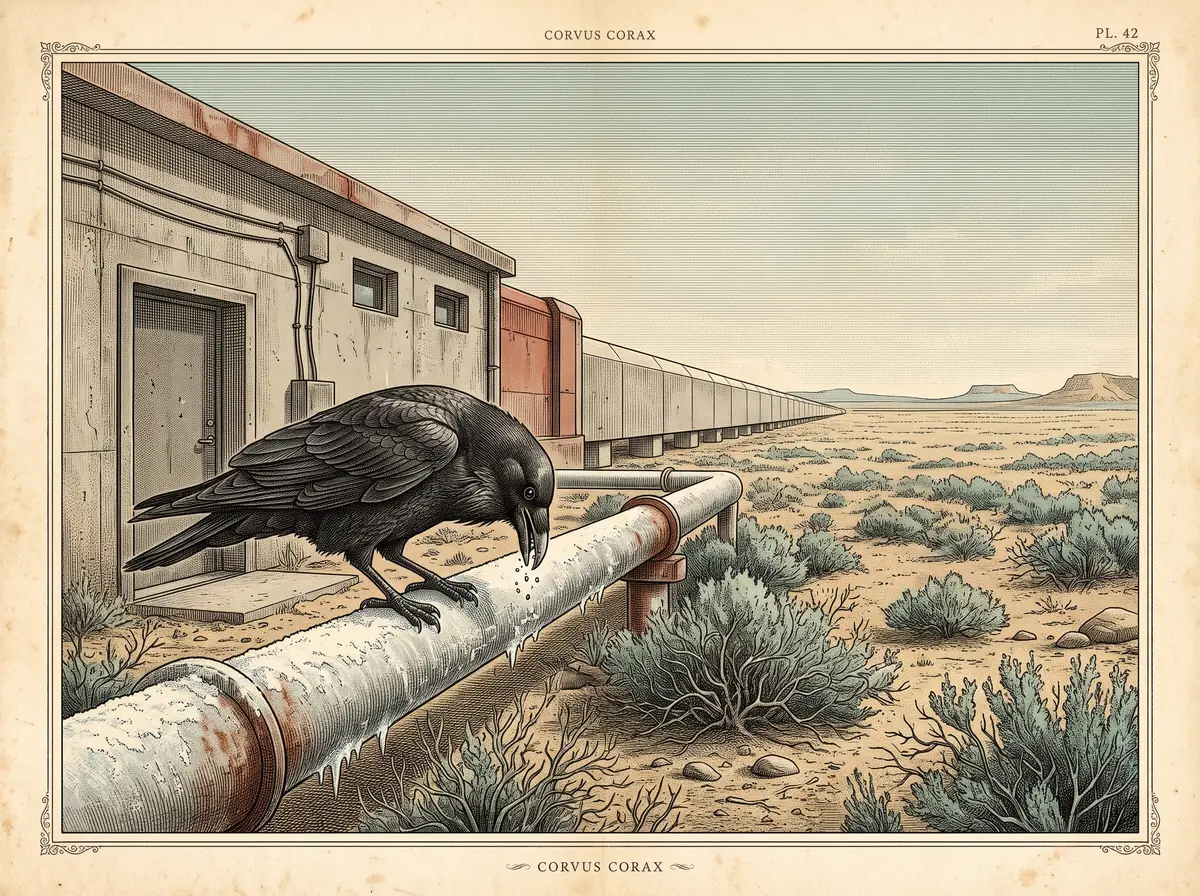
He had a reason to suspect them. Schofield had often seen ravens around the site. On a day when the temperature passed 100 degrees Fahrenheit, the team went out to the end station and found the culprit. Pipes carrying cold nitrogen gas away from a cryopump, a device that uses extreme cold to help keep the arms’ vacuum clean, were frosted over. The frost was covered in peck marks the size of a raven’s beak, and the team spotted a bird scraping its beak through the frost. A raven had found a desert snow cone.
To confirm the connection, the team imitated the pecking on the ice themselves. That produced the same kind of noise they had seen in the data. Berger presented the findings on April 16, 2018, at an American Physical Society meeting in Columbus, Ohio, and the story spread quickly, helped along by a physicist’s affectionate parody of Edgar Allan Poe’s “The Raven.”
Why it was strange: LIGO Hanford
LIGO was built to detect events like colliding black holes and exploding stars. It is engineered to ignore trucks, wind, and earthquakes as well as it can. Yet a bird weighing about three pounds, looking for something cold to drink on a hot day, left its fingerprints in the data of a Nobel-winning observatory.
The ravens weren’t doing anything wrong. Common ravens are clever, curious birds that make good use of whatever their surroundings offer, and a frosty pipe in the desert in July is a good offer. The surprise was the chain connecting them to the measurement. A peck on a vent pipe outside the building traveled into the instrument.
LIGO isn’t the only big physics machine to discover it was part of the landscape. Its European cousins learned the same lesson in The Particle Accelerator That Could Tell When the Train to Paris Left.
What scientists learned: LIGO Hanford
The investigation, written up by LIGO physicist Laura Nuttall in a 2018 review of detector noise in Philosophical Transactions of the Royal Society A, traced the exact path. The pecking vibrated the nitrogen vent lines. Those vibrations shook the vacuum enclosure and parts inside it. A tiny fraction of the laser light was scattered, meaning it bounced off a vibrating surface instead of following its intended path, then rejoined the main beam. That stray light added a flicker the detector couldn’t tell apart from a real change in the arm length.
That mechanism, scattered light, is one of the most common sources of LIGO “glitches,” the name physicists use for short noise bursts that can mimic or hide a real signal. The ravens were a memorable example of a general rule. In a detector this sensitive, anything that moves a surface near the beam, even slightly, can show up in the data.
The same review lists other local troublemakers: thunder at Livingston, snowplows and strong winds at Hanford, and a compressor whose switching left magnetic blips. The Associated Press reported that the Hanford team has also tracked noise to passing trucks, a humming refrigerator, distant airplane propellers, and water flowing over a dam about 15 miles away.
How it reaches us today: LIGO Hanford
The fix was simple. The team insulated the pipes so ice no longer built up on them, which took away the ravens’ reason to visit. They also repaired an internal component that had been jiggling when the birds pecked. The paper notes a second option, a casing to keep birds off the lines. The work was finished before LIGO’s third observing run.
The bigger legacy is the method. Every gravitational-wave detection LIGO announces today depends on proving that the signal didn’t come from a local source. That means a network of environmental sensors, careful logs, and people like Schofield who listen to microphone recordings and go outside to look. Machine-learning tools now help sort glitches. Sometimes the answer is still a person walking out into the heat to look at a pipe.
Animals have halted bigger projects, too: see The Woodpeckers That Grounded a Space Shuttle — and the Plastic Owls NASA Sent to Guard It, and more stories of science meeting the real world on When the Experiment Left the Lab.
Fun fact: LIGO Hanford
Among the noise sources the Hanford team has tracked down: water flowing over a dam about 15 miles away.
Sources: LIGO Hanford
- L. K. Nuttall for the LIGO Scientific Collaboration, “Characterising Transient Noise in the LIGO Detectors,” Philosophical Transactions of the Royal Society A 376 (2018), doi:10.1098/rsta.2017.0286 (Section 3.1, “Thirsty Ravens”).
- Emily Conover, “How ravens caused a LIGO data glitch,” Science News, April 18, 2018.
- Associated Press, “Suddenly there came a tapping: Ravens cause blips in massive physics instrument at Hanford,” Yakima Herald-Republic, May 2018.
- Laura Geggel, “Are Those Gravitational Waves? Nope, They’re Just Thirsty Ravens,” Live Science, April 19, 2018.
- LIGO Caltech, “Most Precise Ruler Ever Constructed” (arm length and measurement precision).