The Toy Top That Stood on Its Head — and Had Niels Bohr and Wolfgang Pauli Bent Over the Floor
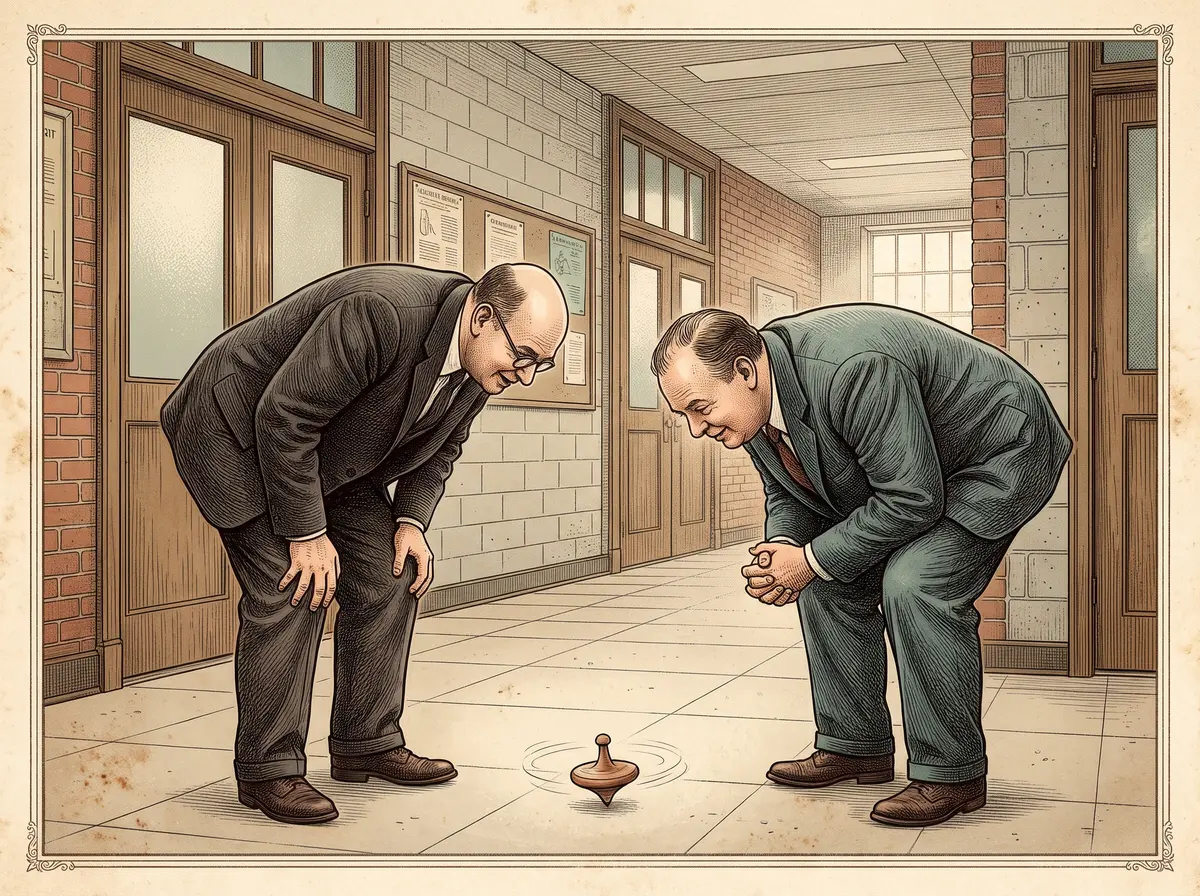
In the spring of 1951, at the opening of a gleaming new physics building in Lund, Sweden, a photographer caught Niels Bohr and Wolfgang Pauli doing something undignified. Both Nobel laureates are bent nearly double, staring at the floor. Between their feet spins a small, cheap toy. It is doing something that looks impossible: flipping itself upside down and carrying on spinning on its own handle.
By the Curiosities Desk · · 5 min read · Filed under Physics · Today’s round
What happened: A Tippe Top
The toy was a tippe top: a small, mostly hollow ball with a slice cut off the top and a short stem sticking up where the slice used to be. Spin it by the stem with the round side down, and for a second or two it behaves like any top. Then it starts to wobble, leans further and further over, and finally pops up onto its stem, now spinning upside down with the ball in the air.
The idea was older than the craze. In 1891 a woman in Munich named Helene Sperl patented a “Wendekreisel,” German for a “turning-over top” (patent no. 63261). By one account the patent lapsed the following year when the fee went unpaid. Nineteenth-century physicists had noticed related tricks, too: the engineer John Perry’s 1890 book Spinning Tops described a small sphere, weighted off-center, that rises up as it spins. But the toy did not catch on.
It came back around 1950 through a Danish engineer, Werner Østberg. According to the Vendsyssel Historical Museum in northern Denmark, which holds his scrapbook, Østberg got the idea on a trip to South America after watching people spin a small round fruit. He gave the top its name, patented it in several countries, and mass-produced it. Danish newspapers were soon running headlines like “The Tippe Top enigma” (March 1951) and, that November, “The Tippe top mystery solved.” By 1952 the toy was on sale in the Netherlands, and later versions would turn up as prizes in American cereal boxes.
Which brings us to Lund. The university’s new physics building, Fysicum, had been finished in 1950, but its opening waited on Sweden’s royal succession; King Gustaf VI Adolf finally cut the ribbon in the spring of 1951. Bohr came over from Copenhagen, Pauli from Zurich. The photograph of the two of them hunched over the spinning top was taken by Erik Gustafson and is now in the American Institute of Physics’ Emilio Segrè Visual Archives. Most researchers date it to May 31, 1951, the day of the opening, though some archive captions give 1954. A Danish newspaper headline the next day reported that Bohr had shown the tippe top to the king of Sweden.
What the two men said to each other about it, nobody recorded.
Why it was strange: A Tippe Top
Everyday experience says a spinning top should do one thing: slowly lose speed, wobble, and fall over. A tippe top instead seems to choose to do something harder. It is built with its center of mass, the balance point of its weight, sitting below the center of the ball. When it flips onto its stem, that balance point rises. In other words, the toy lifts its own weight against gravity, apparently by itself.
It also seems to reverse direction. Seen from above, the top keeps turning the same way throughout. But because the toy is now upside down, it is spinning backward relative to its own body. For physicists who spent their careers thinking about spin, from planets down to the electron, a toy that appeared to rearrange its spin for free was an irresistible puzzle.
Another toy that sent serious physicists to the floor is The Super Ball: The Kids’ Toy That Named the Super Bowl — and Baffled Physicists Under a Table.
What scientists learned: A Tippe Top
The tippe top set off a small flurry of research. In 1952 alone, papers on it appeared in Nature, the American Journal of Physics, the Philosophical Magazine, and the Dutch journal Physica. The Dutch physicist C. M. Braams traced the theory back to Lord Kelvin in the 1870s, and a reader of Nature soon pointed out that Perry had described a near-identical top in 1890.
The answer is friction. The top is not free energy: it touches the table at a single point, and as it tilts, that point skids slightly across the surface. The sliding friction there pushes on the top in a direction that tips its axis further over, and it keeps pushing until the top is standing on its stem. Some of the energy of the spin gets spent lifting the center of mass, and some is lost as heat. The top’s total angular momentum, its “quantity of spin,” stays pointed the same way in space, which is why the spin looks unchanged from above even though the body has turned over beneath it.
That’s the short version. The full mathematics is notoriously hard. The physicist Christian Ucke, who has studied the toy’s history, said in a 2000 lecture that there is “no simple explanation” of the flip and that solving it means diving deep into differential equations. Researchers have kept publishing on it for more than 70 years. One lasting lesson is that the details of friction matter: the French researcher P. Contensou showed that the common simplifying assumption that the contact point never slips gets the motion wrong.
For another physics puzzle hiding in something ordinary, see The Spaghetti That Stumped Richard Feynman by Refusing to Break in Two.
How it reaches us today: A Tippe Top
The tippe top never left the physics classroom. University lecture-demonstration collections around the world keep one on the shelf, and it remains a favorite way to show students that friction can do far more than just slow things down. It was even set as a theory problem at the 2019 Asian Physics Olympiad.
It has also become a test case for mathematicians who model “dissipative” systems, ones that lose energy as they move. Studies of how a tippe top makes its way from one steady state to another feed into the broader science of rolling, sliding, and spinning contact, the same kind of physics at work in wheels, bearings, and robots that move by rolling.
And you can still buy one for the price of a coffee.
A toy that flipped for two Nobel laureates belongs with The Ordinary Object With the Strange Origin.
Fun fact: A Tippe Top
When Christian Ucke rebuilt the tops described in Helene Sperl’s 1891 patent, he found that none of them worked as they should, even though her patent describes the flipping effect perfectly well in words.
Sources: A Tippe Top
- Tippe Top — Fysikbasen, Aarhus University (Sperl patent, Østberg and the Vendsyssel Historical Museum, the Lund photograph and 1951 Danish newspaper headlines, bibliography of physics papers)
- Lecture on physics toys, Grimstad 2000 — Christian Ucke (Bohr and Pauli photo dated 31.05.1951; rebuilding Sperl’s patent tops; “no simple explanation”)
- The Symmetrical Spherical Top — G. N. Copley, Nature 170, 169 (1952) (Perry’s 1890 top and Kelvin’s earlier theory; reply to C. M. Braams)
- Fysicum 75 years: a lively anniversary with a long history — Lund University Department of Physics (opening of the building by Gustaf VI Adolf in spring 1951)
- A New Analysis of the Tippe Top: Asymptotic States and Liapunov Stability — S. Ebenfeld and F. Scheck, Annals of Physics 243 (1995) (the physics of the inversion)