The Scientist Behind It · Engineering
The Wooden Hat That Got an Engineer Hired — and the Steam Model a Vicar Mistook for the Devil
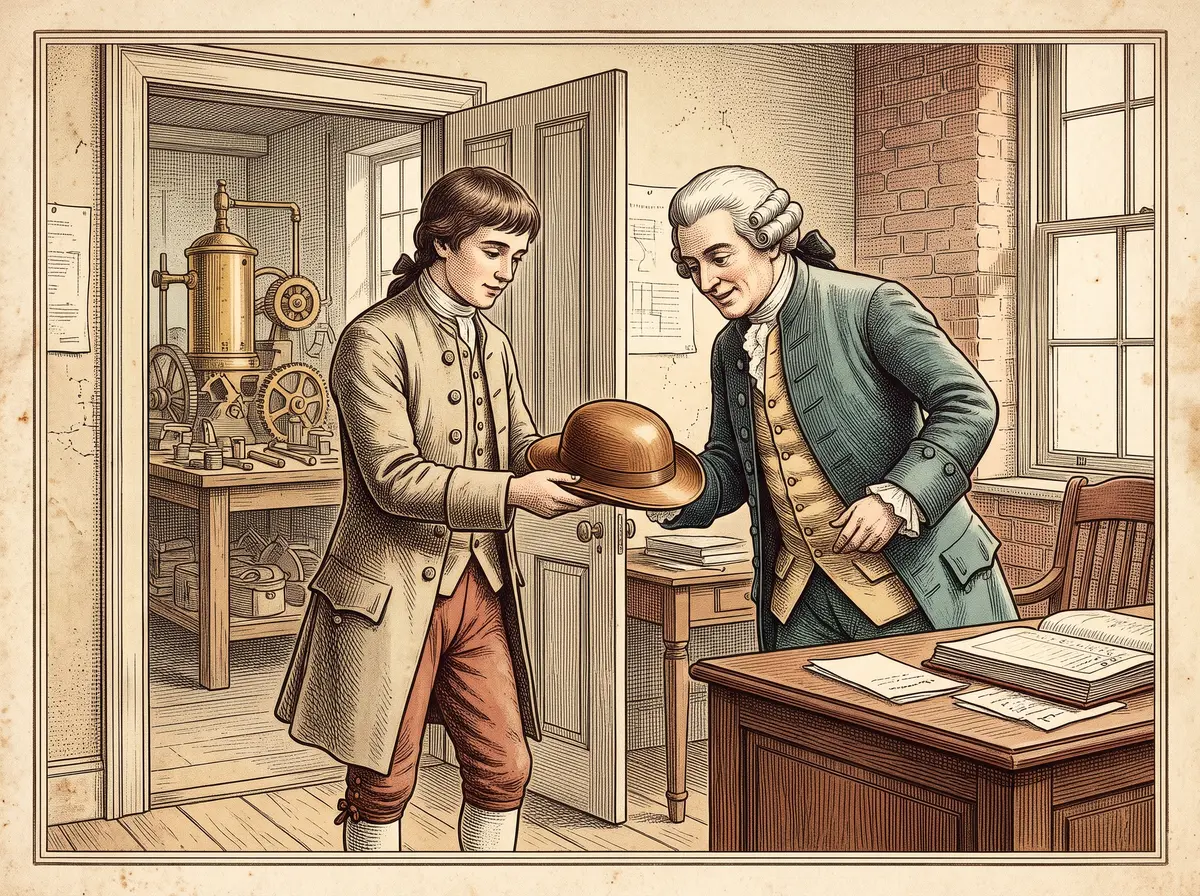
In 1777, a 23-year-old Scotsman named William Murdoch stood in front of Matthew Boulton, one of the richest manufacturers in Birmingham, asking for a job. Boulton said there was no work. Then, as the story goes, Murdoch's nervous fingers dropped his hat, and it hit the floor with a sound no felt hat makes. It was made of wood. He had turned it himself, on a lathe he had built himself. Boulton hired him.
By the Curiosities Desk · · 5 min read · Filed under Engineering · Today’s round
Part of The Person Who Would Not Drop It
What happened: Murdoch's Wooden Hat
William Murdoch was born on 21 August 1754 near Old Cumnock in Ayrshire, the son of a millwright. He grew up around gears, water wheels and timber, and by his early twenties he had heard about the steam engines that James Watt and his business partner Matthew Boulton were building at the Soho Manufactory outside Birmingham. In 1777 he set out for Soho, a journey of roughly 300 miles that biographers say he made largely on foot.
The famous hat scene comes from the Victorian writer Samuel Smiles, who published it in 1884, more than a century later, without naming a source. In Smiles’s version, Boulton notices the odd hat and asks what it is made of. “Timmer, sir,” Murdoch replies, using the Scots word for timber. He explains that he made it on “a bit laithey of my own contrivin’.” Boulton, impressed that a young man could turn a smooth oval hat on a homemade lathe, decides to find him something after all. Smiles records the terms: 15 shillings a week at the works, a little more when posted away. The hat story may well be family tradition polished in the retelling, so it is best held as a legend with a believable core: Murdoch was hired in 1777, and he was exactly the kind of man who would build his own lathe.
The hire paid off. In 1779 Boulton & Watt sent Murdoch to Redruth in Cornwall, where tin and copper mines bought their engines to pump water out of deep shafts. He became the firm’s indispensable fixer there, so devoted that Smiles says he was once found heaving at his bedpost in his sleep, shouting, “Now she goes, lads!”
In his spare hours, Murdoch tinkered. By 1784 he had built a small, three-wheeled steam carriage model, about a foot tall, with a boiler and engine between the rear wheels and a tiller to steer. Witnesses later recalled seeing it run around his living room in Redruth. Watt, who distrusted the high-pressure steam such a machine needed, wrote letters trying to talk Murdoch out of it. He also did not want to lose his best man in Cornwall to a side project.
That is where the vicar comes in. According to Smiles, Murdoch tested the model one night on a narrow, level church path outside town. It was faster than he expected, and it raced off ahead of him, hissing and throwing sparks. Murdoch chased it into the dark and heard shouts of terror: the local clergyman had met the little fire-breathing machine and taken it for the Devil himself. Historians tend to agree that if this happened, it involved the model and not a full-size carriage. It is still a legend, but a hard one to forget.
Murdoch’s most lasting work came next. Around 1792, he began heating coal in a closed iron retort, a sealed vessel used for heating substances, and piping the gas it gave off to burners. By 1794 his house in Cross Street, Redruth, was lit by gas. Smiles adds that he would fill a bladder with gas, fit it to a glass lantern, and use it to light his way home across the moors at night.
Why it was strange: Murdoch's Wooden Hat
We usually remember the Industrial Revolution through famous names on patents. Murdoch is a reminder of how much of it depended on someone in the background who never got top billing. Watt took out the 1781 patent for the “sun and planet” gear, a way of turning an engine’s up-and-down motion into rotation. A surviving drawing in Murdoch’s hand suggests he invented it.
There is also a nice irony. Watt, one of history’s great steam pioneers, warned his own employee away from the steam vehicle. Murdoch kept tinkering anyway, and Boulton still had the idea added to a Watt patent, just in case.
Another engineer seen from the human side: The Engineer Who Built a Flip Table to Shake a Gold Coin Out of His Own Windpipe.
What scientists learned: Murdoch's Wooden Hat
Murdoch’s gas work showed that light could be made in one place and delivered through pipes to many. Heating coal without enough air to burn it drives off a flammable mix of gases, mostly hydrogen and methane. Stored and piped, it could feed a flame anywhere a pipe could reach.
In March 1802 he lit up the Soho works with gas to celebrate the Peace of Amiens, a brief truce between Britain and France. In 1808 he reported his results to the Royal Society, describing the Philips and Lee cotton mill in Manchester. It had 271 Argand burners, a bright lamp design with a hollow circular wick, and 633 simpler “cockspur” jets. Together they gave a little more light than 2,500 candles, for about £600 a year, against roughly £2,000 for the candles. The Society awarded him its Rumford Medal.
Another inventor whose quirks made history: The Computer Pioneer Who Declared War on London’s Organ Grinders.
How it reaches us today: Murdoch's Wooden Hat
Gas lighting spread through British cities within a few decades, lengthening working hours and making streets safer at night. It was also the start of the idea of a utility: a central plant feeding homes through a network of pipes, the same model that later carried electricity, water and the internet.
Murdoch’s ideas ran in other directions too. Smiles credits him with proposing to send messages through tubes using air pressure, an idea later used in pneumatic tube systems in offices and shops. Samuel Clegg, who had learned gas engineering at Soho, later helped develop the atmospheric railway system that Isambard Kingdom Brunel tried in Devon. Read more in The Railway That Ran on Suction — and the Rats Blamed for Eating It.
Murdoch died on 15 November 1839 in Handsworth, near Birmingham. He was buried at St Mary’s Church, close to Boulton and Watt.
Murdoch, still at the engines after the hat story, sits with the others in The Person Who Would Not Drop It.
Fun fact: Murdoch's Wooden Hat
A statue in central Birmingham shows Boulton, Watt and Murdoch together in gilded bronze. Locals call it “The Golden Boys,” so the man hired over a wooden hat now stands beside his bosses, cast in gold.
Sources: Murdoch's Wooden Hat
- William Murdoch, “An Account of the Application of the Gas from Coal to Economical Purposes,” Philosophical Transactions of the Royal Society, read 25 February 1808 (Royal Society archive record; full text)
- Samuel Smiles, “William Murdock,” Men of Invention and Industry (1884), via Grace’s Guide to British Industrial History
- Grace’s Guide to British Industrial History, “William Murdoch: Steam Carriage”
- Birmingham City Council, “Archives of Soho: William Murdoch”
- Revolutionary Players, “A Portrait of William Murdoch”