Accidental Discoveries · Medicine
The Worm Pill a Scientist Swallowed Before a Dinner Party — and Why His Beer Turned on Him
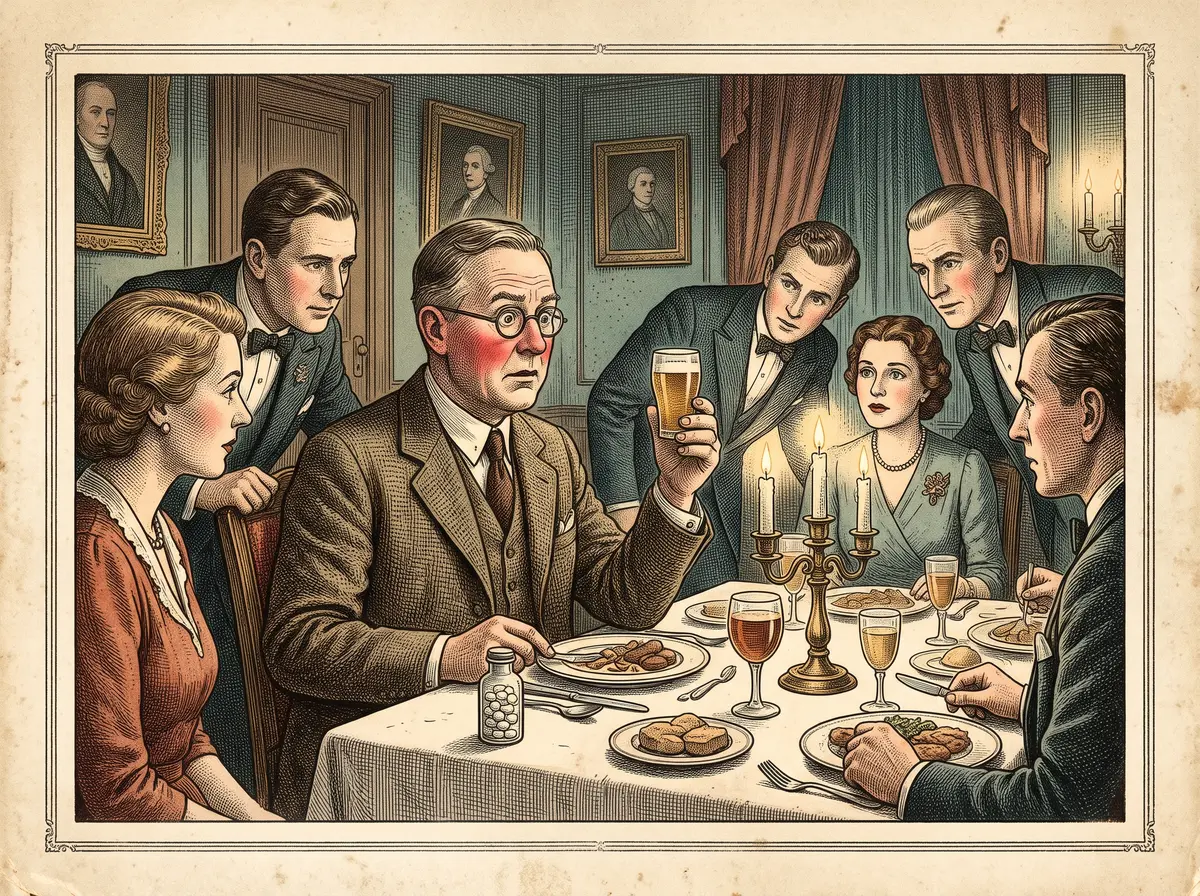
In 1945, a Copenhagen pharmacologist named Erik Jacobsen swallowed a couple of experimental pills meant for intestinal worms and then went out to a dinner party. Someone handed him a small glass of beer. According to the account he gave *Time* magazine a few years later, his face went red and his heart started to pound. Something in the pills had turned an ordinary drink against him, and that unpleasant evening would become one of the first medicines ever prescribed for alcohol dependence.
By the Curiosities Desk · · 5 min read · Filed under Medicine · Today’s round
What happened: The Worm Pill a Scientist Swallowed Before a Dinner Party — and Why His
Jacobsen was no stranger to testing things on himself. A physician trained in biochemistry, he had run the biological-chemical laboratory at the Danish drug company Medicinalco since 1934, and he had a habit of trying his own lab’s compounds on his own body. His colleague Jens Hald, a pharmacologist and skilled analytical chemist, was studying how intestinal worms use copper, and the two were looking for chemicals that might get rid of the parasites.
One candidate was tetraethylthiuram disulfide, now called disulfiram. It was hardly a new substance. A chemist had first reported making it in 1881, and by the 20th century it was an industrial workhorse in rubber factories, where it helped speed up vulcanization, the heat-and-sulfur process that makes rubber tough and stretchy. Medicinalco mainly hoped it could become an ointment for scabies, a skin infestation caused by tiny mites. If it also killed worms, so much the better.
Rabbit tests suggested it did work against worms. So Jacobsen took some himself. Then came the dinner party and the beer. According to the 1948 Time report, “any form of alcohol revolted him” while the drug was in his system. Hald, who had also taken the pills, noticed a similar but milder reaction. The two men began to suspect the combination of disulfiram and alcohol. Jacobsen later recalled that “it only took a few days to confirm” the tablets really did change how alcohol affected the body.
Then, for about two years, almost nothing happened. The researchers vaguely realized in spring 1945 that the effect might help people who drank too much, but they didn’t pursue it. According to historian Helge Kragh, they believed alcoholism was not a major problem in Danish society.
That changed in the fall of 1947, when Oluf Martensen-Larsen, a physician who treated patients with alcohol dependence, got in touch with Jacobsen. Between December 1947 and May 1948, he gave the drug to 83 patients and reported that more than half benefited. He was careful to add that the pills “must often be only part of a general treatment.”
Meanwhile, the lab kept experimenting, sometimes on its own staff. One later book claims that Jacobsen had alcohol injected into his veins after taking the drug and that his blood pressure fell to almost zero. Kragh cites that dramatic story but treats it as one author’s account rather than an established record, and it’s best read the same way.
The drug got a new name, too. The team recrystallized it into a form with a much larger surface, which the body absorbed more easily, and called it Antabus in Danish, Antabuse in English: “anti” plus “abuse.” Jacobsen announced the discovery in a lecture to the British Pharmacological Society in July 1948. That December, Time ran the story under the blunt headline “Drug for Drunks,” and companion papers on the drug appeared in The Lancet.
Why it was strange: The Worm Pill a Scientist Swallowed Before a Dinner Party — and Why His
Most medicines work by making you feel better. Antabuse was among the first to work by threatening to make you feel worse. It doesn’t reduce a craving or ease a hangover. It makes a drink so unpleasant that the person taking it chooses not to have one.
The clue had also been hiding in plain sight. As early as 1937, a factory physician named E. E. Williams described rubber workers who handled a closely related chemical and felt ill when they drank. He even suggested it might lead to “the cure for alcoholism.” Nobody followed up. It took a worm study and a glass of beer to rediscover what factory workers had already noticed.
The story belongs on the shelf with The Scientists Who Ran the Experiment on Themselves.
What scientists learned: The Worm Pill a Scientist Swallowed Before a Dinner Party — and Why His
At first, nobody knew why the drug worked. The key turned out to be a smell. A chemist colleague visiting the lab noticed a strong odor of acetaldehyde, a sharp-smelling chemical. Jacobsen and Hald had worked around it so long they had stopped noticing. Jacobsen later said, “This observation gave us the key to understand the process.”
Here’s the process. When you drink, your liver first turns alcohol into acetaldehyde, which is quite toxic, and then an enzyme called aldehyde dehydrogenase quickly breaks that down into harmless acetate. Disulfiram blocks that second step. Acetaldehyde builds up in the blood. In their 1948 work, Hald and Jacobsen measured roughly an eightfold rise in blood aldehyde in people who drank after taking the drug. That buildup causes flushing, nausea, and a racing heart.
For another heart-centered experiment run on the scientist’s own body, read The Surgeon Who Threaded a Tube Into His Own Heart.
How it reaches us today: The Worm Pill a Scientist Swallowed Before a Dinner Party — and Why His
Denmark and Sweden approved Antabuse for prescription in early 1949, and the U.S. Food and Drug Administration approved disulfiram for alcohol dependence in 1951. It’s still prescribed today, though it’s no miracle pill. A U.S. government treatment guide describes its effectiveness as “modest,” and notes strong evidence that it works best when someone else, like a pharmacist, clinician, or family member, watches the person take it. A pill only helps if you swallow it.
Newer medications for alcohol dependence work in different ways, by dulling cravings rather than punishing a drink. But Antabuse was the first the FDA approved, and it began as a worm pill.
For another drug that turned out to do something its makers didn’t plan, see The Failed Heart Pill That Trial Volunteers Wouldn’t Give Back.
Fun fact: The Worm Pill a Scientist Swallowed Before a Dinner Party — and Why His
Nature got there first. The common ink cap mushroom contains a compound called coprine that jams the same liver enzyme, so people who eat it and drink alcohol can get the same flushed, pounding-heart reaction. Foragers have long called it “tippler’s bane.”
Sources: The Worm Pill a Scientist Swallowed Before a Dinner Party — and Why His
- Kragh, H. (2008). “From Disulfiram to Antabuse: The Invention of a Drug.” Bulletin for the History of Chemistry 33(2), 82ff (PDF)
- Hald, J., et al. (1948). “The Sensitizing Effect of Tetraethylthiuramdisulphide (Antabuse) to Ethylalcohol.” Acta Pharmacologica et Toxicologica 4, 285–296 (Garrison-Morton bibliography entry)
- Center for Substance Abuse Treatment (2009). “Chapter 3—Disulfiram.” Incorporating Alcohol Pharmacotherapies Into Medical Practice, TIP 49, SAMHSA (NCBI Bookshelf)
- “Coprinopsis atramentaria” (common ink cap), Wikipedia, with citations to the toxicology literature on coprine
A note: this story touches on alcohol dependence. If you or someone you know is struggling with drinking, talking to a doctor or a local support service is a good first step — in the U.S., the SAMHSA National Helpline (1-800-662-4357) is free and confidential.