Accidental Discoveries · Medicine
The Blood Sample Left on a Sunny Windowsill — and Why Jaundiced Newborns Now Sleep Under Blue Lights
On a summer ward round in 1956 at Rochford General Hospital in Essex, England, a nurse showed the doctors a premature baby lying with its belly bare. The baby was a pale, faded yellow all over, except for one sharp-edged triangle of skin that was much more yellow than the rest. The triangle, she explained, was where the corner of a sheet had been. Everywhere else, the sun had been at work.
By the Curiosities Desk · · 5 min read · Filed under Medicine · Today’s round
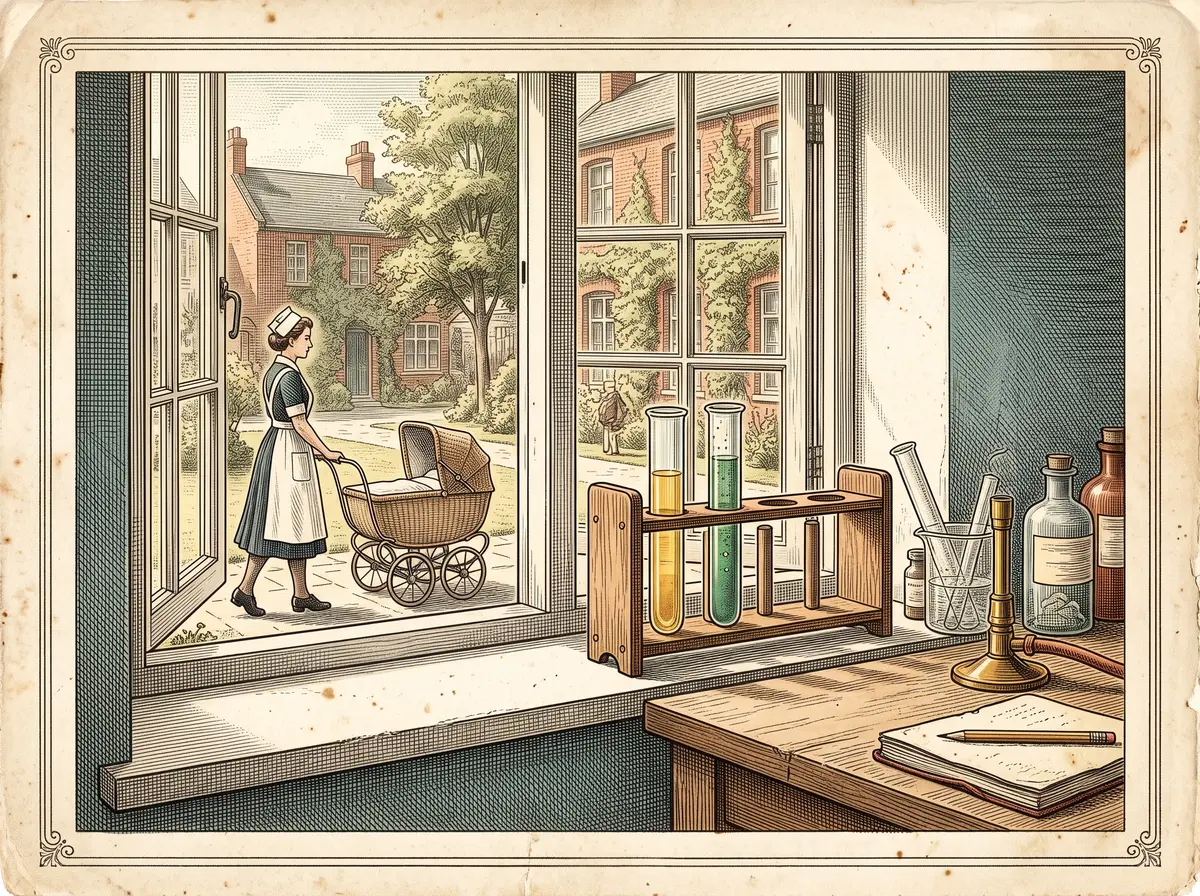
What happened: The Blood Sample Left on a Sunny Windowsill — and Why Jaundiced Newborns
The nurse was Sister J. Ward (usually remembered as Jean Ward), who ran Rochford’s premature baby unit. The unit’s rooms opened onto a sunny courtyard, and Sister Ward was a firm believer in fresh air and sunshine. On warm days she wheeled the sturdier infants outside, and she was convinced it did them good.
Many of those babies had jaundice, the yellowing of skin and eyes caused by a buildup of bilirubin. Bilirubin is a yellow pigment made when the body breaks down old red blood cells. Adults clear it through the liver without a second thought, but a newborn’s liver is still getting up to speed, and premature babies’ livers even more so. Most jaundice in newborns is mild and fades by itself. In a small number of babies, though, bilirubin climbs so high that it can seep into the brain and cause permanent damage, a condition called kernicterus. In 1956, the main defense was an exchange transfusion: slowly swapping out the baby’s blood for donor blood, a delicate and risky procedure.
The pediatrician R. H. Dobbs and his registrar, a young doctor named Richard Cremer, looked at the baby with the yellow triangle. Sister Ward’s theory was that sunlight had bleached the exposed skin. The doctors noted it with interest, but nobody followed it up at the time. The baby recovered and went home.
Then came the windowsill. A few weeks later, according to the account Dobbs and Cremer published in 1975, a blood sample from a deeply jaundiced baby went to the hospital’s biochemistry lab. The result phoned through to the ward was about 13–14 mg of bilirubin per 100 ml of blood. That didn’t fit how sick the baby looked. The biochemist, P. W. Perryman, went to check and found the original tube still sitting on a sunny windowsill. A fresh sample from the baby measured 24. The tube that had spent the day in the sun now measured 9.
Something in that window was destroying bilirubin. Later that summer, on a bright July day, the same thing happened again: a pre-transfusion sample left in the sunshine turned green instead of yellow, and its bilirubin reading came in far lower than anyone expected.
This time the team ran with it. Cremer, Perryman, and the hospital’s chief biochemistry technician, D. H. Richards, began exposing samples to different kinds of light. Hospital engineers built a curved reflector fitted with blue fluorescent tubes that could sit over a baby’s cot. In May 1958 the three published their results in The Lancet under the title “Influence of Light on the Hyperbilirubinaemia of Infants.” Light, they reported, could lower bilirubin in jaundiced babies.
Why it was strange: The Blood Sample Left on a Sunny Windowsill — and Why Jaundiced Newborns
For one thing, the breakthrough came from a mistake that most labs would simply have fixed and forgotten. A tube left in the wrong place produces a wrong number, and the usual response is to draw a new sample and move on. Perryman instead asked why the wrong number was wrong.
For another, the idea sounded like folk medicine. “Sunshine is good for babies” is the kind of thing a grandmother says. Here it turned out to be literally true for a specific, measurable reason, and the person who first noticed it was the nurse who had been carrying babies outside all along.
And then the medical world mostly ignored it. The paper drew little notice in Britain, and American pediatricians largely dismissed it for about a decade, citing the small number of infants and doubts that light was really the cause. Doctors in South America and Europe kept testing it meanwhile. The turnaround came in 1968, when Jerold Lucey, Mario Ferreiro, and Jean Hewitt at the University of Vermont published a randomized controlled trial of 111 premature babies in Pediatrics. Babies under the lights had lower bilirubin levels than those who weren’t, and the researchers saw no obvious side effects. By the mid-1970s, phototherapy was standard care in the United States.
Another accident with a medical payoff: The Farmer Who Drove Through a Blizzard With a Dead Cow and a Milk Can of Blood.
The windowsill sample belongs with The Mistakes That Became Things You Still Use.
What scientists learned: The Blood Sample Left on a Sunny Windowsill — and Why Jaundiced Newborns
The Rochford team showed early on that the active ingredient wasn’t heat or ultraviolet rays. It was ordinary visible light, especially blue. Bilirubin is yellow because it absorbs blue light, and absorbing that energy changes the molecule. The green color of the sunlit samples came from biliverdin, a related pigment.
The full chemistry took decades to work out. Researchers first assumed light was mainly oxidizing bilirubin, burning it up, in effect. Work in the 1980s, notably by Antony McDonagh and colleagues, showed that the bigger effect is photoisomerization: light twists bilirubin into slightly different shapes, called isomers, that dissolve more easily in water. The baby can then get rid of them in bile and urine without waiting for the liver to process them. Light doesn’t destroy the pigment so much as reshape it into a form the body can flush out.
How it reaches us today: The Blood Sample Left on a Sunny Windowsill — and Why Jaundiced Newborns
Phototherapy is now one of the most common treatments in newborn care. Hospitals worldwide place jaundiced infants under blue or blue-green lights, typically around 460–490 nanometers, wearing eye shields and little else so plenty of skin is exposed. It has greatly reduced the need for exchange transfusions. The American Academy of Pediatrics’ current jaundice guidelines, updated in 2022, are built around when to start it.
Doctors no longer recommend putting babies in direct sunlight to treat jaundice, since sun brings risks of sunburn and overheating that medical lights avoid. But the idea started with the sun, a courtyard, and one nurse’s habit.
For light treatments that didn’t hold up: The Box of Light Bulbs the Corn Flakes Doctor Said Cured a King.
Fun fact: The Blood Sample Left on a Sunny Windowsill — and Why Jaundiced Newborns
In 2017, a hospital laboratory in London recreated Perryman’s accident for BBC One’s The One Show. Staff taped tubes of jaundiced babies’ serum to a sunny window, and within 24 hours the bright yellow samples had turned green.
If you’re a new parent worried about your baby’s color, feeding, or sleepiness, your midwife, health visitor, or pediatrician would much rather check than have you wait. Newborn jaundice is common and very treatable.
Sources: The Blood Sample Left on a Sunny Windowsill — and Why Jaundiced Newborns
- R. H. Dobbs and R. J. Cremer, “Phototherapy,” Archives of Disease in Childhood 50 (1975): 833–836. The doctors’ own account of Sister Ward, the triangle of skin, and the windowsill samples. PubMed: https://pubmed.ncbi.nlm.nih.gov/1108807 ; reproduced at Neonatology on the Web: https://neonatology.net/?p=3960
- R. J. Cremer, P. W. Perryman, and D. H. Richards, “Influence of Light on the Hyperbilirubinaemia of Infants,” The Lancet 271 (1958): 1094–1097. Citation record: https://www.historyofmedicine.com/id/15219
- Embryo Project Encyclopedia, Arizona State University, “The Effectiveness of Phototherapy in Premature Infants (1968)”: https://embryo.asu.edu/pages/effectiveness-phototherapy-premature-infants-1968
- Neonatology on the Web, “Richard John Cremer (1925–2014)”: https://neonatology.net/gallery/people/richard-john-cremer-1925-2014/
- Synnovis (formerly Viapath), “The Birth of Phototherapy”: https://ww2.synnovis.co.uk/news-and-press/the-birth-of-phototherapy