Accidental Discoveries · Engineering
The Frustrated Yank That Turned a Snapping Plastic Rod Into Gore-Tex
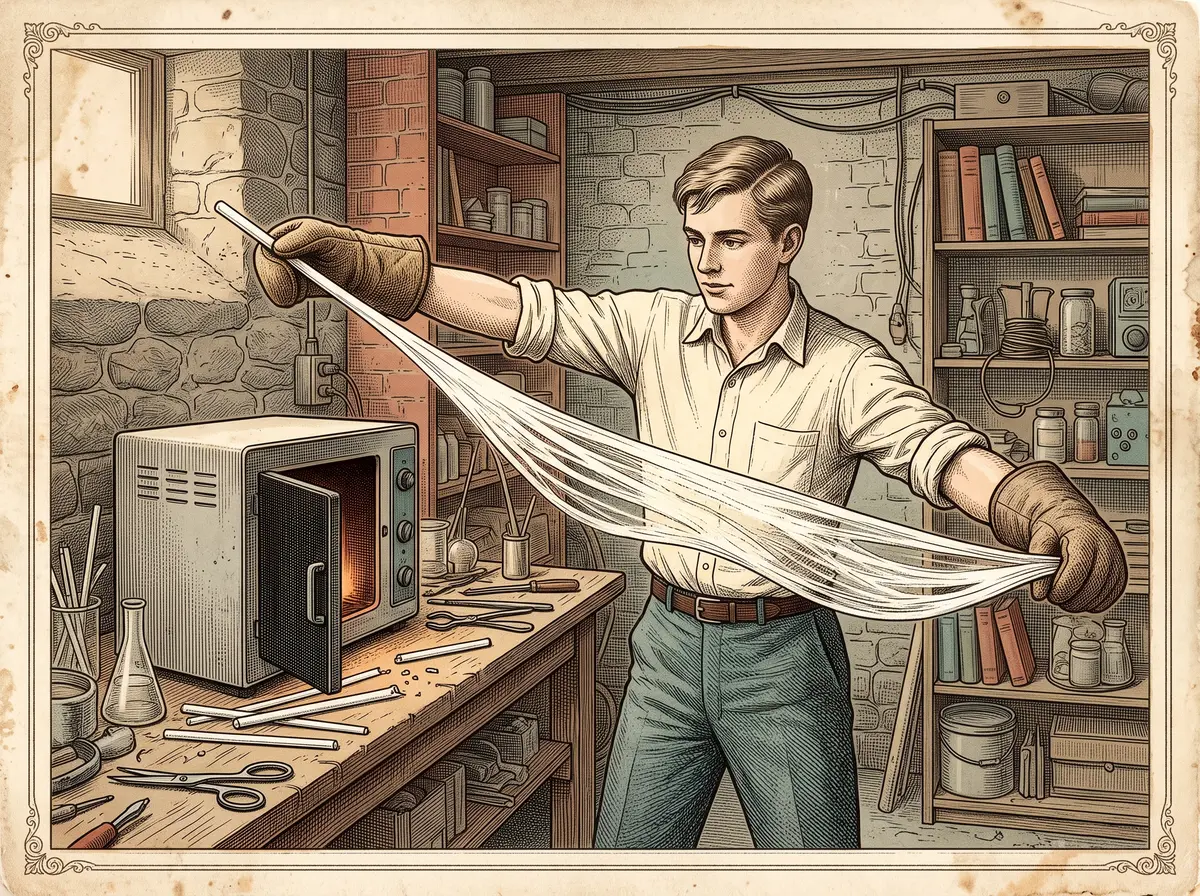
In 1969, a young chemical engineer named Bob Gore stood in his family's lab with a heated rod of the slippery plastic behind Teflon, and it had beaten him again. Every time he stretched one of these rods slowly and carefully, it snapped. So, out of frustration, he grabbed one and yanked it hard. Instead of breaking, the rod stretched by about 800 percent, turning into a strong, airy material no one had seen before. That angry tug became the heart of Gore-Tex.
By the Curiosities Desk · · 5 min read · Filed under Engineering · Today’s round
What happened: The Frustrated Yank That Turned a Snapping Plastic Rod Into Gore-Tex
The plastic in question was polytetrafluoroethylene, or PTFE, a material so chemically unreactive that almost nothing sticks to it. DuPont sold it under the name Teflon. Bob Gore knew it well. His father, Wilbert “Bill” Gore, had been a chemical engineer at DuPont before leaving in the late 1950s to start his own company, W. L. Gore & Associates, with his wife, Vieve. The family firm built its early business around PTFE, including insulation for electrical cables.
Bob had studied chemical engineering at the University of Delaware and earned a doctorate from the University of Minnesota in 1962. By 1969 he was working on a practical problem: turning extruded PTFE into thread-seal tape, the thin white tape plumbers wrap around pipe threads to stop leaks. Stretching the plastic would let the company make more tape from less material. But according to the Science History Institute, attempts to stretch heated PTFE rods by even about 10 percent kept failing. The rods simply broke.
The conventional wisdom was to go slowly. Bob did, night after night, wearing thick oven mitts to handle the hot rods. Then, in October 1969, he tried the opposite. He gave a heated rod what the Science History Institute calls a “sudden, accelerating yank.” It stretched by roughly 800 percent without breaking. The next morning, he showed his father. Both men saw that this could be the company’s future.
The new material was named expanded PTFE, or ePTFE. In 1970, the trade magazine Plastics World called it “a whole new ball game.” It could be made into yarn, film, tubes, and cable insulation. Early field tests showed the thin membrane was too delicate on its own, so the fix was to bond it to sturdier fabric.
Gore filed for patents in May 1970. The first, U.S. Patent 3,953,566, was granted in 1976 and claimed stretching PTFE “at a rate above 10% per second,” the speed that made the trick work. Gore-Tex fabric reached outdoor gear makers that same year, with early products including a tent from the Seattle outfitter Early Winters and a sleeping bag from Marmot.
There’s a twist. Gore wasn’t the only person who had stretched PTFE. Court records show that a New Zealand inventor, John Cropper, had built a machine for making stretched and unstretched PTFE tape in 1966. He kept his process secret, and in 1968 sold a machine to a company called Budd, which used it under conditions of secrecy. When Gore later sued the company Garlock for patent infringement, a lower court ruled Gore’s patents invalid, partly because of Cropper’s earlier work. In 1983, a federal appeals court reversed much of that ruling. Its reasoning: a secret process that was never shared with the public could not block a later inventor who promptly filed a patent and told the world how it worked.
Why it was strange: The Frustrated Yank That Turned a Snapping Plastic Rod Into Gore-Tex
The breakthrough came from doing exactly what experience said not to do. Gentle stretching seemed like the obvious way to treat a fragile material. Yet PTFE behaved the opposite way: pulled slowly, it tore; pulled fast, it spread out evenly into a web of tiny fibers.
It also turned a famously solid, slippery plastic into something that was about 70 percent air. And the legal fight added another surprise: the person recognized as the inventor wasn’t necessarily the first person to do it, but the first to share it.
More discoveries that began as a mistake: The Mistakes That Became Things You Still Use.
What scientists learned: The Frustrated Yank That Turned a Snapping Plastic Rod Into Gore-Tex
When PTFE is stretched quickly at the right temperature, it doesn’t just thin out. It forms a microscopic structure of solid “nodes” connected by thin threads called fibrils, like knots joined by strands of a net. The spaces between them are pores, which is why the result is so light and full of air.
Those pores turned out to be a perfect size for rainwear. According to Gore, one square inch of the membrane holds about nine billion pores. Each is roughly 20,000 times smaller than a water droplet, so liquid rain can’t push through. But each is also about 700 times larger than a single molecule of water vapor, so sweat, in the form of vapor, can escape. That combination of being waterproof and “breathable” is what earlier rubberized raincoats couldn’t manage.
It wasn’t perfect at first. Early Gore-Tex gear leaked at the seams and could be fouled by body oils. Gore added seam tape and improved the membrane, and refunded roughly $4 million in returns along the way.
Teflon’s own discovery was an accident, too: The Cylinder That Weighed Too Much and Became Teflon.
How it reaches us today: The Frustrated Yank That Turned a Snapping Plastic Rod Into Gore-Tex
Gore-Tex became a standard name in rain jackets, hiking boots, and gloves, used by everyone from dog walkers to mountaineers. But expanded PTFE reaches far beyond clothing. It shows up in cable insulation, filters, industrial seals, and medical implants.
Bob Gore went on to lead the company as president and CEO from 1976 and as chairman from 1986 to 2016. He was inducted into the National Inventors Hall of Fame in 2006 and died in 2020.
The Gore v. Garlock decision is still taught in patent law. It’s a reminder that, in the patent system, keeping a great idea secret can cost you the credit for it.
Another everyday material born from an unexpected result: The Unwashed Flask That Fell 11 Feet and Became Your Windshield.
Fun fact: The Frustrated Yank That Turned a Snapping Plastic Rod Into Gore-Tex
Gore-Tex’s first real-world test was a family camping trip. Bill and Vieve Gore pitched a tent with homemade patches of the new material, a hailstorm tore the patches, and Bill still reported that the tent held water “like a bathtub.”
Sources: The Frustrated Yank That Turned a Snapping Plastic Rod Into Gore-Tex
- Robert W. Gore — Science History Institute
- Bob Gore’s Outdoor Revolution — Distillations, Science History Institute
- US Patent 3,953,566, “Process for Producing Porous Products,” Robert W. Gore (1976) — Google Patents
- W. L. Gore & Associates, Inc. v. Garlock, Inc., 721 F.2d 1540 (Fed. Cir. 1983) — vLex
- Stretched to the Limit — GORE-TEX Brand