Science Through Time · Physics
From a Flask of Liquid Air to Soup in Your Lunchbox: A Short History of the Vacuum Flask
In a basement museum in London stands the glass bottle James Dewar made in 1892, about 35 centimeters tall and sealed with tin and wax. It is really two bottles, one tucked inside the other, with almost nothing in between. He built it to keep liquefied gases so cold they would boil away in a warm room in minutes. He never patented it. Within a few years, German glassblowers were putting his laboratory instrument into picnic baskets, and the name on the side wasn't his.
By the Curiosities Desk · · 5 min read · Filed under Physics · Today’s round
What happened: The Vacuum Flask
The idea started small and hot, not cold. In the early 1870s, the Scottish chemist James Dewar was measuring the specific heat of palladium loaded with hydrogen — how much energy it takes to warm the metal by one degree. To stop his sample from trading heat with the room, he built a brass chamber inside a second brass chamber and pumped the air out of the gap between them. He published the apparatus in 1873.
Two decades later, Dewar was Fullerian Professor of Chemistry at the Royal Institution in London and deep in the race to liquefy the “permanent” gases. Liquid oxygen boils at about −183 °C. Make some, set it in an ordinary jar, and the room’s warmth pours in so fast that your hard-won sample simply evaporates. Keeping it liquid long enough to study was expensive and maddening.
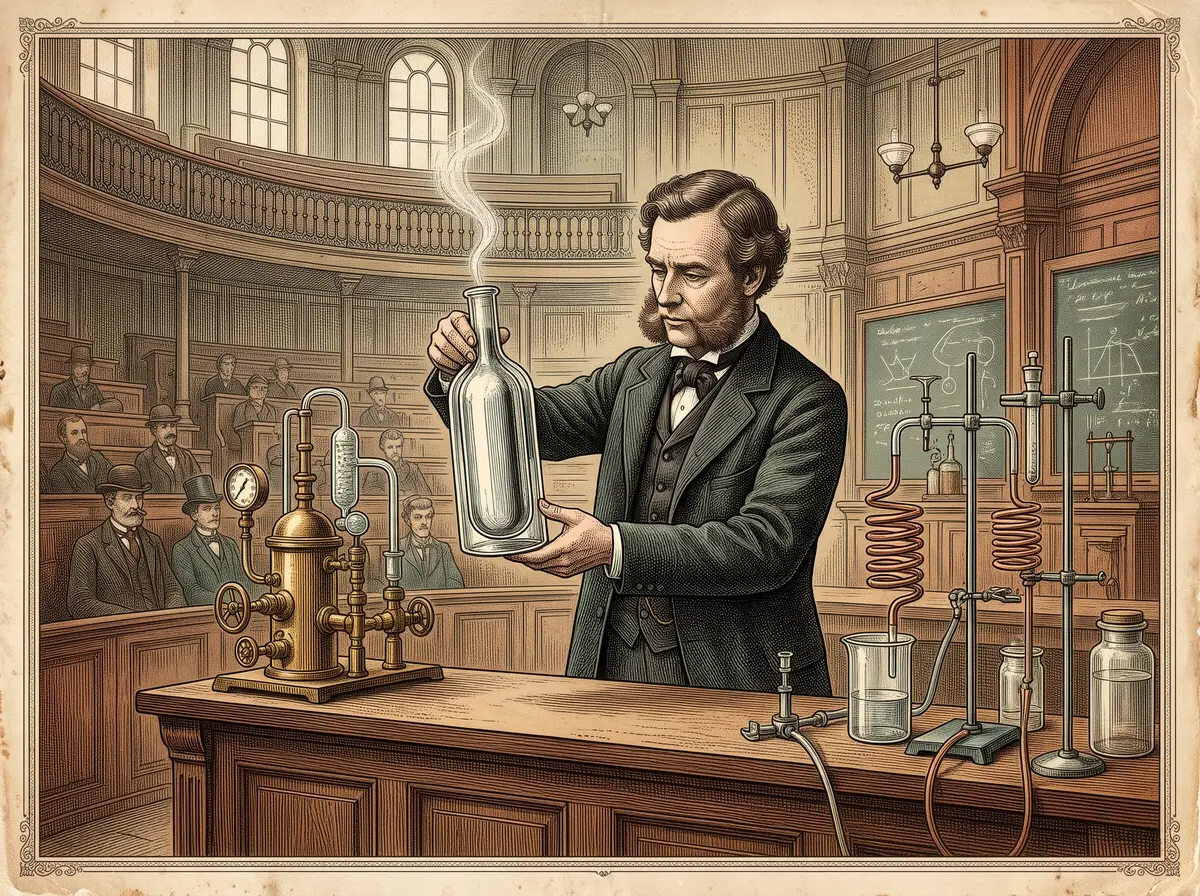
So around 1892 he returned to the double wall, this time in glass: one flask sealed inside another at the neck, with a partial vacuum between them. The Royal Institution still owns that first flask, made in-house of glass, tin, and wax, and displays it in its Faraday Museum.
Then he kept tinkering. By 1893 he could show that vacuum insulation made liquid nitrogen last about five times longer. A pinch of charcoal in the gap soaked up stray gas molecules and improved the vacuum. And coating the glass with a thin layer of silver or mercury, he found, cut heat lost to radiation by a factor of about 13. Those mirrored walls are why a vacuum flask still looks silver inside.
Oddly, British glassblowers struggled to make the delicate vessels, so for years Dewar had them made in Germany. In 1898, using a large refrigerating machine at the Royal Institution, he became the first person to liquefy hydrogen — a feat that depended on having somewhere to put it.
Here the story leaves the lab. According to a story recounted by the physicist Robert Soulen, a German glassblower discovered that a silvered vacuum flask would keep his baby’s milk warm overnight. Whether or not that is exactly how it went, glassblowers clearly noticed what Dewar had not pursued: the same flask that kept cold things cold would keep hot things hot.
In 1904, two of them, Reinhold Burger and Albert Aschenbrenner, formed Thermos GmbH to sell a sturdier household version. A Munich resident reportedly won a contest to name it, coining “Thermos” from the Greek word for heat. By 1907 an American, William Walker, had bought the rights and founded the American Thermos Bottle Company in Brooklyn. The company later boasted that its bottles had traveled with Robert Peary toward the North Pole and with aviation pioneers like the Wright brothers — claims best read as marketing.
Dewar, meanwhile, went to court to reclaim rights to the invention, and lost.
Why it was strange: The Vacuum Flask
The flask is one of the rare objects that went from the frontier of physics to the lunchbox almost unchanged. The instrument that let a scientist hold liquid hydrogen is, in its essentials, the one that keeps a commuter’s coffee warm.
And the man who invented it walked away with nothing but the scientific credit, while a word invented in a naming contest became the household name. Dewar was no stranger to patents — he co-developed the smokeless propellant cordite — so his decision not to protect the flask still puzzles historians. Soulen’s best guess is that, as an elite London academic, he simply didn’t think of patenting lab research as the done thing.
The story of how we learned to empty a space in the first place runs through From a Lead Pipe Up a Roman House to Sixteen Horses Losing a Tug-of-War: A Short History of the Vacuum.
What scientists learned: The Vacuum Flask
Heat moves in three ways. Conduction is heat passing through touching matter, like a hot pan handle. Convection is heat carried by moving fluid, like warm air rising. Radiation is heat traveling as infrared light, which needs no matter at all.
Dewar’s flask attacks all three. The vacuum removes the air that would conduct and convect heat across the gap. The mirrored coating reflects radiation back toward where it came from. What’s left is the weak point you can feel with your hand: the neck and stopper, where the inner and outer walls meet. Most of the heat a vacuum flask gains or loses leaks through that rim.
The Dutch physicist Heike Kamerlingh Onnes, who beat Dewar to liquid helium in 1908, called the flask the most important appliance for working at extremely low temperatures. Without it, cryogenics — the science of the very cold — would have been a series of brief, expensive puffs of vapor.
Glass made all this possible; its own long story is told in From a Beach Bonfire to a Cake in a Battery Jar: A Short History of Glass.
How it reaches us today: The Vacuum Flask
Scientists still call the lab version a “dewar.” Liquid nitrogen arrives in them, frozen cells and samples are stored in them, and the superconducting magnets in MRI scanners sit in liquid helium inside vacuum-insulated vessels built on the same principle.
The other legacy is legal. In 1963, a U.S. appeals court ruled in King-Seeley Thermos Co. v. Aladdin Industries that lowercase “thermos” had become a generic word. A survey cited in the case found that about 75 percent of American adults familiar with such bottles called them “thermos,” while only about 12 percent knew it was a brand. Rivals could now sell a thermos, though Aladdin had to call its product “Aladdin’s thermos,” and capital-T Thermos stayed a trademark. The company that took Dewar’s invention ended up losing its own name to the public.
Measuring the heat these flasks hold back has its own history: From a Glass Frog Tied to Your Wrist to 98.6: A Short History of the Thermometer.
Dewar’s doubled bottle is one more walk from the lab to the lunchbox in From the First Spark to the Thing You Still Use.
Fun fact: The Vacuum Flask
Dewar’s late-career obsession was soap bubbles. He blew some about four feet across and, by keeping one sealed away from dust and drafts, nursed a single bubble along for 322 days.
Sources: The Vacuum Flask
- Royal Institution, “James Dewar’s vacuum flask” — the museum record for Dewar’s original 1892 flask, with its construction and history.
- Robert J. Soulen Jr., “James Dewar, His Flask and Other Achievements”, Physics Today 49(3), 1996 — on the brass calorimeter, silvering, the patent question, and the soap bubbles.
- APS News, “January 19, 1894: James Dewar produces solid air”, 2012 — on the flask, Thermos GmbH, Kamerlingh Onnes’s praise, and Dewar’s failed court case.
- King-Seeley Thermos Co. v. Aladdin Industries, Inc., 321 F.2d 577 (2d Cir. 1963) — the ruling that made “thermos” a generic word.
- Encyclopedia.com, “Thermos Company” — company history covering Thermos GmbH, the naming contest, and the American Thermos Bottle Company.