Science Through Time · Physics
From a Lead Pipe Up a Roman House to Sixteen Horses Losing a Tug-of-War: A Short History of the Vacuum
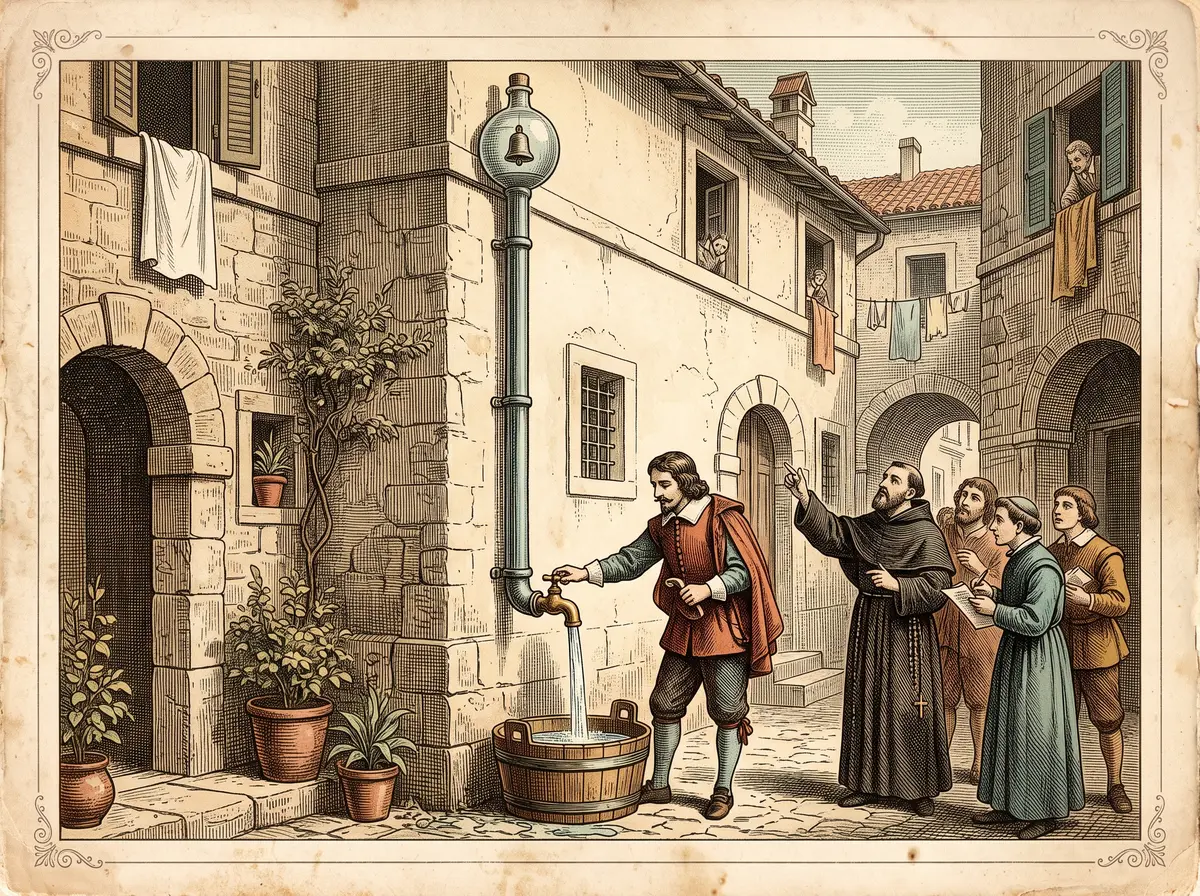
Around 1640 in Rome, Gasparo Berti bolted a lead pipe taller than a three-story building to the side of his house, filled it with water, sealed the top, and opened a tap at the bottom. The water ran out — and then stopped, hanging in the pipe about 10 meters up as if something were holding it. Above it, in a glass vessel at the top of the pipe, was a space that seemed to contain nothing at all. Inside that space, a little bell was waiting to be rung.
By the Curiosities Desk · · 5 min read · Filed under Physics · Today’s round
What happened: The Vacuum
The puzzle started with plumbing. By the 1630s, well diggers and fountain builders in Italy knew an annoying fact: a suction pump could not lift water more than about 18 braccia — around 11 meters. Galileo Galilei thought the water column simply broke under its own weight, the way a long rope snaps. But nobody had tested the idea properly.
Berti did, in the courtyard of his Roman house. His lead pipe stood about 21 braccia high, with a glass vessel and stopcocks at the top. When he opened the bottom tap into a tub of water, the column dropped and settled at roughly 18 braccia, the same limit the pump makers had hit. The question was what filled the gap above it. Most scholars of the day followed Aristotle’s view that “nature abhors a vacuum,” meaning truly empty space could not exist. The Jesuit scholar Athanasius Kircher, working with Berti, placed a bell in that upper space and rang it from outside with a magnet. Kircher reported that the bell was “distinctly audible” and took this as proof that air was still in there.
In Florence, Evangelista Torricelli had a sharper idea. If the limit came from the weight of the liquid, a denser liquid should stop lower. He filled glass tubes with mercury, about 13.6 times as dense as water, turned them upside down into a dish of mercury, and watched the column settle at just under a meter. In a letter of June 11, 1644, to his friend Michelangelo Ricci, he explained the result: the mercury wasn’t being pulled up by the empty space. It was being pushed up by the weight of the air pressing on the dish. “We live immersed at the bottom of a sea of elemental air,” he wrote.
In France, Blaise Pascal pushed the idea up a mountain. If air has weight, there should be less of it pressing down at altitude. Pascal asked his brother-in-law, Florin Périer, to test this, and on September 19, 1648, Périer carried a mercury tube up the Puy de Dôme, a volcanic peak in central France, while an identical tube stayed behind in a convent at the bottom. At the summit, the mercury stood about three inches lower. On the way down, it rose again. Pascal also wrote that he had raised glass tubes some 15 meters tall in Rouen, filled with wine and with water. Historians have long questioned whether he could actually have staged that one.
Then came the showman. Otto von Guericke, the mayor of Magdeburg in Germany, built one of the first air pumps and used it to pull the air out of two large copper hemispheres fitted together. With nothing inside pushing back, the outside air pressed the halves together so hard that teams of horses could not pull them apart. A 1657 letter describing the demonstration mentions 12 horses; the famous engraving in his 1672 book shows 16, eight to a side. Either way, the horses lost.
Why it was strange: The Vacuum
For about 2,000 years, educated Europeans had good reasons to believe empty space was impossible, and the evidence seemed to agree: water follows a pump’s piston, and liquid stays put in a straw when you cap the top. The new experiments flipped the explanation. Nothing was “sucking.” The air around us, which feels like nothing, was pressing on every surface with enormous force all along.
We never notice it because we are pressed on equally from all sides, the way a fish doesn’t feel the weight of the sea.
The pressure of the air turned out to be a weather sign too, as an earlier story here shows: The Twelve Leeches That Rang a Bell When a Storm Was Coming.
What scientists learned: The Vacuum
At sea level, the air presses down with about 1 kilogram on every square centimeter, or about 14.7 pounds per square inch. A column of water about 10 meters tall weighs the same as a column of air reaching to the top of the atmosphere, which is why Berti’s water stopped where it did. Mercury, being 13.6 times denser, balances at about 76 centimeters. Torricelli’s tube was the first barometer, an instrument that measures air pressure.
Guericke’s hemispheres showed the other side of that same force. A vacuum doesn’t pull; the surrounding air pushes. Remove the air from inside a container and the outside pressure has nothing to push against.
The fact that space itself is a near-vacuum confused some people for centuries afterward: The Newspaper That Took 49 Years to Admit Rockets Work in Space.
How it reaches us today: The Vacuum
The pioneers are still with us in our units. The torr, named for Torricelli, is 1/760 of a standard atmosphere — the pressure that holds up 760 millimeters of mercury. The pascal, the official scientific unit of pressure, is named for Pascal. Every weather forecast that mentions high or low pressure traces back to the tubes of Florence and the Puy de Dôme.
Vacuums now hide inside ordinary things, from insulated flasks to the packaging that keeps coffee fresh. They also make modern physics possible. The LIGO observatories, which detect ripples in space-time called gravitational waves, run their laser beams through about 10,000 cubic meters of tubing pumped down to roughly one-trillionth of atmospheric pressure. According to LIGO, only the vacuum system at the Large Hadron Collider is bigger.
Another story of measuring the invisible with clever tubes and mirrors: From Lanterns on Two Hills to Mirrors Left on the Moon: A Short History of Measuring the Speed of Light.
That path, from a pipe on a Roman wall to the pumps still used in labs, is one of the long histories in From the First Spark to the Thing You Still Use.
Fun fact: The Vacuum
Guericke also built a roughly 10-meter water barometer in front of his house in Magdeburg, with a small wooden doll floating inside it. In fair weather, high air pressure lifted the doll into view behind a glass window at the top; when a storm was coming, it sank out of sight.
Sources: The Vacuum
- Evangelista Torricelli, letter to Michelangelo Ricci, June 11, 1644 (English translation, Le Moyne College)
- Gasparo Berti and Athanasius Kircher — Museo Galileo, Florence (“The Vacuum” exhibit)
- Florin Périer and the Puy de Dôme experiment — Linda Hall Library, Scientist of the Day
- “The pressure was on for scientists to explain what Galileo could not” — Chemistry World
- LIGO’s Vacuum System — LIGO Caltech