Science Through Time · Engineering
From a Gas Lamp That Exploded Outside Parliament to an Upside-Down Light in Syracuse: A Short History of the Traffic Light
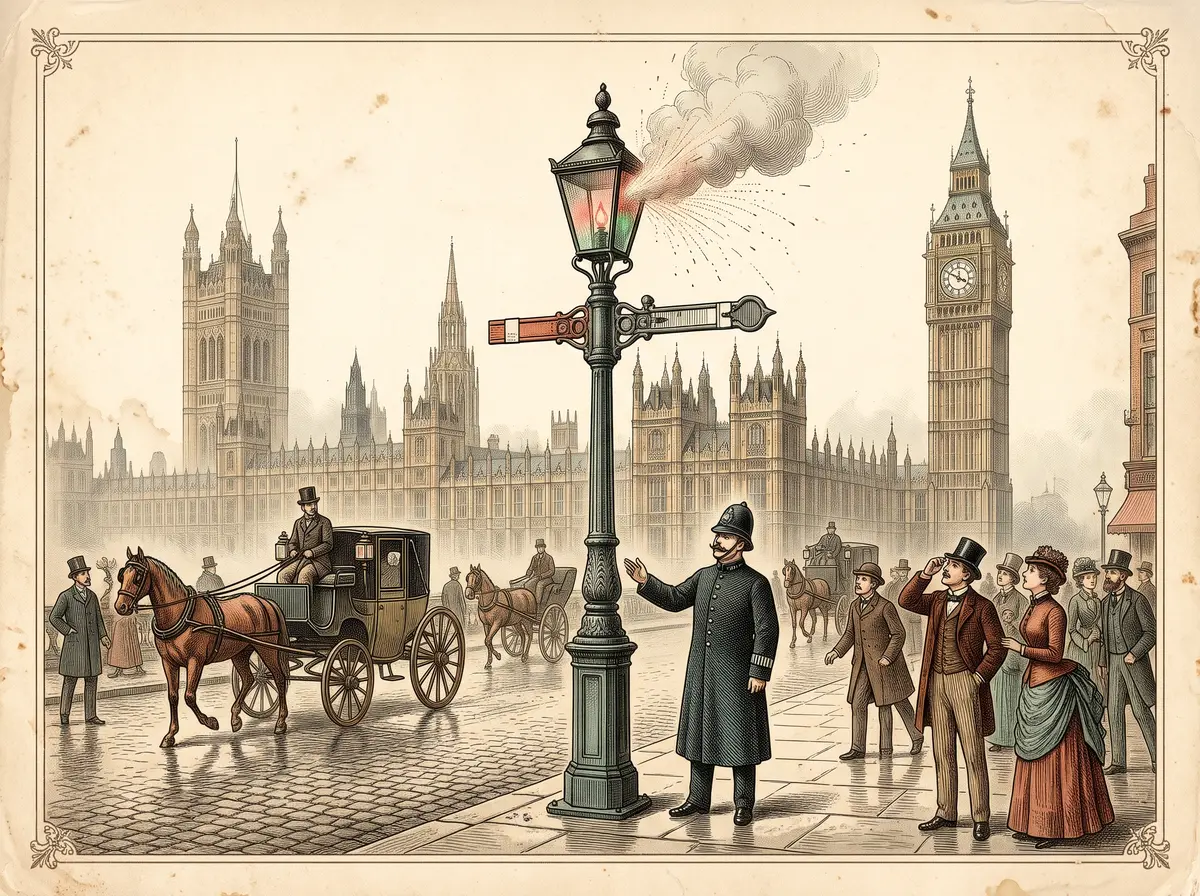
On January 2, 1869, a London police constable was standing at his post outside the Houses of Parliament, working the world's first traffic signal, when the thing blew up. Gas had leaked inside the 20-foot iron pillar, the lamp ignited it, and the officer was badly injured. The world's first traffic light had been switched on barely two weeks before.
By the Curiosities Desk · · 5 min read · Filed under Engineering · Today’s round
What happened: The Traffic Light
In the 1860s, the street outside Parliament in Westminster was a scrum of carriages, carts, omnibuses, and people on foot, including members of Parliament trying to get to work alive. A parliamentary select committee suggested something be done, and the job went to John Peake Knight, a railway engineer from Nottingham who happened to live on nearby Bridge Street.
Knight did the sensible thing for a railway man: he borrowed a railway signal. Built by the signal makers Saxby & Farmer, his pillar was installed in early December 1868 and went into use on December 17. It carried semaphore arms, wooden or metal blades that swing out from a post. An arm sticking straight out meant “stop.” An arm lowered to 45 degrees meant “caution.” Railways already used that language for trains.
After dark, arms were hard to see, so a gas lantern on top showed colored light instead: red for stop, green for caution. A police constable stood at the base and changed the signal by hand. It was, in short, a policeman with a very tall assistant.
Then came January 2, 1869, and the gas leak. Accounts agree a constable was seriously hurt; they do not agree on much more, and the signal seems to have soldiered on only briefly before it was quietly removed. London would not try traffic lights again for decades.
The idea resurfaced in America, where the car arrived in force. In 1912, Lester Wire, a police officer in Salt Lake City, built a box on a pole at 200 South and Main Street. It held red and green bulbs that, by local accounts, he colored by dipping them in paint, and it drew power from the overhead trolley wires. Admirers said it looked like a yellow birdhouse. Wire never patented it.
In August 1914, Cleveland installed what historian Clay McShane calls the first permanent electric traffic light, at East 105th Street and Euclid Avenue. It showed red and green in two directions, used a buzzer design from inventor James Hoge to warn that the color was about to change, and was still run by an officer in a booth on the sidewalk, who could flip it for fire engines.
Detroit added the color most of us now treat as a dare. Police officer William Potts brought in a yellow caution light (McShane dates it to 1917) and in 1920 built a three-color, four-direction signal, borrowing amber from the railroads. In 1922 the Syracuse signal company Crouse-Hinds took the officer out of the loop with automatic timers, first in Houston. And in 1923, the inventor Garrett A. Morgan received U.S. Patent 1,475,024 for a three-position signal after reportedly witnessing a crash between a car and a horse-drawn carriage. His patent rights were later bought by General Electric.
Why it was strange: The Traffic Light
We think of the traffic light as a car invention. It is older than the car. The first one was built for horses and pedestrians, and it was lit by gas.
Its “language” is also borrowed. Red for danger did not start with roads, or even railways. McShane traces it to the sea: a red lamp was used at the Flamborough Head lighthouse in 1806, reportedly because red was the most see-through colored glass available, and in 1852 the British Admiralty standardized red for a ship’s left side and green for its right. Railways picked the colors up from ships, and streets picked them up from railways. Your morning commute still runs on a color scheme partly chosen for what a glassmaker could make.
London’s later experiments with machines in the streets include The Department Store That Served Brandy at the Top of Its Moving Staircase.
What scientists learned: The Traffic Light
The deeper lesson was about people, not lamps. A traffic signal is a rule turned into a machine. Knight’s version still needed a constable to decide when to change it, and so did Cleveland’s. Every step since has moved judgment from a human to a device: Hoge’s buzzer warned drivers in advance, Potts’s yellow gave a buffer between “go” and “stop,” and Crouse-Hinds’s timers let one schedule control a whole street.
Engineers also learned that one light changes nothing on its own. The real gains came from coordination: signals timed so a stream of cars meets a “green wave” instead of stopping at every block. Coordinated signals let cities move officers off street corners in large numbers, which, as McShane notes, changed policing as much as it changed driving.
The same problem of horses, people, and new machines sharing a road appears in From Starving Horses to ‘Bicycle Face’: A Short History of the Bicycle.
How it reaches us today: The Traffic Light
Today’s signals are full of sensors, buried loops of wire or cameras that notice a waiting car, and many are networked so a city can retime them in real time. The idea is still Knight’s: a signal, borrowed from railways, telling strangers who goes first.
Some details never changed. Red sits on top almost everywhere, partly so drivers who cannot easily tell red from green can read the light by position. That makes one exception famous. In the Tipperary Hill neighborhood of Syracuse, New York, the light at Tompkins Street and Milton Avenue has green above red. According to local history, when the city put up a light there in 1925, residents of the heavily Irish neighborhood objected to “British” red sitting over “Irish” green, and stones kept breaking the red lens. The details come from neighborhood tradition, but the result is real: the city gave in, and the upside-down light still hangs there.
For more objects with long, winding backstories, see From the First Spark to the Thing You Still Use.
Fun fact: The Traffic Light
In 1920s New York, some traffic signals on Fifth Avenue were topped with small statues of Mercury, the Roman messenger god famous for speed, standing guard over lights whose main job was to make people stop.
Sources: The Traffic Light
- The Origins and Globalization of Traffic Control Signals — Clay McShane, Journal of Urban History 25(3), 1999
- 150th anniversary of the first traffic lights — IanVisits, drawing on December 1868 London newspaper reports
- Traffic signal, U.S. Patent 1,475,024 — Garrett A. Morgan, granted November 20, 1923
- Utah inventions: The world’s 1st electric traffic light — KSL, citing the Utah Department of Transportation
- Woe, Orangemen and Color-Blind — American Heritage 28(2), February 1977