Science Through Time · Engineering
From a Shoe Clasp That Popped Open to Galoshes Named for Their Noise: A Short History of the Zipper
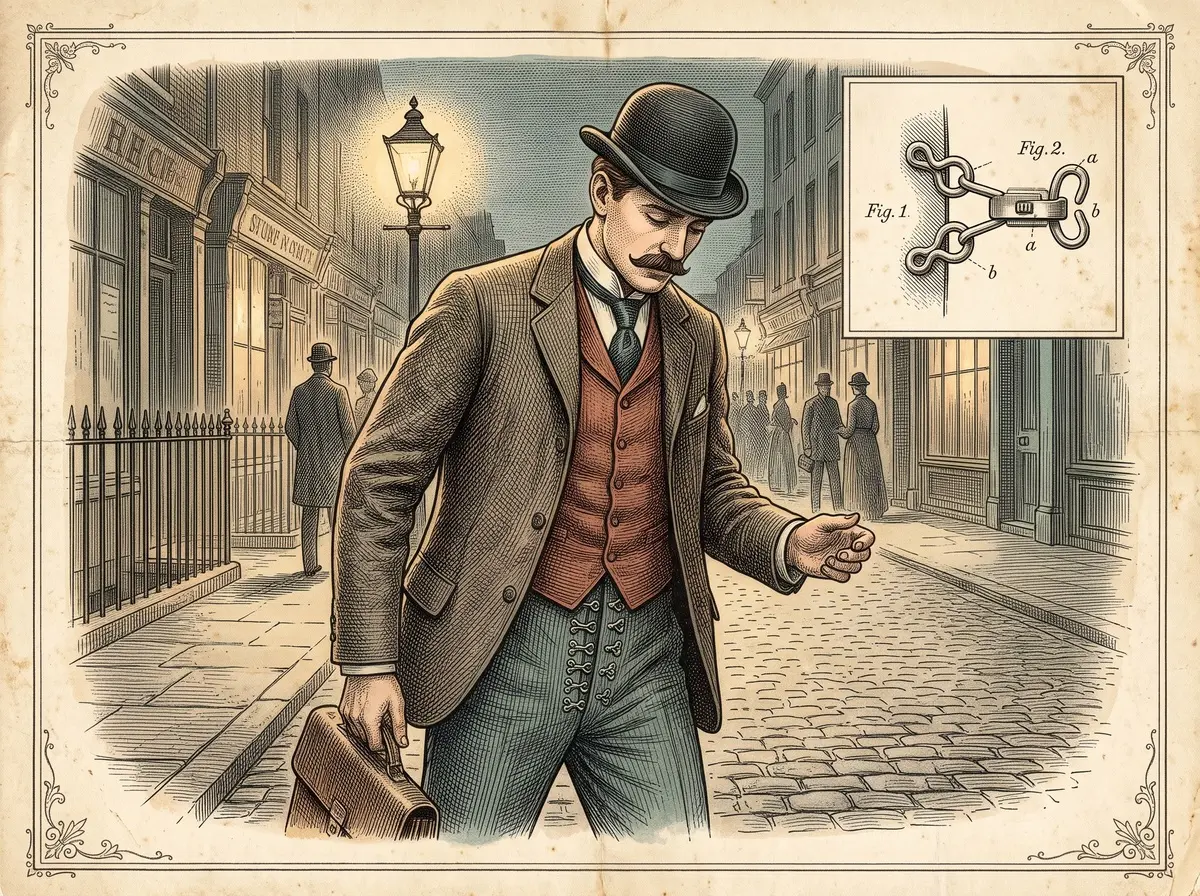
In 1906, after Lewis Walker hired Gideon Sundback, a company secretary went out wearing trousers fitted with the company's newest fastener, one that closed with a single pull. One evening it popped open, then jammed, and he had to hurry home. His employer was the company that would go on to make the zipper.
By the Curiosities Desk · · 5 min read · Filed under Engineering · Today’s round
What happened: The Zipper
The zipper’s story starts in 1851, when Elias Howe, better known for the sewing machine, patented an “Improvement in Fastenings for Garments.” It worked more like a fancy drawstring than a zipper, and Howe never seriously tried to sell it.
The real start came from Chicago. Whitcomb L. Judson, a mechanical engineer who had already patented railway brakes, applied in 1891 for a patent on a “Clasp Locker or Unlocker for Shoes.” The engineer Henry Petroski passes on a story that Judson, a heavy-set man, was tired of bending over to lace his high boots. Whether or not that’s true, the idea was simple. Judson’s patent, granted on August 29, 1893, described a row of separate hook-and-eye clasps that a sliding piece could close or open in one sweep. It was meant for shoes, but Judson suggested it would work for mail bags and belts too.
A Pennsylvania lawyer named Lewis Walker saw a fortune in the idea. He became the main backer of the Universal Fastener Company, and Judson’s clasp locker was shown at the 1893 World’s Columbian Exposition in Chicago. Almost nobody noticed. The early fasteners, Petroski writes, “tended to pop open at inopportune times,” and their sharp edges tore the fabric they were sewn into.
So the company tried again. In the mid-1900s, reorganized as the Automatic Hook and Eye Company, it launched an improved version called the C-curity. The name was a promise that this one would stay shut. Its slogan was “A pull and it’s done!” It didn’t stay shut either. It also had to be taken off clothes before washing, and the company offered to send “more detailed instructions” to customers who couldn’t get it on.
In 1906, Walker hired a Swedish-born electrical engineer, Gideon Sundback. Judson died in 1909, and Sundback carried on alone. His first new model, the Plako (named for the placket, the slit opening in a garment), was the one that sent the secretary hurrying home. Sundback decided the hooks themselves were the trouble. “The great need was to eliminate the hooks,” he later said.
His answer, finished around 1913 and called the Hookless No. 2, replaced the hooks with small identical metal scoops clamped along two strips of fabric tape. Each scoop had a bump on one side and a hollow on the other. A slider pressed the two rows together so each bump nested in the hollow next to it. Sundback also packed them far more tightly, going from about four fastening elements per inch to ten or eleven. The company, renamed the Hookless Fastener Company, moved to Meadville, Pennsylvania. Sundback’s U.S. patent for the “Separable Fastener,” filed in 1914, was granted on March 20, 1917.
Then the customers finally arrived. A New York tailor used the fasteners on money belts for World War I sailors, whose uniforms had no pockets. Flight suits, gloves, and tobacco pouches followed. In 1923, the B.F. Goodrich Company put the fastener on its rubber galoshes. Goodrich had been selling them as the “Mystik” boot, a name that didn’t catch on. For the 1923 season it renamed them after the sound they made: Zippers.
Why it was strange: The Zipper
We tend to picture inventions arriving all at once, in a single flash. The zipper took about twenty years to start working at all, and another twenty to become normal. Its name didn’t even come from the people who built it. The word belonged to a boot, and Goodrich later registered it as a trademark. The company that actually made the fastener kept calling its product “Hookless” and, from 1928, “Talon.”
Even after it worked, people weren’t sure they wanted it. Early zippers rusted, and clothes came with instructions on how to use them. Men’s trousers held out longest. Tailors and fashion writers argued through the 1930s over buttons versus zippers in what came to be called the “Battle of the Fly.” Esquire sided with the zipper partly because it prevented “unintentional and embarrassing disarray.” Just ask that secretary. The historian Robert Friedel spent a whole book on that slow start, Zipper: An Exploration in Novelty. Other inventions that took a winding road are on the shelf of From the First Spark to the Thing You Still Use.
What scientists learned: The Zipper
The zipper is a lesson in engineering through failure. Judson’s hooks failed because each clasp was a separate part that could twist loose under strain. Sundback’s insight was to make every element identical and let them lock by shape rather than by catching on each other. Pushed together at a slight angle by the slider’s Y-shaped channel, each tooth slips into place. Once the tape straightens out, the teeth hold each other tight. Pull sideways on a closed zipper and the force spreads along dozens of nested teeth instead of tugging on one hook.
Identical parts brought a second payoff: they could be stamped out by machine. Sundback also designed the machinery to make them, which turned a fussy handmade novelty into something cheap enough for a tobacco pouch. Another everyday fastener with a strange origin is The Burrs Stuck to a Dog That Became Velcro.
How it reaches us today: The Zipper
The zipper is now one of the most common machines in the world, though few people think of it as one. Talon dominated the U.S. market for decades. By the 1980s, the Japanese company YKK, founded in Tokyo in 1934, held about 45 percent of the world market. Most zippers today use a coil of nylon or polyester instead of metal teeth, but they still lock by Sundback’s principle of interlocking shapes.
Zippers seal spacesuits, tents, luggage, and medical gear. Goodrich’s trademark on the word lapsed in the 1980s, long after “zipper” had become an everyday word. Goodrich’s galoshes depended on another happy accident, told in The Hot Stove Accident That Invented Modern Rubber.
Fun fact: The Zipper
“Zipper” started out as the name of a boot, not a fastener. Goodrich named its 1923 galoshes for the zipping sound they made, and the word attached itself to every slide fastener after that.
Sources: The Zipper
- Whitcomb L. Judson, “Clasp Locker or Unlocker for Shoes,” U.S. Patent 504,038 (1893), Google Patents
- Gideon Sundback, “Separable Fastener,” U.S. Patent 1,219,881 (1917), Google Patents
- Henry Petroski, The Evolution of Useful Things, Chapter 4 (course excerpt, Montana State University)
- Philip Yam, “Google Pays Homage to Zipper Engineer Gideon Sundback,” Scientific American (drawing on Louis Weiner’s June 1983 Scientific American cover story)
- Robert Friedel, reply to readers on “The History of the Zipper,” American Heritage of Invention & Technology, Fall 1994