Science Through Time · Medicine
From a Gold-Veined Eyeball in the Burnt City to Dentists Making Eyes: A Short History of the Artificial Eye
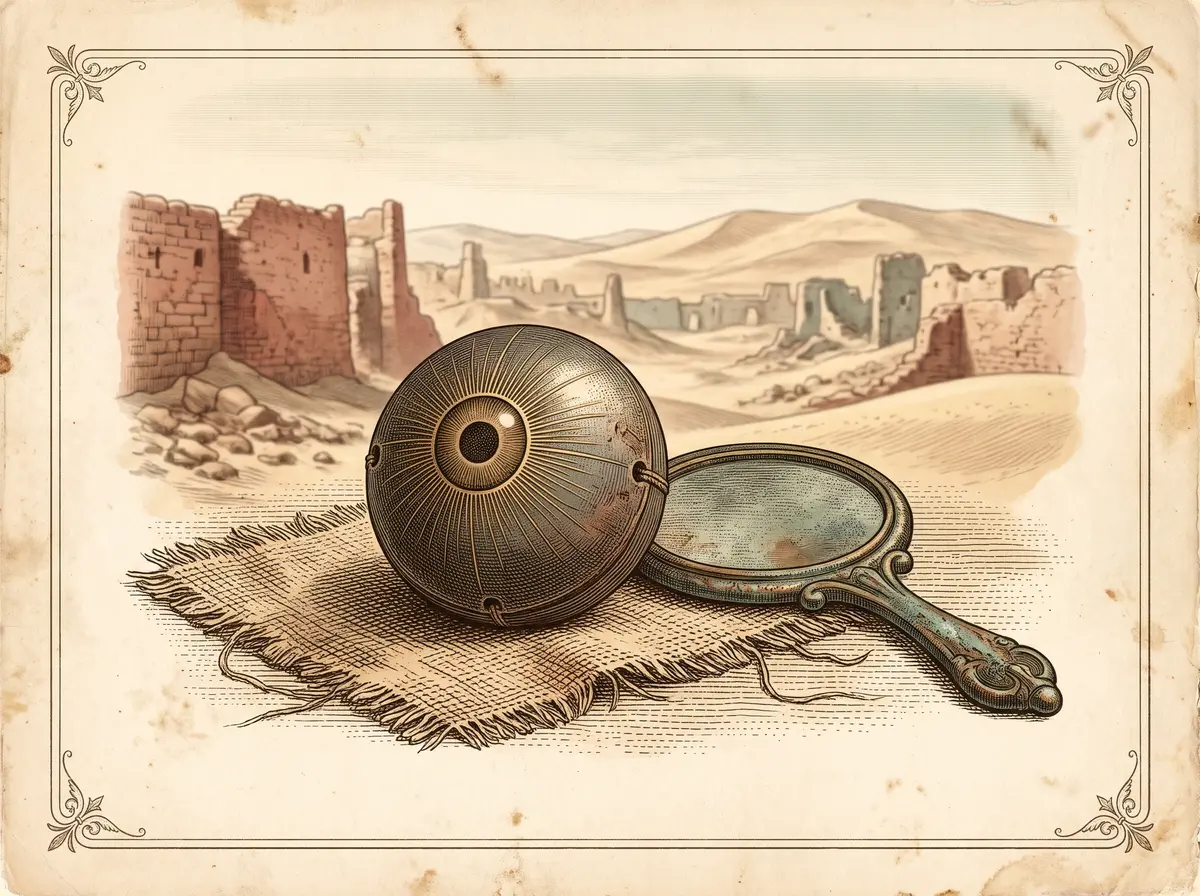
Sometime around 2900 BC, in a desert city in what is now southeastern Iran, a tall woman was buried with a small bronze mirror and something unexpected in her left eye socket: a half-sphere just over an inch across, made of a light, tar-like paste and covered in thin gold. Fine gold lines radiated from a circle at its center, like the iris of an eye drawn by a jeweler. Nearly 5,000 years later, archaeologists would call it the oldest known artificial eye.
By the Curiosities Desk · · 5 min read · Filed under Medicine · Today’s round
What happened: From a Gold-Veined Eyeball in the Burnt City to Dentists Making Eyes: A
The woman’s grave was dug up in 2006 at Shahr-i Sokhta, the “Burnt City,” in Iran’s Sistan region near the Afghan border. A team led by Iranian archaeologist Mansour Sajjadi dated her burial to roughly 2900–2800 BC. Her eye was probably made of bitumen paste (a natural asphalt), with two tiny holes drilled on either side for a fine thread that held it in place. Microscopic study found the object’s imprint in her eye socket, which suggests she wore it for a long time while alive. Not everyone agrees on what it was, though: some archaeologists think it was a kind of eyepatch tied on with string rather than an eye in the modern sense.
For most of the next few thousand years, replacement eyes were more for the dead than the living. Ancient Egyptians filled the eye sockets of the dead with wax or plaster and set stones in them to suggest an iris. For the living, the options were things like painted clay eyes fixed to cloth and worn on the outside of the face.
In the 1500s, the French military surgeon Ambroise Paré described two devices that read like inventions from a steampunk novel. The hypoblepharon was a metal eye, possibly gold, slipped under the eyelids. The ekblepharon was a steel band that wrapped around the head and ended in a small leather-covered oval painted with an eye and eyelid. Neither was comfortable, and few people wore them.
Around the same time, glassmakers in Venice began making glass eyes. They were thin and fragile, but for more than a century they were the best a one-eyed person could buy. Paris later became the center of the trade, and its eyes were expensive.
That price is what brought the craft to a small glassmaking village in the Thuringian Forest. In the early 1830s, a Würzburg professor named Adelmann asked whether a Lauscha glassblower could match the Paris eyes for less. He found Ludwig Müller-Uri, who until then had been making glass eyes for dolls and stuffed animals in his father’s workshop. By 1835, Müller-Uri was selling human eyes under his own name. From 1868 he made them from cryolite glass, a recipe including the mineral cryolite (sodium aluminum fluoride) that gives a soft, natural-looking white.
German eyes went global. In the 1800s, German ocularists (makers of artificial eyes) toured the United States, setting up for a few days in each city. Many patients simply had an eye picked out for them from cabinets holding hundreds of ready-made glass eyes, chosen for the closest match.
Then World War II cut off the supply of German glass and German eye-makers. American makers needed a new material fast, and they found it at the dentist’s office. Fritz Jardon, working with the American Optical Company, is believed to have collaborated with an Army dentist and a Navy dentist on the early research. The material was methyl methacrylate, the same family of plastic used to make dentures.
Why it was strange: From a Gold-Veined Eyeball in the Burnt City to Dentists Making Eyes: A
The artificial eye has never been able to see. For almost its entire history, its whole job was to look right: to let people meet another person’s gaze without a missing eye being the first thing noticed. That makes it a strange kind of medicine, closer to art than to surgery.
The routes it traveled were strange, too. One of the great leaps in eye-making came from a man who made eyes for dolls. Another came from dentistry, a field that had spent decades learning to make plastic look like the inside of a mouth. And the Burnt City eye, if it truly was worn in life, shows someone taking care over this problem nearly 5,000 years ago, with gold.
The eye has drawn other people into odd experiments. Isaac Newton once went further than anyone should: The Needle Isaac Newton Slid Behind His Own Eyeball to Find Out Where Color Comes From.
What scientists learned: From a Gold-Veined Eyeball in the Burnt City to Dentists Making Eyes: A
Each material taught the makers something about the body. Metal was heavy and stiff. Early Venetian glass was thin and fragile. Cryolite glass was a big improvement, but it was still glass, and a dropped eye could break.
Acrylic solved several problems at once. It is lightweight, it doesn’t shatter, and it can be shaped exactly to a mold of a person’s eye socket rather than picked off a shelf. An ocularist can also paint the iris by hand, layer by layer, and even add tiny threads to imitate the blood vessels in the white of the eye. That custom fit matters, because a well-shaped eye sits comfortably and lets the eyelids close naturally.
Acrylic’s route into the body ran through dental labs, much as soft contact lenses had a playful origin of their own: The Toy Construction Set That Made the First Soft Contact Lenses.
How it reaches us today: From a Gold-Veined Eyeball in the Burnt City to Dentists Making Eyes: A
Most artificial eyes made today are custom-fitted acrylic, though glass eyes are still blown in Germany, including in Lauscha. Training is long: in Germany, ocularist is its own recognized profession. In the United States, the field is tiny, with fewer than 200 certified ocularists nationwide.
The basic promise hasn’t changed since the Burnt City. A good artificial eye doesn’t restore sight, but it can restore something people care about deeply: the ability to look in a mirror, or across a table, and feel like themselves.
For another device that grew from an ornate oddity into everyday medicine, see From a Lion-Headed Throne to the Cochlear Implant: A Short History of the Hearing Aid.
Fun fact: From a Gold-Veined Eyeball in the Burnt City to Dentists Making Eyes: A
Ludwig Müller-Uri’s first customers weren’t people at all. Before he made eyes for humans, the Lauscha glassblower was making them for dolls and stuffed animals.
If you or someone you love has lost an eye, an ophthalmologist can refer you to a certified ocularist, and support groups for people adjusting to vision loss can help with the parts no prosthesis fixes.
Sources: From a Gold-Veined Eyeball in the Burnt City to Dentists Making Eyes: A
- “Müller-Uri, Ludwig,” Neue Deutsche Biographie, Deutsche Biographie (Bavarian Academy of Sciences)
- “Iran’s Burial Goods,” Archaeology magazine, Archaeological Institute of America, November/December 2011
- Dan Roche, “The Ancient Art and Intimate Craft of Artificial Eyes,” The MIT Press Reader (adapted from Eyes by Hand)
- “History of Artificial Eyes,” Ocularists.com
- “Tradition,” Augenprothetik Lauscha