Science Through Time · Biology
From an Overstuffed Walrus to Elephants Sculpted in Clay: A Short History of Taxidermy
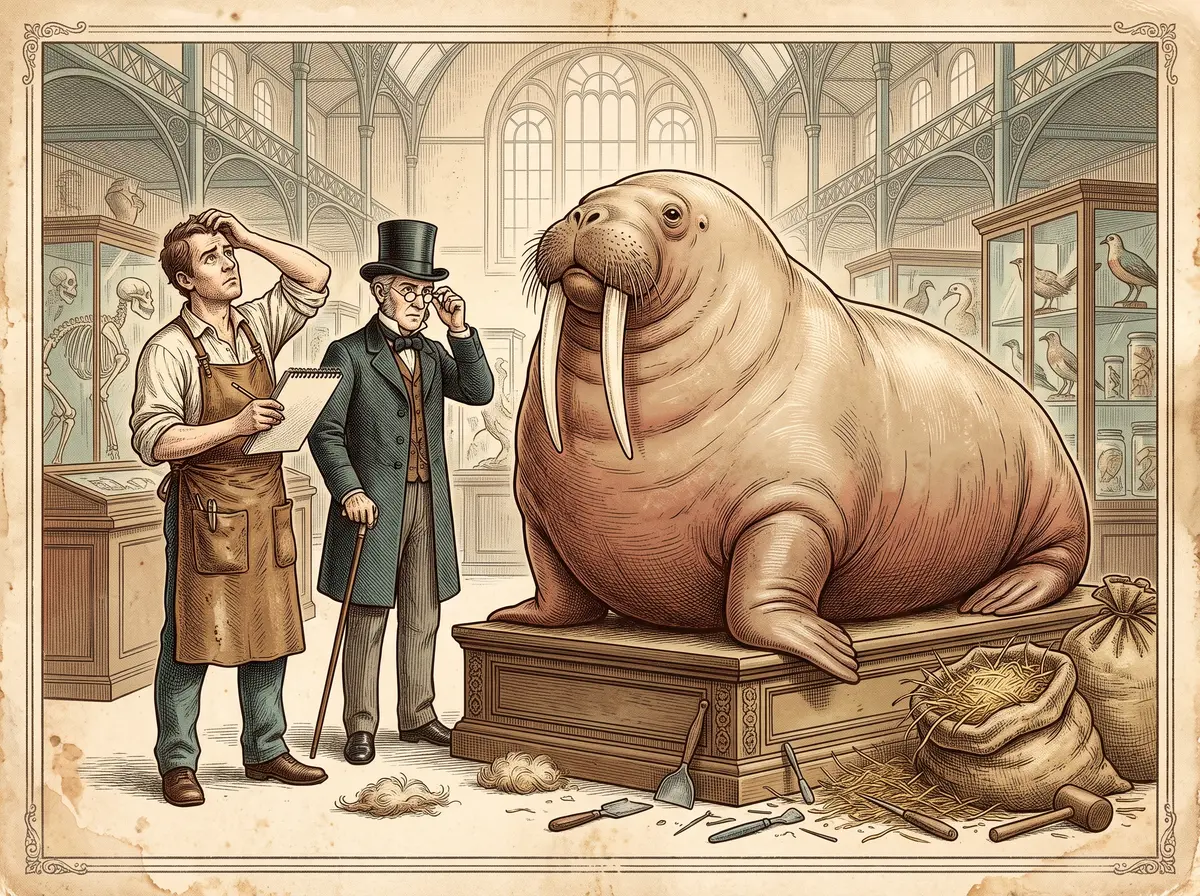
In 1886, a taxidermied walrus from the Hudson Bay region of Canada went on show in London, and something about him was off. A real walrus is a heap of deep folds and wrinkles. This one was smooth, round and taut, as if someone had kept filling him until the skin could hold no more. The museum that still owns him offers a gentle explanation: at the time, few people in Europe had ever seen a live walrus.
By the Curiosities Desk · · 5 min read · Filed under Biology · Today’s round
What happened: The History of Taxidermy
The walrus made his London debut in the Canadian section of the Colonial and Indian Exhibition in South Kensington, part of a display of Canadian animals put together by the hunter and explorer James Henry Hubbard. When the exhibition closed, the tea merchant and collector Frederick Horniman bought him. Horniman had opened his crowded house to visitors as a museum in 1890, and in 1901 he gave the museum to London County Council. The walrus has been the star of the Horniman Museum ever since.
He is a useful snapshot of where taxidermy stood in the 1880s. Taxidermy, from Greek words meaning “arranging skin,” is the craft of preserving an animal’s skin and mounting it so it looks alive. People have preserved animals for thousands of years; ancient Egyptians mummified cats, birds and crocodiles. But making a skin last for decades in a museum turned out to be a stubborn scientific problem.
The first enemy was insects. Beetle and moth larvae happily eat dried skin, feathers and fur, and early collections could be chewed to dust within a few years. In 1748, the French naturalist René-Antoine Ferchault de Réaumur published advice in the Philosophical Transactions of the Royal Society on how to preserve birds so they survived the trip home from distant places.
The fix came from Jean-Baptiste Bécœur (1718–1777) of Metz, France, an apothecary’s son who collected birds. He worked out a preservative paste, an “arsenical soap” built around arsenic, that insects would not touch. His birds stayed in such good condition that the great naturalist Buffon praised them. Bécœur, however, kept the recipe a secret and died without publishing it. Only in the early 1800s did it appear in print, through workers linked to the natural history museum in Paris, including Louis Dufresne. After that, arsenical soap spread through museums worldwide and stayed in common use until roughly the 1950s.
Preservation solved, the next problem was making animals look alive. Many early mounts were stiff skins packed with straw, rags or cotton around a rough frame, which is where the word “stuffing” comes from. The result often depended on whether the person doing the work had ever seen the animal move. In 1851, the English naturalist John Hancock showed what was possible. At London’s Great Exhibition, he displayed a group of birds that included a hawk pinning down a heron, wings spread mid-struggle. Critics hailed it as something new: taxidermy that looked lifelike.
The decisive change came from an American. Carl Akeley, born in New York State in 1864, trained at Ward’s Natural Science Establishment in Rochester, where he helped mount the skin of P. T. Barnum’s famous elephant, Jumbo. He later dismissed his work from that period as “neither scientific nor artistic.” As chief taxidermist at Chicago’s Field Museum from 1896 to 1909, he stopped stuffing animals altogether. He sculpted each animal’s muscles in clay over a frame, cast a plaster mold of the sculpture, and built a light, hollow form inside the mold out of papier-mâché and wire mesh. The tanned skin was then fitted over that form like a tailored coat. He first used the method on The Four Seasons of the Virginia Deer (1902), and later on The Fighting African Elephants (1908–09), two bulls he and his wife, Delia Akeley, collected in Kenya in 1905. They still stand in the Field Museum’s main hall.
Why it was strange: The History of Taxidermy
For most of its history, taxidermy asked people to rebuild an animal from the outside in, often without knowing what the inside looked like. A skin is only a shell. Without the skeleton, muscles and fat that shaped it, the taxidermist had to guess, and guesses could go badly wrong.
Walrus skin naturally hangs in heavy folds, and without a live walrus to study, the mount came out as a smooth, overfilled oval. Sweden’s Gripsholm Castle has a similar puzzle: a stuffed 18th-century lion with a famously odd face. According to a long-told legend, he was a gift from the ruler of Algiers to King Fredrik I, but the castle itself says no one knows when he arrived. The popular explanation that his taxidermist had never seen a lion is plausible, but unproven.
Other museum specimens have puzzled experts in different ways, like The Platypus Pelt a Museum Keeper Cut Open With Scissors, Hunting for the Stitches.
What scientists learned: The History of Taxidermy
Taxidermy taught naturalists that preserving an animal is two separate problems: chemistry and anatomy. Arsenic answered the chemistry by poisoning the insects that destroyed collections. Akeley answered the anatomy by treating each mount as a study of how the living body is built. To sculpt an elephant’s muscles accurately, he had to measure the body, photograph the animal and understand its anatomy before the skin ever went on.
That shift turned museum displays into scientific arguments. Akeley’s groups placed animals in reconstructed habitats, so visitors could see how a species fit into its surroundings, not just what it looked like.
Some of taxidermy’s early experimenters were famously eccentric, including the subject of The Naturalist Who Rode a Caiman — and Then Built the First Nature Reserve.
How it reaches us today: The History of Taxidermy
The habitat diorama, with a mounted animal in front of a painted landscape, became a standard museum display through the 20th century, and many of Akeley’s techniques remain the basis of modern mounting.
Taxidermy’s chemistry also left a legacy. Because arsenical soap was used for so long, older specimens may still carry arsenic, and museums handle them with care. The Horniman’s own records list an arsenic warning on the walrus. In 2024, he went into temporary storage while his gallery was refurbished, the latest chapter for a walrus who, before a 2013 loan to a gallery in Margate, had barely moved in more than a century.
From the overstuffed walrus to Akeley’s clay elephants, the craft’s long walk is part of From the First Spark to the Thing You Still Use.
Fun fact: The History of Taxidermy
Carl Akeley also invented a movie camera. He patented it in 1915, and it was nicknamed the “pancake” camera for its round shape. The U.S. War Department went on to use it during World War I.
Sources: The History of Taxidermy
- Walrus (NH.H.44) — Horniman Museum and Gardens collection record
- Rookmaaker, L. C., Morris, P. A., Glenn, I. E., & Mundy, P. J. (2006). “The ornithological cabinet of Jean-Baptiste Bécoeur and the secret of the arsenical soap.” Archives of Natural History 33(1): 146–158
- Carl Akeley — Field Museum history
- Hugh Owen, “The Great Exhibition, 1851: Hawk and Heron by Hancock” — Royal Collection Trust
- The Legend of Leo — The Royal Palaces of Sweden