Science Through Time · Biology
From a Polar Bear Fishing in the Thames to the 'World Herd': A Short History of the Zoo
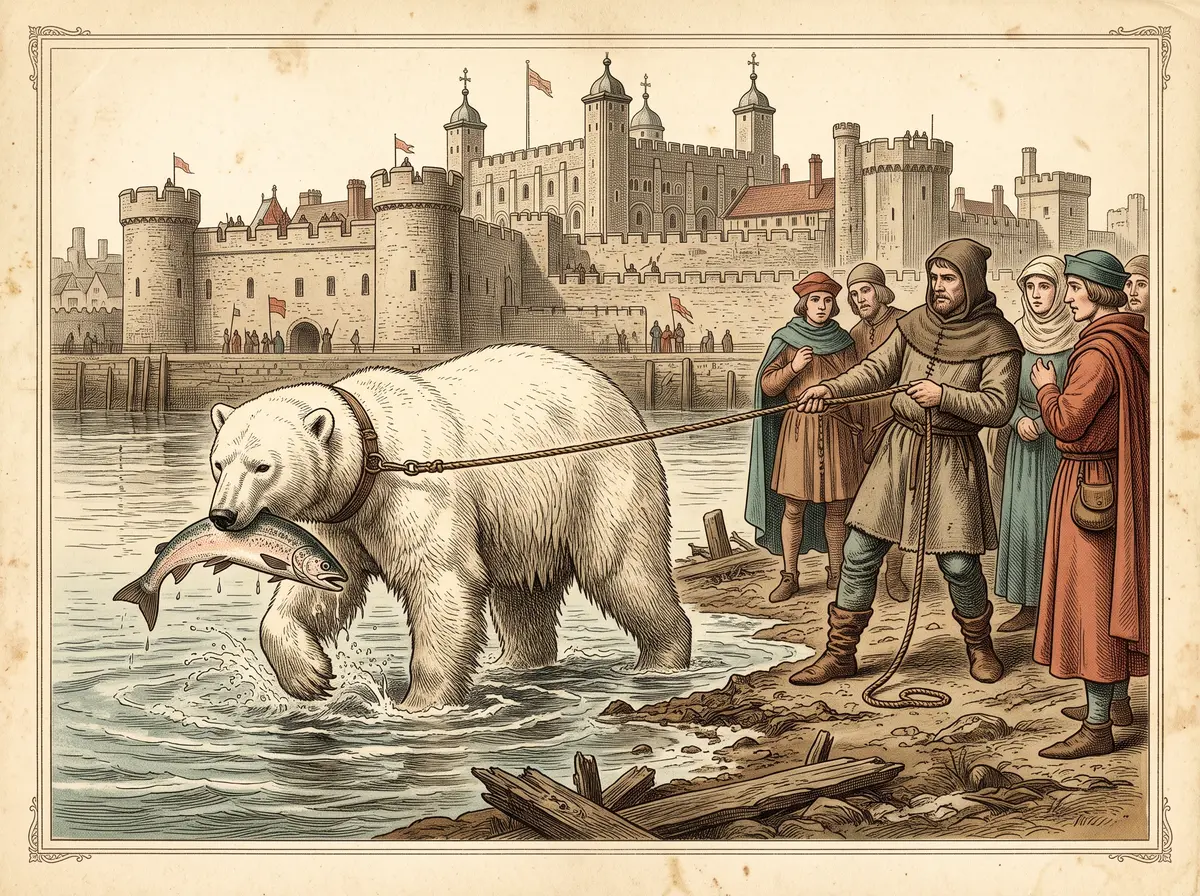
In 1253, King Henry III of England sent the sheriffs of London a very specific shopping list: a muzzle and a chain for his bear, plus a long rope so it could fish in the River Thames. The bear was white, a gift from the King of Norway, and almost certainly a polar bear. Picture it: a medieval Londoner on the riverbank, watching an Arctic predator on a leash, hunting salmon a short walk from the Tower of London.
By the Curiosities Desk · · 5 min read · Filed under Biology · Today’s round
What happened: From a Polar Bear Fishing in the Thames to the 'World Herd': A Short
The bear lived in the Royal Menagerie at the Tower of London, a royal animal collection that would last for roughly six centuries. It began in 1235, when the Holy Roman Emperor Frederick II sent Henry III three “leopards,” which were probably lions. Exotic animals were diplomatic gifts in those days, a way for one monarch to impress another.
King Haakon IV of Norway added the white bear in 1252. Henry, apparently wincing at the cost, passed the bill to the sheriffs of London and ordered them to pay for its food and to clothe its Norwegian keeper. The following year came the muzzle, the chain for dry land, and the rope for the water. The river was the bear’s fishing hole and, conveniently, its free food supply.
In 1255, the King of France, Louis IX, outdid everyone by sending an elephant. Crowds came to stare. The sheriffs built it a wooden house, 40 feet by 20 feet, and a keeper named Henry de Flor looked after it. The monk and chronicler Matthew Paris went to see it in person and sketched it. Sadly, it died in February 1257, after about two years in England.
For centuries, the menagerie was less a scientific institution than a royal curiosity cabinet with teeth. By the 1700s, members of the public could visit the lions for a fee. A much-repeated story says you could skip the three-halfpence ticket by bringing a cat or a dog to feed to the lions. That claim traces mainly to a 1976 book, and fact-checkers have found no evidence for it from the period itself, so treat it as legend, not record.
Things changed in the 1820s. The Zoological Society of London was founded in 1826 by Sir Stamford Raffles and the chemist Sir Humphry Davy. Its gardens in Regent’s Park opened on 27 April 1828, at first only to the Society’s Fellows, because the collection was meant for scientific study. That same year, the Duke of Wellington had become Constable of the Tower and wanted it kept as a fortress, not a petting zoo. In 1831, King William IV ordered the animals out. The first of them, including two lions and two leopards, arrived at Regent’s Park on 30 December 1831. The general public was finally let into the Society’s gardens in 1847, largely to help pay the bills.
Around 1869, a music-hall hit called “Walking in the Zoo,” sung by Alfred Vance (“The Great Vance”), helped make the short word “zoo” fashionable in Britain. The animals now had a home, a purpose, and a catchy name.
Why it was strange: From a Polar Bear Fishing in the Thames to the 'World Herd': A Short
We tend to think of zoos as places built around animals. For most of their history, they were built around people: kings who wanted to show off, and crowds who wanted a thrill. The polar bear fished in the Thames not because anyone studied its diet, but because it was the cheapest way to feed it.
The strange twist is how a status symbol slowly turned into a laboratory, and later into a lifeboat. Another animal that ended up far from home and teaching scientists something: The Stork That Came Home With an African Spear Through Its Neck.
What scientists learned: From a Polar Bear Fishing in the Thames to the 'World Herd': A Short
Simply putting a living animal in front of a careful observer was revolutionary. Matthew Paris’s elephant sketch is described by Cambridge’s Parker Library as the earliest Western depiction of an elephant drawn from life. Before then, many artists copied elephants from older books, rather than looking at the real thing.
London’s new zoological garden made that kind of observation routine. On 28 March 1838, a young Charles Darwin saw an ape for the first time: Jenny, an orangutan at the zoo. When a keeper held back an apple, she threw herself down and kicked, which Darwin wrote was “precisely like a naughty child.” He later noted that she was astonished by her own reflection. Observations like these fed his growing conviction that humans and other animals were related. For a much later conversation between a scientist and a clever animal, see The Parrot That Asked What Color Am I.
Zoo design changed too. In 1907, the animal dealer Carl Hagenbeck opened his Tierpark in Stellingen, outside Hamburg, with open enclosures separated from visitors by hidden moats instead of bars. He sized the moats using circus data on how far animals could jump. It was not perfect welfare by modern standards, and Hagenbeck also staged deeply exploitative “human exhibitions.” But the idea that an enclosure should resemble a habitat stuck.
How it reaches us today: From a Polar Bear Fishing in the Thames to the 'World Herd': A Short
The biggest shift came in the 20th century, as zoos became backup populations for species vanishing in the wild. In 1962, a project called Operation Oryx captured three wild Arabian oryx in what is now Oman. The animals were taken to the Phoenix Zoo in Arizona, where a captive group grew into what was nicknamed the “World Herd.” The species went extinct in the wild around 1972. Oryx from captive herds were returned to Oman in the early 1980s, and in 2011 the IUCN, the global authority on extinction risk, moved the species from Endangered to Vulnerable.
Modern zoos still argue, internally and publicly, over what animals need and whether captivity is justified. Those debates are part of the story, too. Zoos today run research and breeding programs that a medieval king would never have imagined, and some still ask surprisingly basic questions about familiar animals, like The Zookeepers Who Wiped a Hippo’s Face With Gauze to Find Out Why It ‘Sweats Blood’.
Fun fact: From a Polar Bear Fishing in the Thames to the 'World Herd': A Short
Medieval artists often drew elephants without knees, partly because of a popular belief that the animals could not get up again after falling over. Matthew Paris, sketching from life in 1255, gave his elephant properly jointed legs.
Sources: From a Polar Bear Fishing in the Thames to the 'World Herd': A Short
- Historic Royal Palaces, “The Tower of London Menagerie” — the official history of the menagerie, from the 1235 lions and the 1252 white bear to its closure.
- University of Cambridge, “Elephants and Humans: A Love Affair Over 1,300 Years” — on Matthew Paris’s 1255 elephant drawing in the Parker Library.
- ZSL London Zoo, “Darwin and the Orangutan” — Darwin’s 1838 visits to Jenny and his notebook observations.
- Snopes, “Could London Zoo Patrons Feed Dogs to Lions to Cover Admissions in 18th Century?” — on the unproven cat-and-dog admission legend.
- Phoenix Zoo, “The Resurrection of the Arabian Oryx” — on Operation Oryx, the World Herd, and the 2011 IUCN downlisting.