Science Through Time · Chemistry
From Gallnut Juice to the CIA's Oldest Secret: A Short History of Invisible Ink
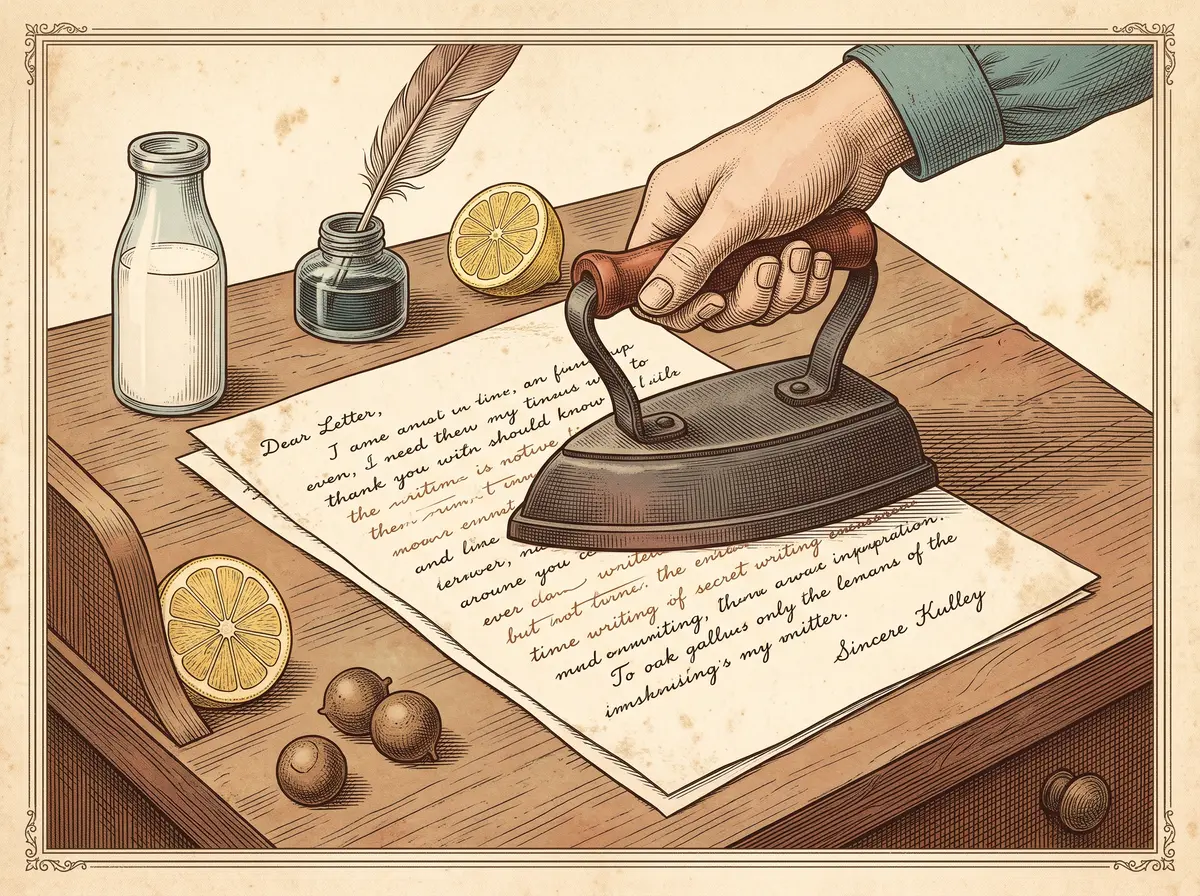
In April 2011, the CIA declassified the six oldest secret documents in the U.S. government's collection. They dated from 1917 and 1918, and they had stayed classified for nearly a century. What were they guarding? Recipes for invisible ink, including a tip for writing between the lines of a letter in milk and bringing the words back with a hot flatiron.
By the Curiosities Desk · · 5 min read · Filed under Chemistry · Today’s round
What happened: The History of Invisible Ink
People have been hiding words on paper for more than two thousand years. Philo of Byzantium, an engineer working around the third century BC, is credited with one of the oldest known methods: write with a solution of crushed gallnuts (the hard, tannin-rich swellings that wasps cause on oak trees), let it dry to nothing, then wipe the page with a sponge soaked in iron sulfate. The letters darken into view. The Roman naturalist Pliny the Elder described another trick: write with the milky sap of the tithymalus plant, a spurge, and once it dries, sprinkle ash over the page so the powder sticks to the hidden strokes.
For centuries, secret writing stayed a craft of lovers, prisoners, and plotters. The American Revolution turned it into an organized tool of war. James Jay, a physician and the brother of the diplomat John Jay, developed a “sympathetic stain”: an ink that stayed invisible until it was brushed with a second liquid, its “counterpart.” George Washington supplied it to the Culper spy ring operating in British-held New York.
Washington was a careful spymaster. In a letter of September 24, 1779, to his intelligence chief, Major Benjamin Tallmadge, he advised that agents write reports in the stain on the blank pages of cheap pamphlets, almanacs, or pocket books, which he judged “least liable to detection.” He also objected to shipping the ink on a bare blank sheet, since an innocent-looking empty page was suspicious in itself. By April 1780 he had run so low that he wrote to Jay asking for more.
By World War I, invisible ink had become an industrial-scale contest between spies and chemists. Kristie Macrakis, a historian of science, tells the story of George Vaux Bacon, an American journalist recruited by German intelligence and sent to Britain in 1916. His ink came disguised in a pair of black wool socks: a brown paste had been smeared into the tops, and soaking the socks in water released a liquid to write with. British censors opened his letters, and Scotland Yard’s search turned up the socks. Postal-censorship chemists, using spectroscopy (reading the light given off by a substance to identify its elements), found that the ink was Argyrol, a commercial antiseptic made with silver. Bacon was sentenced to death; the sentence was commuted so he could testify against his German handlers in New York.
The British side improvised too. Mansfield Smith-Cumming, the first chief of the Secret Intelligence Service (later MI6), went looking for an ink that agents always carried with them. According to the diary of his colleague Walter Kirke, Cumming reported in October 1915 that “the best invisible ink is semen.” Macrakis writes that agents did try it, and that the letters of one officer in Copenhagen stank badly enough to give the experiment away. Popular retellings add that the practice ended because of the smell; historians have not found a source that says so.
Why it was strange: The History of Invisible Ink
Invisible ink is a technology that only works if nobody believes it is there. That made it an arms race fought in kitchens and laboratories. Every new ink, whether milk, lemon juice, silver antiseptic, or something stranger, pushed censors to invent a new test, and every new test pushed spies toward a subtler ink. By late in World War I, German agents were using solutions diluted as far as one part in 500,000, according to Macrakis.
And the secrecy outlived everyone involved. As recently as 2002, the CIA defended keeping the 1917 recipes classified in federal court, arguing that they still described intelligence methods. Only in 2011 did CIA Director Leon Panetta announce that advances in technology meant the papers could finally be released.
For another chemical story that began with people improvising, see From Matches You Lit With Your Teeth to the Safety Match: A Short History of the Match.
What scientists learned: The History of Invisible Ink
Nearly every invisible ink falls into one of two families.
The first family is organic inks such as milk, lemon juice, or diluted sugar. These leave a faint residue of carbon-rich compounds and slightly weaken the paper fibers. Heat makes that residue brown or scorch before the clean paper around it does, so the words appear. That is why the 1917 recipe called for a hot flatiron.
The second family is “sympathetic” inks, which need a specific partner chemical. Philo’s gallnuts are the classic case: the tannins in the gallnut react with iron to form a dark iron-tannin compound. That same reaction produced iron gall ink, the ordinary writing ink of Europe for over a thousand years. Jay’s stain and its counterpart worked on the same principle, even though his exact formula was never recorded publicly.
Catching a hidden message also became a science. Wartime censorship offices hired chemists and physicists who used reagents, spectroscopy, and, in France, electrolysis to raise words written in extremely dilute inks. During World War II, the U.S. Government Printing Office made special coated stationery for prisoner-of-war mail that changed color if someone wrote on it with a wet ink, and then a version that also caught “dry” inks.
The intelligence world’s taste for odd technical tricks did not stop at ink; see Acoustic Kitty: The CIA Wired a Live Cat for Sound to Spy on the Soviets.
How it reaches us today: The History of Invisible Ink
The same chemistry now protects, rather than hides. Many passports, banknotes, and ID cards carry inks that are invisible in daylight but glow under ultraviolet light, a security feature that is hard to counterfeit. Owners mark bicycles and electronics with UV pens so stolen property can be identified. The children’s spy kit with a lemon and a candle runs on the same browning reaction as Washington-era tradecraft.
Invisible ink is one of the oldest threads running from simple kitchen chemistry to modern security, which puts it on the shelf with the stories in From the First Spark to the Thing You Still Use.
Fun fact: The History of Invisible Ink
George Washington once had to ration his invisible ink. When he sent a fresh supply to his New York spies in February 1780, he added a postscript: “The stain in the small Phial is more than half I have.”
Sources: The History of Invisible Ink
- CIA Declassifies Oldest Documents in U.S. Government Collection — CIA news release, April 19, 2011 (archived by the Federation of American Scientists)
- George Washington to Benjamin Tallmadge, 5 February 1780 — Founders Online, U.S. National Archives
- George Washington’s letter to Benjamin Tallmadge, September 24, 1779 — Stony Brook University Libraries Special Collections
- Invisible Ink War: How Chemists Revealed Germany’s Secret WWI Writing — excerpt from Kristie Macrakis, Prisoners, Lovers, & Spies (Yale University Press, 2014), via Scientific American
- Did Capt. Cumming Suggest Semen as Invisible Ink in WWI? — Snopes, tracing the claim to Kirke’s diary, Christopher Andrew, Keith Jeffery’s MI6, and Macrakis